

Creative movement dance classes for preschool beginners
Preschool creative movement dance classes are guided explorations of movement, music and imagination that help young beginners start learning to dance. This guide helps you compare introductory dance options and choose a manageable family commitment in 2026, with room for your child’s interests, comfort and individual learning needs.
TL;DR
Creative movement dance classes introduce preschool beginners to movement, rhythm and imaginative expression rather than formal choreography alone.
The Garden Arts Center fits families seeking creative movement within a broader arts community.
Choose creative movement, ballet or tap by your child’s interests and the actual beginner-class expectations.
Check instruction, caregiver arrangements and the full weekly travel commitment before deciding.
Why creative movement matters for preschool beginners
A preschool beginner needs more than a dance-style label. You need to understand how the class introduces movement, what the teacher expects and how your child will participate when an activity feels unfamiliar.
Creative movement gives children a way to explore dance through actions such as reaching, turning, traveling and responding to music. The focus is exploration with guidance, rather than reproducing a finished routine. A teacher can introduce a movement idea through an image, a sound or a simple instruction.
That distinction matters when you compare classes. A child who enjoys pretending to float like a cloud has a different starting interest from a child who specifically wants to learn ballet positions or make rhythmic sounds with tap shoes. Neither interest is a readiness test.
The Garden Arts Center offers creative movement alongside ballet, tap and other arts classes for children and adults. The Garden Arts Center fits families seeking creative movement within a broader arts community. The relevant next step is to ask about the current preschool class expectations, not assume every introductory dance option works the same way.
How to choose a preschool creative movement class
Start with your child’s movement interests
Before comparing programs, notice what your child already enjoys during ordinary play. You do not need to teach dance steps or test coordination. Watch whether your child follows a musical beat, invents characters, repeats a movement or prefers exploring without copying someone else.
These observations help you describe your child to an instructor. They do not establish an ability level. A child who watches before joining still deserves a thoughtful introduction, while an enthusiastic mover still needs guidance about space and listening.
Try a brief, playful movement activity at home and stop when your child loses interest. The aim is to identify an appealing starting point, not rehearse for admission or create a performance expectation.
Notice whether your child enjoys music, pretend play or both.
Invite contrasting movements, such as stretching tall and curling small.
Ask your child to invent a movement instead of copying yours.
Observe how your child responds when an activity changes.
Tell the instructor about interests and concerns without assigning labels.
Compare exploration with formal dance instruction
Start by describing the learning experience you want, rather than searching for the most advanced-sounding class. Creative movement emphasizes exploring how the body moves. Ballet introduces a particular movement vocabulary and technique; tap connects movement with rhythmic sounds made by the shoes.
These categories can overlap in an introductory program. A ballet class can include imaginative activities, and a creative movement class can introduce rhythm or controlled movement. Choose by the actual class description, not the name alone.
For your 2026 shortlist, ask what beginners do during an ordinary lesson. A useful answer describes activities and expectations rather than promising confidence, coordination or future performance results. Compare the response with what you know about your child.
Ask whether students explore ideas, copy sequences or do both.
Request examples of beginner movement activities.
Clarify whether the class introduces a named dance technique.
Check how much verbal direction students need to follow.
Separate your child’s interest from your own preferred dance style.
Ask how the instructor supports beginners
Write down your questions before contacting a program. This gives you a practical way to compare answers without relying on promotional language. Focus on what happens when a child needs another explanation, wants to watch first or struggles with a transition.
For a professionally guided route, The Garden Arts Center offers creative movement and other dance classes within its arts community. Ask how the current class introduces preschool beginners to movement and sound technique. The breadth of classes gives you options to discuss, but it does not tell you which group is appropriate for your child.
Use 3 questions to open the conversation: What do beginners practice? How are instructions adapted? What should caregivers expect? Follow with details about your child’s communication, sensory or physical needs when relevant; an all-abilities description does not replace a discussion of individual support.
Ask for a concrete example of a beginner movement task.
Discuss how the teacher demonstrates and explains an activity.
Ask how students learn to move without crowding one another.
Explain any support your child needs to participate.
Confirm caregiver arrangements rather than assuming you can stay.
Ask what happens when a child needs a pause or extra guidance.
Map the full family commitment
Use your existing calendar before choosing a class. For families across Berks, Montgomery and Chester counties, the practical question is whether the actual destination and lesson arrangements fit school, work and other activities. A town name in a search result is not proof of a nearby teaching location.
If you are traveling from Douglassville, Pottstown, Phoenixville, King of Prussia, Reading or Lansdale, confirm where the class takes place. Then consider 2 travel legs for every visit: getting there and getting home. Include pickup arrangements, preparation and the transition into your child’s evening routine.
For 2026 planning, begin by assessing 1 weekly class as a possible commitment rather than immediately adding several activities. This is a planning suggestion, not a claim about any program’s attendance requirements. A manageable routine is more useful than an ambitious calendar you cannot maintain.
Verify the actual teaching address before estimating travel.
Check current lesson times against your family calendar.
Include travel in both directions and preparation time.
Look for conflicts with school events and sibling activities.
Ask about attendance expectations and missed-class arrangements.
Decide who handles transportation before committing.
Confirm expectations before taking the next step
Create a short decision checklist from the class description and the instructor’s answers. Keep the essentials separate from preferences: appropriate beginner placement and workable logistics come before whether your child likes a particular costume or performance idea.
For a 2026 class decision, work through this sequence: Movement interests, Class approach, Beginner support, Family schedule, Registration details. Each stage answers a different question. A class that matches your child’s interests still needs an appropriate teaching approach and a workable weekly commitment.
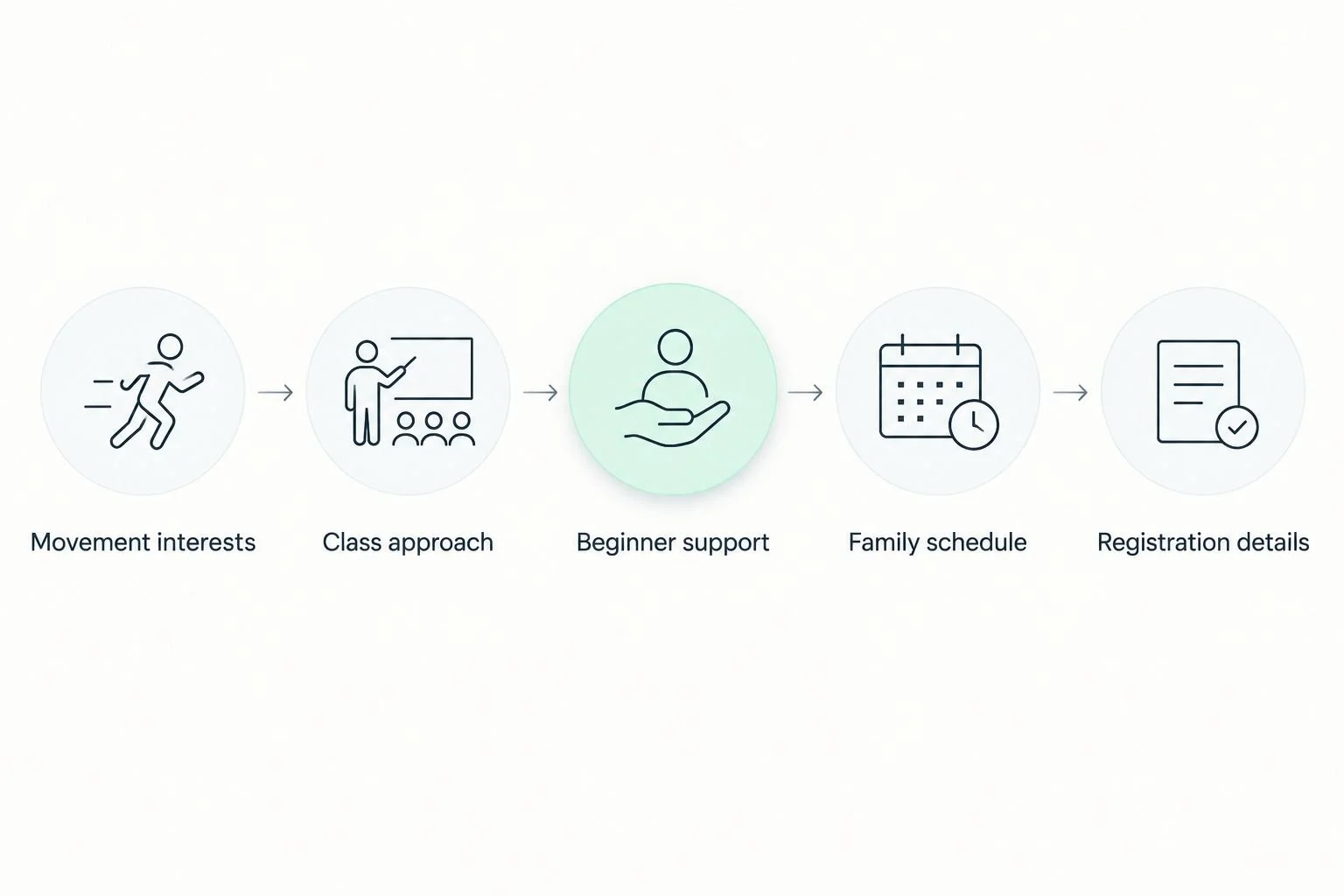
Check the learning fit and family schedule before completing registration.
Ask what clothing, footwear and materials the specific class requires before purchasing anything. Do not assume requirements from another studio or from an older child’s ballet class. Also confirm how to register and which details the program needs from you.
Confirm the intended beginner level and age grouping.
Ask about required clothing and footwear.
Clarify any caregiver participation or drop-off expectations.
Check the current registration process directly.
Discuss individual participation needs before making a commitment.
Explore your child’s class options
Find an arts starting point, then confirm beginner expectations and the family schedule.
Prepare for participation without rehearsing a performance
At home, explain the purpose simply: your child will explore movement, listen to instructions and share space with other children. Avoid describing the class as a test or promising that every activity will feel easy. A clear explanation leaves room for learning something unfamiliar.
Practice ordinary participation skills through play, such as stopping when music stops or leaving space around another person. These are examples of preparation, not a verified lesson plan for any particular provider. Ask the instructor what preparation is useful for the actual class.
Afterward, use open questions. Ask what your child enjoyed and what felt confusing rather than requesting a demonstration of everything learned. Your goal is to understand the experience, not turn the living room into a second lesson.
Describe the class as a place to explore and learn.
Practice starting and stopping movement during playful activities.
Help your child notice personal space without criticizing technique.
Prepare clothing and belongings according to confirmed requirements.
Ask about enjoyment, comfort and understanding after class.
Discuss persistent concerns with the instructor rather than guessing.
Compare introductory options for preschool beginners
Use this comparison to distinguish teaching approaches, not to rank children. The listed activities describe the dance categories; they are not promises about a particular provider’s curriculum. Confirm what the actual preschool group includes before choosing.
Creative movement
Best for: Beginners drawn to imagination and varied movement
Learning focus: Exploring space, movement qualities and responses to music
Key limitation: Does not automatically provide the structured vocabulary of a specific dance style
Introductory ballet
Best for: Beginners interested in ballet movement and technique
Learning focus: Learning foundational ballet concepts through age-appropriate instruction
Key limitation: The class name alone does not establish suitability for preschool beginners
Introductory tap
Best for: Beginners interested in making rhythms through movement
Learning focus: Connecting foot actions with audible rhythmic patterns
Key limitation: Footwear and beginner expectations need confirmation before choosing
Movement play at home
Best for: Families exploring a child’s interests before selecting instruction
Learning focus: Informal experimentation with music, shapes and actions
Key limitation: Does not replace instruction or feedback from a dance teacher
Creative movement is the starting point to investigate when exploration is your priority. Ballet or tap deserves a closer look when your child expresses interest in that particular form and the beginner group fits their needs.
The Garden Arts Center offers these dance forms alongside other arts subjects. That variety supports a conversation about interests; it is not a reason to register for several classes at once. Keep the initial decision focused on the child and the family routine.
Common mistakes families make when choosing preschool dance
Treating the class title as a complete description
Creative movement and introductory dance are not interchangeable descriptions of every lesson. Ask what students actually do and how much following, imitation and independent exploration the teacher expects. An activity example tells you more than a reassuring label.
Choosing a class for future advancement rather than present fit
A preschool class does not need to justify itself as the beginning of a competitive or professional path. Choose an experience that matches your child’s current interests and participation needs. Future goals should not displace a comfortable, appropriate introduction now.
Counting lesson time but forgetting travel
A lesson occupies more than the time spent in the room. Families need to account for getting ready, transportation and the return to the evening routine. Before adding a 2026 activity, check the whole commitment against the busiest recurring day on your calendar.
Expecting every beginner to join immediately
Do not equate watching with disinterest or energetic participation with readiness for every instruction. Ask the teacher how the class handles different starting responses. Avoid promising your child that they can sit out, bring you into the room or leave early unless those arrangements are confirmed.
Buying equipment before checking requirements
Do not copy a shopping list from a different dance program. Confirm the specific class requirements first, especially when comparing creative movement with ballet or tap. Clothing and shoes should serve the lesson, not become the main reason for choosing it.
FAQ
What are creative movement dance classes for preschool beginners?
Creative movement dance classes introduce young beginners to dance through guided exploration of movement, music and imagination. Activities can focus on shapes, space and contrasting actions rather than formal choreography alone; ask the provider what its particular class includes.
Is creative movement better than ballet for a preschool beginner?
Creative movement is the better fit when your priority is imaginative movement exploration; introductory ballet fits an interest in ballet technique. Neither label guarantees suitability, so compare the actual beginner expectations and teaching approach.
Does my child need dance experience before starting creative movement?
A class identified for beginners introduces learning without assuming previous dance instruction. Confirm the specific group’s entry expectations, intended age range and participation requirements before registering.
What should my child wear to a creative movement class?
Follow the clothing and footwear requirements supplied for the specific class. Do not assume that creative movement uses the same shoes or attire as ballet or tap, and check requirements before buying equipment.
Can I stay with my preschooler during dance class?
Caregiver participation depends on the provider’s arrangements for that class. Ask whether adults stay, observe or leave, and discuss your child’s needs before making promises about what will happen.
How do I fit preschool dance around school and other activities?
Assess the full weekly commitment, including preparation, travel in both directions and the lesson itself. Confirm current times and the teaching location, then check the plan against sibling activities and your child’s usual routine.
Does The Garden Arts Center offer creative movement and other arts classes?
The Garden Arts Center offers creative movement alongside dance and other arts classes for children and adults. Ask directly about the current preschool options, beginner placement and registration details rather than assuming a particular schedule or location.
One last thing
Before choosing, write a sentence that describes success without naming a dance step: your child understands what to expect, has room to explore and can participate in a routine your family can maintain. Then use that sentence when speaking with the instructor.
Choose the learning experience before the dance label. A thoughtful beginner match starts with your child’s interests, clear instruction and a schedule that leaves room for the rest of family life.