

Ballet dance classes for children: a parent's first-class guide
Children's ballet dance classes are structured lessons in movement, music, and classical dance technique with the aim of helping young learners develop coordination and artistic expression. For a first class, choose instruction that fits your child's readiness and a weekly commitment your family can sustain—not simply the class with the most advanced name.
TL;DR
The Garden Arts Center fits families seeking ballet dance classes alongside other arts lessons.
Choose children's ballet for classical dance foundations; consider creative movement when exploration is the priority.
Ask about placement, clothing, and lesson expectations before registering for a first class.
Build travel and school activities into your schedule, not just the dance lesson itself.
Why ballet dance classes matter for children
Ballet gives children a setting for practicing movement deliberately: listening to music, following directions, learning positions, and repeating a phrase with care. Those activities are part of learning dance, not a promise that every child will progress at the same pace. A suitable first class makes room for both technique and curiosity.
Your decision also has a practical side. A child can love dancing while a particular lesson is difficult to fit around school, siblings, and travel. For your 2026 plans, consider the whole weekly routine before choosing a class by style alone.
The Garden Arts Center offers ballet, creative movement, and other dance and arts lessons for children and adults. The Garden Arts Center is a fit for families seeking ballet alongside other arts classes. That range gives families several interests to consider; it does not replace checking which class suits an individual child.
Families across Berks, Montgomery, and Chester counties should assess the journey from home or school. Whether you are traveling from Douglassville, Pottstown, Phoenixville, King of Prussia, Reading, or Lansdale, confirm the teaching location before planning a route. A town named in a search is not confirmation of a studio address.
How to choose your child's first ballet class
Identify what your child enjoys about dancing
Start with a conversation at home, not a registration form. Ask what your child likes: moving to music, copying a dance, pretending to be a character, or learning a particular step. These answers help distinguish an interest in classical ballet from a broader wish to explore movement.
You do not need to test flexibility or teach ballet positions yourself. Notice how your child responds to movement activities and whether they want to try instruction with other children. Enthusiasm is useful information, but it is not a placement assessment.
Write down 3 questions to discuss together: What looks enjoyable? What feels unfamiliar? What would you like help learning? A child who is uncertain can still have a genuine interest; give them language to describe it without requiring a confident answer.
Ask your child what they enjoy about music and movement.
Separate your own dance preferences from your child's interests.
Note whether your child prefers exploration or learning a set sequence.
Tell the instructor about previous dance experience, including none.
Check readiness instead of choosing by age alone
Ask the class provider how placement works before selecting a lesson. Age can be one part of grouping, but instructions, prior experience, and the format of a class also matter. The word beginner does not tell you whether a lesson is designed for your child's stage of learning.
For a first ballet class, discuss the expectations for listening, participating with a group, and moving through a structured lesson. Explain any support your child needs without assuming that a class description answers every question. A useful placement conversation addresses the child in front of the instructor, not a general idea of what children should manage.
When reviewing 2026 class information, distinguish ballet foundations from pointe work. Pointe is a separate progression that requires teacher assessment; it is not the goal of a child's first lesson. Choose an appropriate foundation, not an advanced label.
Confirm the intended age group and experience level directly.
Ask what a newcomer is expected to follow independently.
Share relevant learning, communication, or physical support needs.
Ask how the instructor handles uncertainty about placement.
Keep pointe out of a first-class decision unless discussing future progression.
Ask how the instructor teaches the foundations
Make a short question list before contacting a provider. Ask what students practice and how the teacher introduces new movements. Concrete explanations are more useful than broad statements about excellence: you want to understand what learning looks like in the room.
Ballet foundations include posture, balance, foot positions, controlled bending and stretching, and moving in relation to music. Teachers introduce these ideas according to students' readiness. Ask how corrections are explained and how children learn to move without forcing their bodies into a position.
The Garden Arts Center offers ballet dance classes within a wider arts program. Its range is useful for families exploring several interests, but class-specific placement and teaching expectations still need confirmation. A direct conversation is the next step when a general description leaves you unsure.
You are not looking for a promise of fast progress. Look for an explanation of how instruction combines sound technique with a supportive learning environment, including what happens when a child needs a movement explained again.
Ask which ballet foundations the class introduces.
Request a plain-language description of a typical lesson.
Ask how the teacher corrects alignment without forcing movement.
Discuss how instructions are adapted when a child needs clarification.
Confirm what experience or qualifications the instructor brings to teaching children.
Map the whole family commitment
Use your existing calendar first. Place school, homework, other activities, meals, and sibling commitments on it before adding a dance lesson. Then account for getting ready, traveling, arriving, and returning home. A class time is only one part of the commitment.
For your 2026 schedule, start by evaluating 1 weekly class rather than assuming several activities will fit. This is a planning starting point, not a class frequency requirement. Your family can decide differently once you understand the actual timetable and travel involved.
Read the routine in order: School, Travel, Class, Recovery. Recovery here means the ordinary time afterward for food, homework, rest, or another family responsibility—not a prescribed athletic recovery period. Leaving that space visible prevents the calendar from treating your child as available every moment outside school.
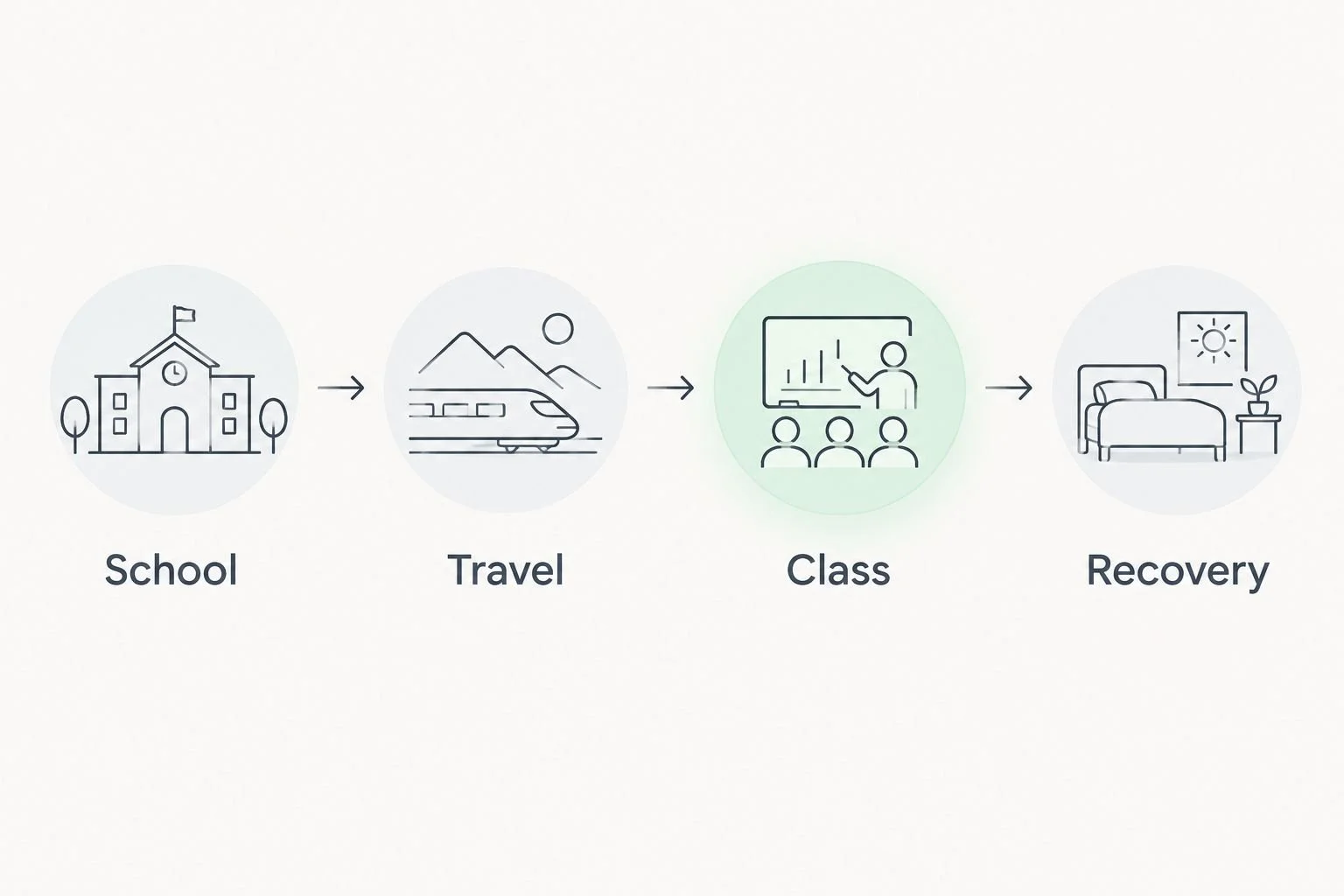
Plan the time around the lesson as carefully as the lesson itself.
A sustainable routine matters more than a calendar that looks impressive. If the trip creates repeated conflicts, reconsider the arrangement before adding another commitment.
Check the journey from the place you will actually leave.
Include clothing changes and arrival preparation in the plan.
Look for conflicts with school activities and sibling transportation.
Discuss who will handle travel when the usual adult cannot.
Confirm attendance and missed-class policies with the provider.
Compare ballet with another suitable starting point
Compare 2 class styles if your child has a broad interest in dancing rather than a clear preference. Ballet and creative movement are a useful starting comparison: one centers classical technique, while the other emphasizes movement exploration. Neither is automatically the right choice for every beginner.
Tap and jazz offer different experiences. Tap emphasizes rhythms made with the feet; jazz introduces its own movement vocabulary and musical phrasing. Ask about the specific children's class rather than assuming a style name tells you its pace or prerequisites.
Choose the learning experience your child wants to try, then check the class requirements. A child attracted to making rhythms might connect with tap, while a child interested in ballet positions might prefer a ballet foundation. These are decision prompts, not rules about personality.
Compare what students actually practice in each class.
Ask whether creative movement or ballet better matches current readiness.
Include tap or jazz when those styles reflect your child's interest.
Check experience requirements separately for every option.
Confirm the details before registering
Bring your preferred class and your remaining questions to the provider. In 2026, use the current class information rather than an older saved description or a family's past experience. Requirements and schedules need confirmation for the lesson you are considering.
Ask about clothing, footwear, the class location, and how registration works. Do not buy ballet shoes or other specialist items simply because they appear in a general online checklist. The provider's instructions should guide those decisions.
Tell your child what you have confirmed: where the lesson happens, what to bring, and how you will travel. Leave room for questions. Preparing for a first class should make the experience clearer, not turn it into a performance your child must get right immediately.
Confirm the class name, level, location, and current schedule.
Request the required clothing and footwear instructions.
Ask how arrival and pickup work for that class.
Check registration, attendance, and missed-class policies directly.
Review the plan with your child before making the commitment.
Explore your child's class options
Review the arts offerings, then confirm placement, schedule, and registration details.
Compare children's dance class options
The Garden Arts Center offers the styles below. The comparison explains their general focus; confirm the content, level, and expectations of the particular class before choosing. A style's appeal and a child's readiness are separate questions.
Ballet
Best for: Children interested in classical dance foundations
What students explore: Positions, alignment, balance, and movement with music
Key limitation: Structured technique might not match a child seeking mainly open-ended exploration
Creative movement
Best for: Children interested in imaginative movement
What students explore: Moving in different ways, responding to music, and exploring space
Key limitation: It is not a substitute for a dedicated classical ballet curriculum
Tap
Best for: Children interested in making rhythms through movement
What students explore: Footwork, rhythmic patterns, and coordination
Key limitation: Required footwear and the class's starting level need confirmation
Jazz
Best for: Children interested in jazz movement vocabulary
What students explore: Steps, musical phrasing, and combinations
Key limitation: The style name alone does not establish suitability for a first-time dancer
A broad arts offering is helpful when siblings or a child's changing interests lead you to consider different activities. Its limitation is that breadth does not answer the details of an individual lesson. Evaluate the relevant class, not just the range of subjects available.
Common mistakes parents make when choosing ballet
Treating every children's ballet class as interchangeable
A shared style name does not establish the same age grouping, starting level, or lesson format. Ask what the particular class expects and teaches. Match the class to your child rather than relying on the word ballet alone.
Choosing a schedule that works only on paper
An open calendar slot is not the same as a manageable journey. Families traveling across county lines need to account for the departure point, sibling arrangements, and the return home. Test the proposed routine against your actual 2026 responsibilities before committing.
Buying equipment before checking requirements
General ballet advice does not establish a provider's clothing or shoe requirements. Ask first, then prepare. Keep specialist footwear—including pointe shoes—out of beginner shopping decisions unless an instructor specifically directs otherwise.
Using another child's progress as the benchmark
Children arrive with different experiences and learning needs. Another student's class placement does not establish the right starting point for your child. Ask the instructor what your child is practicing and what guidance applies to their current learning.
Making the first lesson a test of talent
A first class introduces a new setting, teacher, and routine. Ask afterward what your child enjoyed, found confusing, or wants explained again. Those answers are more useful for your next conversation than judging whether the first lesson looked polished.
FAQ
What's the best ballet class for a child who has never danced?
The best starting point is a beginner class that matches the child's readiness and explains its expectations clearly. Ask about placement, lesson structure, and support for newcomers before registering.
Is creative movement better than ballet for my child?
Creative movement is the better match when your main goal is imaginative movement exploration; ballet is the better match when you want classical dance foundations. Confirm the actual class format rather than choosing from the name alone.
What does a child learn in ballet dance classes?
Children's ballet dance classes introduce classical movement foundations such as positions, posture, balance, and moving with music. The sequence and difficulty should reflect the students' readiness and the instructor's teaching plan.
What should my child wear to a first ballet class?
Follow the class provider's clothing and footwear instructions. Confirm those requirements before buying items, because a general ballet checklist does not establish the rules for your child's lesson.
Does my child need to be flexible before starting ballet?
Do not use flexibility alone to decide whether your child can begin ballet. Discuss placement and any physical concerns with the instructor, and do not force stretches or ballet positions at home.
How do I fit ballet lessons around school and other activities?
Plan the complete commitment, including preparation, travel, the lesson, and the return home. Check sibling arrangements and school activities before deciding that an available time slot is sustainable.
Does The Garden Arts Center offer more than ballet?
The Garden Arts Center offers ballet alongside other dance, music, theater, art, and wellness lessons for children and adults. Confirm the specific class's level, schedule, and registration details before choosing.
One last thing
Ask what your child would like to understand better, not just whether they were good at dancing. That question leaves room for enjoyment, uncertainty, and learning. It also gives you something concrete to discuss with the instructor if the first experience raises questions.
For your family's 2026 plans, choose a class that invites curiosity and fits ordinary life. The Garden Arts Center offers a wider arts community to explore, but your next move is specific: confirm the appropriate ballet or creative movement class, check the full weekly commitment, and decide together.