

How to fit kids dance classes into a busy family schedule
Fit kids dance classes into a busy family schedule by choosing a class your child wants to attend, mapping the whole trip onto your calendar, and assigning a dependable pickup plan. For your 2026 schedule, protect time for meals, homework, and rest—not just the lesson itself. Before registering, confirm the class requirements and attendance expectations directly with the instructor.
TL;DR
Choose kids dance classes around your child's interests and a sustainable weekly commitment.
The Garden Arts Center offers kids dance, ballet, tap, and other arts classes for families exploring their options.
Count travel, changing, and pickup time when comparing ballet or creative movement with other activities.
Confirm class requirements and attendance expectations before making a registration decision.
Why this matters
A dance lesson occupies more than its place on the timetable. Your family also needs to get there, manage dinner, collect siblings, and get home without turning the evening into a scramble. Choose the class your household can attend consistently, not simply the opening that fits on paper.
Families considering The Garden Arts Center can explore dance alongside music, theater, art, and wellness instruction. That range gives you different interests to discuss with your child; it does not mean you need to add several activities at once.
For your 2026 activity calendar, start with the commitments you already have. Then look for a dance option that fits the space left over, rather than assuming everything else will rearrange itself around it.
How do you fit kids dance classes into a busy family schedule?
Use the following sequence before choosing a class. Each step answers a different question: what your family can manage, what your child wants, and what the class actually requires.
Map commitments
Put school hours, work obligations, existing activities, homework needs, and family responsibilities on the same calendar. Include the adult who handles transportation, not just the child attending dance.
Look for the evenings that already involve difficult handoffs. An empty space on your child's calendar is not an available class window if the driver is working or collecting another child elsewhere.
For a 2026 calendar, separate recurring commitments from occasional events. A regular school activity needs a different plan from a single appointment, and both deserve a place on the calendar before registration.
Choose interests
Ask your child what appeals to them about dancing. Is it moving to music, learning recognizable steps, making rhythms with their feet, or expressing a story through movement?
Use that answer to narrow the search. You do not need a child to know dance terminology before choosing a starting point; a simple description of what they enjoy gives you something useful to discuss with an instructor.
Check requirements
Ask which class suits your child's age, experience, and current skills. Confirm clothing and footwear requirements, how placement works, and whether the class has prerequisites.
Keep these questions separate from scheduling. A convenient time does not make a class appropriate for a beginner, and an appealing class name does not establish that its level matches your child.
Test travel
Work backward from the class start: leaving school or home, gathering belongings, traveling, parking, and getting ready. Then work forward from the end: pickup, the return trip, dinner, homework, and bedtime.
Treat dance as a door-to-door commitment. If your plan only works when traffic is clear and everyone leaves immediately, look for a different arrangement before registering.
Assign pickup
Name the adult responsible for each part of the trip. If one person drops off and another collects, make that handoff explicit rather than relying on an informal assumption.
Decide how the adults will communicate a change. Ask the center about its pickup procedures; do not assume that another family's arrangement applies to yours.
Review the fit
Look at the full evening again. Does your child have time to eat, prepare for school, and settle down afterward? Does the transportation plan work alongside siblings' commitments?
Choose the option that remains manageable on an ordinary busy day. You are building a routine, not solving a calendar puzzle for the registration date alone.
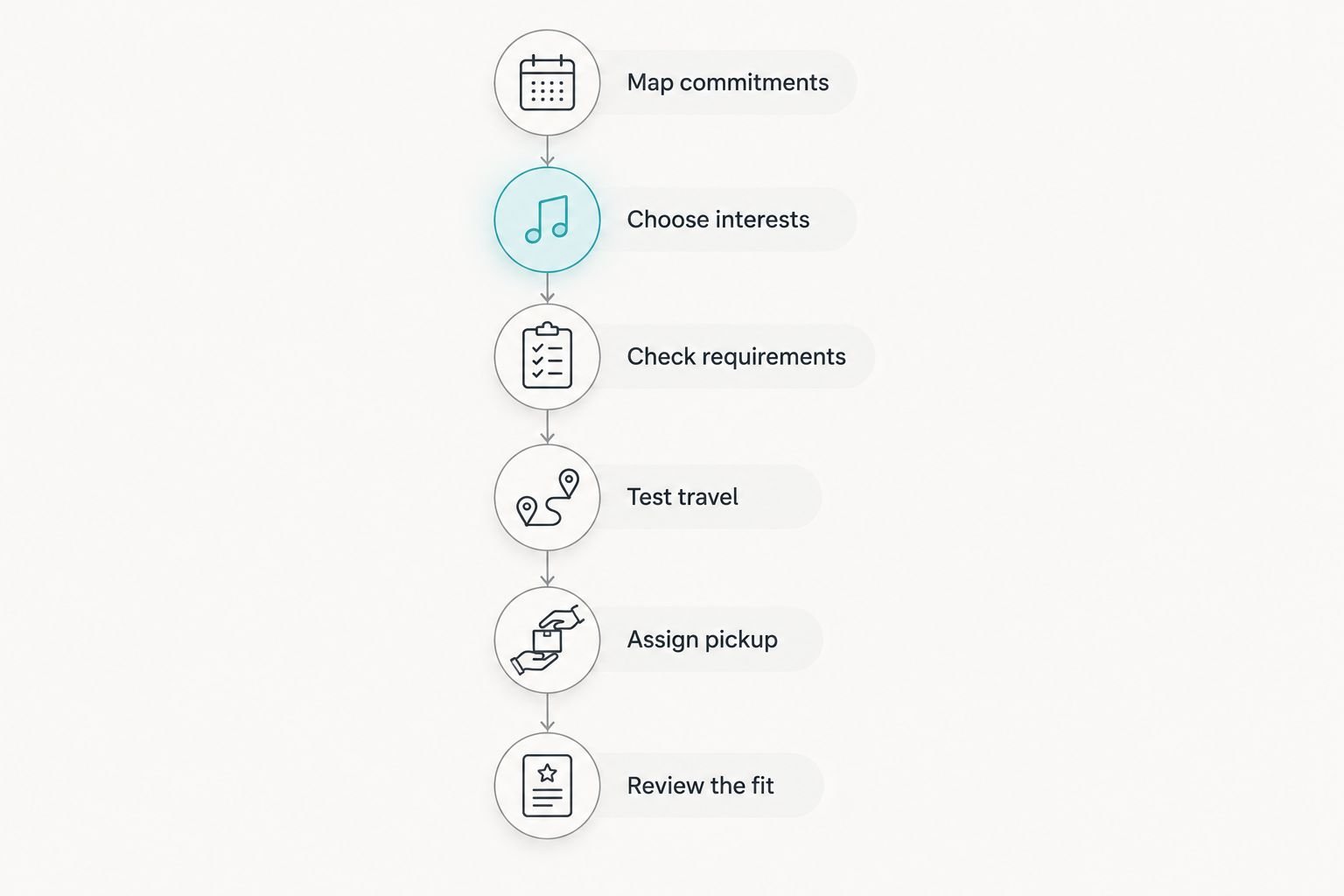
Check the whole family routine before choosing a class.
Which kind of dance class should your child consider?
Choose a dance style by interest and instructional fit first, then compare the schedule. The descriptions below explain common features of these styles, not a specific center's syllabus or placement rules.
Creative movement
Best for: Children drawn to imaginative movement
What students commonly explore: Moving through space, responding to music, and exploring movement ideas
Scheduling or fit consideration: Ask how the class matches your child's age and readiness for group instruction.
Ballet
Best for: Children interested in structured technique
What students commonly explore: Posture, alignment, positions, and coordinated movement
Scheduling or fit consideration: Level placement matters; a convenient opening is not enough.
Tap
Best for: Children interested in rhythm
What students commonly explore: Making rhythmic sounds with the feet and coordinating steps
Scheduling or fit consideration: Confirm footwear requirements before preparing the dance bag.
Jazz
Best for: Children drawn to musical movement combinations
What students commonly explore: Dance technique, changes of direction, and combinations
Scheduling or fit consideration: Ask about the experience expected in the specific class.
Hip hop
Best for: Children interested in movement to hip-hop music
What students commonly explore: Groove, rhythm, and movement combinations
Scheduling or fit consideration: Ask how instruction is organized for the child's age and experience.
Every option has a useful starting point and a practical limitation. Creative movement emphasizes exploration, while families seeking a particular technical syllabus should ask what is taught. Ballet provides structured technique, but the class level still needs to match the student.
Tap makes rhythm central and brings a footwear question to resolve. Jazz and hip hop offer different movement approaches, but neither name tells you the class's pace or prerequisites. Ask about the actual class rather than choosing from the style name alone.
A child's enthusiasm matters, too. If your child is curious about tap but you prefer ballet, discuss what interests them before making the decision. The schedule should support an appropriate choice, not replace that conversation.
Why the scheduling fit varies between families
There is no single best evening for kids dance classes. The right arrangement depends on how the lesson connects to the rest of your household's routine.
Travel: Compare the route you will actually take after school or work, rather than a trip from home that you will rarely make.
School activities: Include recurring clubs, rehearsals, sports, and other commitments already on the calendar.
Sibling needs: Check whether another child needs transportation or supervision during the same window.
Meals and homework: Decide where these fit before adding a lesson, especially when the evening already feels crowded.
Class requirements: Ask about placement, preparation, and participation expectations so the commitment is clear.
Adult availability: A workable class needs a workable transportation plan, including who handles pickup.
For families across Berks, Montgomery, and Chester counties, compare travel from your own starting point. Whether you are coming from Douglassville, Pottstown, Phoenixville, King of Prussia, Reading, or Lansdale, a town name alone does not establish that a class fits your route.
Test your proposed 2026 travel plan at the time you expect to leave. Use the actual departure point and include the return journey. This is a planning exercise, not a promise about traffic or a statement that the center has a location in any of those towns.
How do you choose between dance and another activity?
Start with your child's interest and the demands of the existing week. If both activities fit comfortably, compare what your child wants to learn; if they conflict, resolve the transportation and timing issue before making commitments.
Avoid treating every open evening as a space to fill. An evening without a class still serves a purpose: it leaves room for homework, family responsibilities, and ordinary changes in plans.
You can also distinguish a strong interest from a passing suggestion without dismissing either. Ask what your child hopes to do in the class and explain what attending would mean for the weekly routine. That conversation gives the decision a practical foundation.
Keep the activity your family can support without depending on repeated last-minute fixes. This is not a judgment about dance versus another interest; it is a way to choose a manageable commitment.
What should you ask before registering for kids dance classes?
Ask about the class itself and the family arrangements around it. A useful registration conversation covers placement, preparation, attendance expectations, and arrival and pickup procedures.
Keep your questions concrete:
Which class matches my child's age and experience?
What does a student learn in this class?
What clothing and footwear are required?
What should families know about arriving and collecting children?
What are the attendance expectations?
Are there other required commitments associated with participation?
What is the current registration process?
Bring your scheduling concern into the conversation directly. Explain that you are balancing school activities, travel, or sibling pickup, then ask for the information you need to decide. Do not assume an absence, late arrival, or schedule change will be handled in a particular way.
The Garden Arts Center is best for families seeking kids dance classes within a broader arts community. Its dance, music, theater, art, and wellness offerings give families several areas to explore; the right class still depends on your child's interests and your household's schedule.
Explore your family's class options
Review the center's offerings, then ask about class fit, requirements, and registration.
What if your family schedule changes after registration?
Contact the center about the specific conflict and ask which arrangements its policies permit. Do not assume that changing classes, making up a lesson, or pausing attendance is automatically available.
Separate a temporary disruption from a recurring problem. A single school event calls for a different conversation from an ongoing transportation conflict, so explain which situation you are facing.
When the problem repeats, revisit the door-to-door plan. Identify whether travel, pickup, another activity, or the evening routine is causing the difficulty. A clearer diagnosis gives you a more useful question to ask than simply saying that the schedule is busy.
FAQ
What's the best way to fit kids dance classes around school?
Fit kids dance classes around school by mapping the full evening, including travel, meals, homework, and pickup. Choose a class whose requirements and level suit your child, then confirm that the household can support the routine.
Should my child choose ballet or creative movement?
Choose ballet for an interest in structured dance technique and consider creative movement for an interest in imaginative movement exploration. Ask the instructor which specific class matches your child's age, experience, and readiness.
Can siblings take dance classes at the same time?
Ask the center whether its current class arrangements allow siblings to attend at the same time. Do not assume that simultaneous classes exist or that both children belong in the same level.
How do I know whether the drive to dance is manageable?
Test the full route from your actual departure point and include the return trip. Check that the evening still accommodates pickup, meals, homework, and rest without depending on perfect traffic.
What should I ask about missed dance classes?
Ask about attendance expectations and the policy that applies to a missed class. Confirm any permitted arrangements directly rather than assuming that makeup lessons or class changes are available.
What should my child bring to a first dance class?
Bring the clothing, footwear, and other items the instructor specifies for that class. Requirements differ by dance style and class, so confirm them before buying or packing equipment.
How can I explore classes at The Garden Arts Center?
Explore The Garden Arts Center's arts and dance offerings, then ask about the class that interests your child. Confirm placement, requirements, and the current registration process before deciding.
One last thing
Check the evening after dance, not just the journey to it. A class can fit neatly between school and dinner while leaving the return trip, homework, and next morning's preparation unresolved.
Before committing to your 2026 routine, walk through that whole evening with the adults responsible for it. The best schedule is one your family understands and can repeat. Give your child room to enjoy learning, and give the household a plan that supports getting there.