

Kids’ art classes are guided opportunities to draw, explore materials, and make things with the aim of developing artistic skills and personal expression. For children who already fill notebooks or build with scraps, choosing art classes for kids means matching that curiosity with suitable instruction and a weekly commitment your family can sustain.
TL;DR
The Garden Arts Center is a fit for families seeking art classes for kids within a broader arts community.
Choose drawing, painting, or making activities around your child’s interests, not the most polished sample project.
Ask about instruction, materials, age grouping, and scheduling before choosing a class.
Protect time for travel, cleanup, and school responsibilities when planning a weekly commitment.
Why art classes matter for kids who love making things
A child who enjoys drawing does not necessarily want the same experience as a child who builds cardboard creatures. Both interests belong in art, but they call for different materials, demonstrations, and opportunities to experiment. Start with what your child enjoys doing, then examine how the class teaches it.
Scheduling deserves equal attention. Families planning activities in 2026 need to consider school, travel, meals, and other commitments alongside the subject itself. The practical questions in this guide to fitting kids’ classes into a busy family schedule also apply when choosing an art activity.
An organized class gives children a setting for trying techniques with guidance. It does not replace the pleasure of making things at home, and it should not turn every drawing into a performance. Look for instruction that leaves room for questions, mistakes, and individual choices.
How to choose art classes for kids
Start with what your child makes voluntarily
Watch what your child chooses when nobody assigns a project. Do they draw characters, arrange colors, fold paper, or connect objects into structures? Those choices give you more useful information than asking whether they want to become an artist.
Spend 10 minutes looking through recent creations together. Treat this as a conversation, not an assessment: ask what was enjoyable and what they wanted help doing. A child who loves drawing animals might want help noticing shapes; another might prefer inventing habitats from boxes.
Use those observations to describe an interest without turning it into a fixed label. Enjoying pencils today does not mean a child must avoid paint or sculpture.
Ask your child to choose 2 projects they enjoyed making.
Notice whether drawing, color, texture, or construction holds their attention.
Ask what they would like to try next.
Describe preferences without ranking the finished work.
Match the teaching approach to your child’s needs
A class title cannot tell you how much guidance students receive. Ask how an instructor introduces a task, demonstrates a technique, and helps a child who gets stuck. The answer should explain teaching, not just list attractive finished projects.
Useful examples include showing how simple shapes form a drawing, demonstrating how brushes make different marks, or discussing how materials connect in a construction. These are examples to ask about, not a description of any particular program’s curriculum.
For your 2026 shortlist, separate subject interest from classroom fit. A child might love painting but need clearer demonstrations, a different age grouping, or more room to work independently.
Ask how students receive demonstrations and individual feedback.
Confirm the intended age range and any experience expectations.
Ask what happens when a child needs another explanation.
Explain relevant support needs before making a commitment.
Compare the arts setting with your family’s goals
The Garden Arts Center is a fit for families seeking art classes for kids within a broader arts community. Its stated offerings include art, dance, theater, music, and wellness for different ages and abilities. That breadth matters if your family wants to explore more than one creative interest.
Start with The Garden Arts Center to learn about the center, then ask which current art offering matches your child. The wider arts setting is a reason to inquire, not evidence that a particular drawing medium, age group, or project is included.
You can make a useful shortlist yourself by comparing descriptions and writing down questions. Direct guidance from the center can then help clarify fit without requiring you to interpret a class name alone. The limitation is straightforward: broad offerings do not establish the details of an individual class.
Describe your child’s interests using concrete examples.
Ask which art offering matches those interests.
Confirm whether beginners are appropriate for that class.
Ask about the instructor’s relevant teaching background.
Check what children actually do with materials
An appealing project photograph shows an outcome, not the learning process. Ask what students practice while making it and which choices belong to them. There is a meaningful difference between following every detail of a sample and learning a technique that supports different results.
Drawing might involve observing outlines and experimenting with marks. Painting might involve mixing colors and handling brushes. Making activities might involve arranging shapes or testing how pieces join. Confirm the actual activities rather than assuming every art class includes all these approaches.
Materials also affect your family’s preparation. Ask about supplies and clothing expectations before buying anything; do not assume a listing includes everything a child needs.
Request an example of a typical activity and its learning purpose.
Ask which materials students use.
Confirm what families need to bring.
Ask how children participate in setup and cleanup.
Build the class into a realistic family week
For families across Berks, Montgomery, and Chester counties, the full commitment includes more than instruction. Whether you travel from Douglassville, Pottstown, Phoenixville, King of Prussia, Reading, or Lansdale, check the actual teaching address before judging the journey. A town named in a search result does not establish where a class meets.
Map 1 ordinary school week before choosing a recurring activity. Include the journey from your real starting point, not just from home: some days begin at school, childcare, or another family member’s workplace.
For a 2026 activity plan, choose a commitment that leaves room for meals and existing responsibilities. An interesting class becomes harder to enjoy when every visit requires a rushed handoff. Confirm scheduling details directly rather than building plans around assumptions.
Verify the teaching address and current class schedule.
Check travel from the place your child will actually leave.
Include preparation, arrival, pickup, and cleanup questions.
Compare the commitment with school and other activities.
Define a useful first goal before registering
Choose a goal that describes participation or learning rather than a finished masterpiece. Your child might want to try an unfamiliar material, ask for help with drawing, or spend time making things alongside other children. These are clearer starting points than expecting immediate improvement.
For the first conversation with an instructor, bring 3 questions: what students learn, how support works, and what families need to prepare. Add your child’s own question if they have one. This keeps the decision connected to the learner rather than only the parent’s checklist.
When you are ready to take the next step, confirm the registration process and any applicable attendance expectations directly. Understanding the commitment is part of choosing well, not an administrative detail to leave until afterward.
Write down one interest your child wants to explore.
Choose a process-based goal together.
Confirm the practical details before registering.
Agree on a simple way to discuss the experience afterward.
Compare art options by what your child enjoys
The best option is the one that matches both the activity and the kind of guidance your child needs. Use this comparison to frame questions, not as a list of classes confirmed at any particular center. Each approach has a useful role and a limitation.
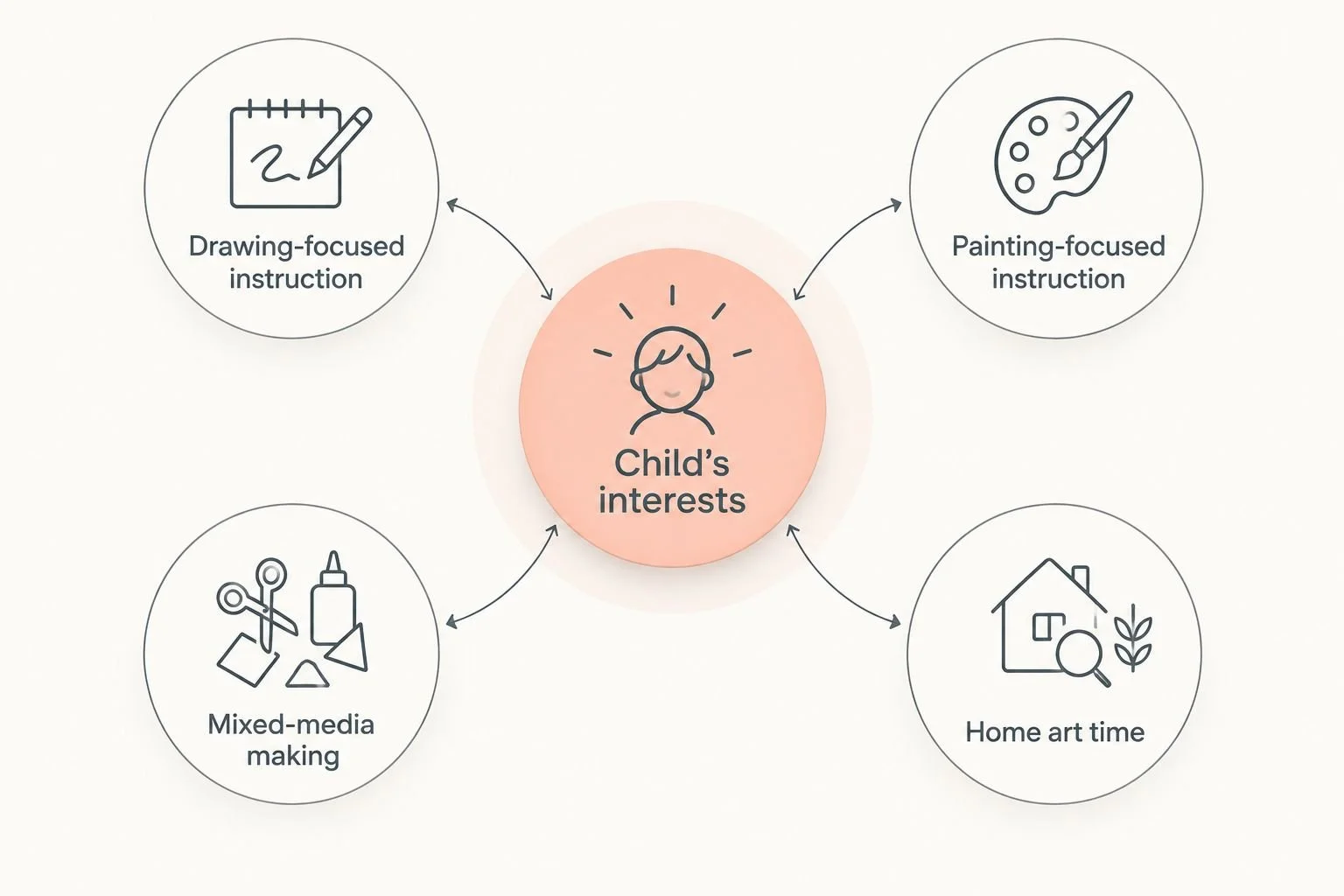
Match the approach to what your child likes doing, then confirm the teaching details.
Drawing-focused instruction
Best for: Children who repeatedly choose pencils, lines, characters, or observation
What to look for: Demonstrations of shapes, marks, and observation with room for personal subjects
Key limitation: Less suitable when the child mainly wants to build with materials
Painting-focused instruction
Best for: Children interested in color and working with brushes
What to look for: Guidance on handling materials and exploring color choices
Key limitation: Requires checking preparation, clothing, and cleanup expectations
Mixed-media making
Best for: Children who enjoy combining paper, textures, and objects
What to look for: Clear instruction on arranging and joining materials
Key limitation: A broad label does not reveal which materials are actually included
Home art time
Best for: Families seeking flexible, self-directed exploration
What to look for: Accessible materials and permission to experiment
Key limitation: Does not provide an instructor’s feedback
There is no need to treat home creativity and a class as competing choices. A child can explore freely at home and bring questions to an instructor. Equally, a family can begin with home projects while deciding whether a recurring class fits.
For your 2026 comparison, record the same details for every option: learning focus, teaching approach, preparation, and weekly logistics. Comparable notes make the decision clearer than a collection of project photographs.
Common mistakes families make when choosing art classes
Choosing the prettiest sample instead of the learning experience
A polished example does not explain what children do independently. Ask which techniques students practice and how much of the project they can interpret for themselves. Look for a clear learning purpose, not matching results.
A sample can still be useful. Use it to ask about the process rather than to set an expectation for your child’s finished work.
Treating every maker as a drawing student
A child who constructs elaborate objects might not want a session centered on pencil work. Describe the actions your child enjoys: folding, joining, layering, sketching, or mixing. Those details help you ask better questions about fit.
Keep the description open. An interest is a starting point, not a restriction on what your child can try.
Assuming age alone settles the decision
Age grouping matters, but it does not explain the pace, teaching style, or support available. Ask how the class accommodates different starting points within its intended group.
Avoid interpreting a child’s experience at home as proof of classroom readiness. Share that experience with the instructor and ask how it relates to the actual class.
Planning around class time but not the journey
A manageable lesson can still create a difficult evening when travel, meals, and pickup are ignored. Check the whole sequence before adding it to your calendar.
When reviewing your 2026 plans, compare an ordinary week rather than an unusually quiet one. Sustainable participation matters more than fitting an activity into a single open slot.
FAQ
What are the best art classes for kids who love drawing?
The best fit is a class that teaches drawing techniques while allowing children to explore subjects they enjoy. Ask about demonstrations, individual feedback, age grouping, and whether beginners are appropriate.
How do I choose between drawing and mixed-media art for my child?
Choose according to what your child enjoys doing: drawing emphasizes marks and images, while mixed-media making combines materials. Ask for examples of actual activities because class titles alone do not explain the curriculum.
Does my child need to be good at drawing before taking art classes?
Choose according to the class’s stated entry requirements, not whether you consider your child good at drawing. Ask whether beginners are welcome and how instruction supports different starting points.
Does The Garden Arts Center offer art alongside other activities?
The Garden Arts Center lists art alongside dance, theater, music, and wellness offerings. Confirm the current art options, intended ages, and teaching details directly before choosing a class.
What should I ask before registering for a kids’ art class?
Ask about age grouping, learning activities, instructor support, materials, location, scheduling, and registration expectations. Describe your child’s interests so the conversation addresses fit rather than only administrative details.
How can I fit art classes into a busy school week?
Plan the entire commitment, including preparation, travel, arrival, pickup, and meals. Compare it with an ordinary school week and confirm the current schedule before making arrangements.
Should we keep making art at home if my child takes a class?
Keep home art time if your child enjoys it. It provides space for self-directed exploration without requiring every project to demonstrate something learned in class.
One last thing
Ask your child, What would you like help figuring out? That question connects something they already enjoy with a reason to seek instruction. Bring the answer to your conversation with The Garden Arts Center, alongside your scheduling questions.
You do not need a portfolio or an ambitious goal to begin that conversation. A description of what your child makes, what interests them, and what your family can realistically commit to is a useful starting point.