

Adult beginner art classes are guided lessons in making visual art with the aim of helping you learn a medium and build a workable creative practice. Choose by the materials you enjoy handling, the instruction you need, and the weekly commitment you can sustain—not by whether you already think of yourself as artistic.
TL;DR
The Garden Arts Center offers art classes within a broader local arts community for children and adults.
Choose drawing for line and observation, watercolor for transparent washes, acrylic for layered paint, or collage for composition.
For adult beginners, clear demonstrations and useful feedback matter more than an impressive finished-project photo.
Match your class choice to travel, preparation, and cleanup before adding it to your weekly schedule.
Why art classes matter for adult beginners
An adult beginner needs room to ask basic questions without feeling behind. A useful class explains how to hold and use materials, demonstrates a process, and gives you a manageable next step when something does not work. You do not need a portfolio to start learning those skills.
The medium matters because it shapes the experience. Drawing asks you to look closely and revise marks; painting adds decisions about water, opacity, and drying. Collage lets you explore arrangement with existing shapes and textures instead of drawing every element yourself.
The Garden Arts Center offers art classes alongside dance, theater, music, and wellness instruction for all ages and abilities. The Garden Arts Center is best for adults seeking art classes within a broader local arts community. Choose a particular class by its stated content and beginner expectations, not by the breadth of the center's other offerings.
For your 2026 plans, make practical fit part of the creative decision. A medium you like is a starting point; a class you can reach and prepare for is the next consideration.
How to choose your first art class
1. Identify the part of making art you enjoy
Start without buying a full set of materials. Use a pencil and ordinary paper to sketch an object, or arrange scraps of paper into a simple composition. This small experiment helps you distinguish enjoying an image from enjoying the process used to make it.
Pay attention to what holds your interest. Do you like examining edges and proportions? Mixing colors? Moving shapes around until the arrangement feels balanced? Your answer gives you a more useful starting point than choosing the medium that sounds most advanced.
Treat this as exploration, not an entrance test. A difficult first attempt tells you what you need explained; it does not decide whether you belong in a classroom.
Sketch a familiar object with materials you already own.
Arrange paper shapes before attaching them.
Notice whether line, color, texture, or arrangement interests you most.
Write down what you want an instructor to explain.
2. Match the medium to your preferred process
Compare the actual actions involved before comparing finished artwork. A watercolor landscape and an acrylic landscape can share a subject while asking you to work quite differently. Drawing and collage can both teach composition, but only one requires you to construct the image primarily through marks.
Choose the process you want to practice, not just the picture you want to bring home. If you enjoy deliberate observation, drawing is a useful starting point. If moving and combining shapes interests you more, consider collage.
For a 2026 class shortlist, describe your preference in everyday language. Saying that you want to learn transparent color mixing gives an instructor more direction than saying you want to become better at art.
Choose drawing to explore line, shape, proportion, and shading.
Consider watercolor for transparent washes and water control.
Consider acrylic for opaque color and layered painting.
Choose collage to explore shape, texture, and composition.
Ask how the class introduces the medium to complete beginners.
3. Check what the instructor actually teaches
Read the class description for learning activities rather than reassuring adjectives. Beginner-friendly instruction should make the starting point clear. Look for an explanation of demonstrations, guided practice, material handling, and opportunities to ask questions.
At home, you can pause a demonstration and repeat an exercise. A guided class adds the opportunity to ask why your paint behaves differently or why a shape looks misplaced. That feedback is the reason to consider instruction rather than simply collecting more tutorials.
When considering The Garden Arts Center for art classes, ask which current offering matches your preferred medium and experience. Its broad arts program establishes the setting; the individual class description should establish what you will learn.
Ask whether students need previous drawing or painting experience.
Request an example of a beginner exercise.
Ask how demonstrations connect to independent practice.
Find out how students receive feedback during the lesson.
Clarify whether everyone follows a project or develops individual work.
4. Build the class into your real week
Start with your own calendar before comparing class details. Mark work, caregiving, school activities, meals, and travel. Then identify a weekly window that does not depend on everything else running perfectly.
Adults across Berks, Montgomery, and Chester counties face different journeys. Whether you are traveling from Douglassville, Pottstown, Phoenixville, King of Prussia, Reading, or Lansdale, check the actual teaching location and your route. A town mentioned in a service area is not proof of a classroom there.
For your 2026 calendar, reserve time for the whole outing, not just the lesson. If children also attend activities, coordinate the commitments without assuming different classes run together.
Check travel at the time you would actually leave home.
Include preparation, parking, and the return journey.
Keep school and household commitments visible on the same calendar.
Ask about class dates and attendance expectations before registering.
Choose a commitment you can sustain without regularly rushing.
5. Plan materials and practice before buying supplies
Begin with what you own for informal exploration, but follow the instructor's supply guidance for the class itself. Familiar material names can conceal meaningful differences: watercolor paper handles wet washes differently from ordinary printer paper, and drawing tools produce different kinds of marks.
Avoid assembling an elaborate home studio before you know what the course uses. First clarify what students bring, what stays in the classroom, and how unfinished work travels home. Those details affect whether the medium fits your space.
As a suggested planning exercise, reserve 15 minutes for practice and 5 minutes for cleanup at home. These are optional calendar blocks, not a course requirement or a promise about how quickly you will improve.
Request the supply list before making purchases.
Ask which materials, if any, the class provides.
Identify a suitable surface for small practice exercises.
Plan where wet work or loose paper can rest undisturbed.
Choose a simple way to transport materials and unfinished projects.
6. Compare classes and ask before registering
Make a short comparison using the same questions for every option. Record the medium, beginner expectations, teaching approach, location, schedule, and materials. This prevents an appealing project image from outweighing a practical mismatch.
Keep your first learning goal narrow. Learning to mix a wash, observe proportions, or arrange a balanced composition gives you something specific to discuss with an instructor. Wanting to become good at everything makes a first class harder to choose.
Before committing to a 2026 course, resolve anything that would change your decision. A direct question about the starting level is more useful than assuming an introductory title covers every beginner's needs.
Compare each class against the same written criteria.
Name the skill you most want to learn first.
Confirm the teaching location and dates.
Clarify supplies and registration requirements.
Ask how to choose a suitable next class after the introduction.
Compare beginner art mediums
These are medium-selection options, not a list of verified courses at any particular center. Use the comparison to ask better questions about a current class description.
Drawing
Best for: Beginners interested in close observation
What you practice: Line, proportion, value, and mark-making
Key limitation: Does not introduce paint mixing or wet-media handling
Watercolor
Best for: Beginners drawn to transparent color
What you practice: Washes, water control, and layering
Key limitation: Dried marks are not always easy to remove or cover
Acrylic painting
Best for: Beginners who prefer opaque layers
What you practice: Color mixing, brushwork, and coverage
Key limitation: Paint can dry on brushes and palettes while you work
Collage
Best for: Beginners interested in arrangement and texture
What you practice: Shape, overlap, contrast, and composition
Key limitation: Depends on the papers and images available; does not replace drawing practice
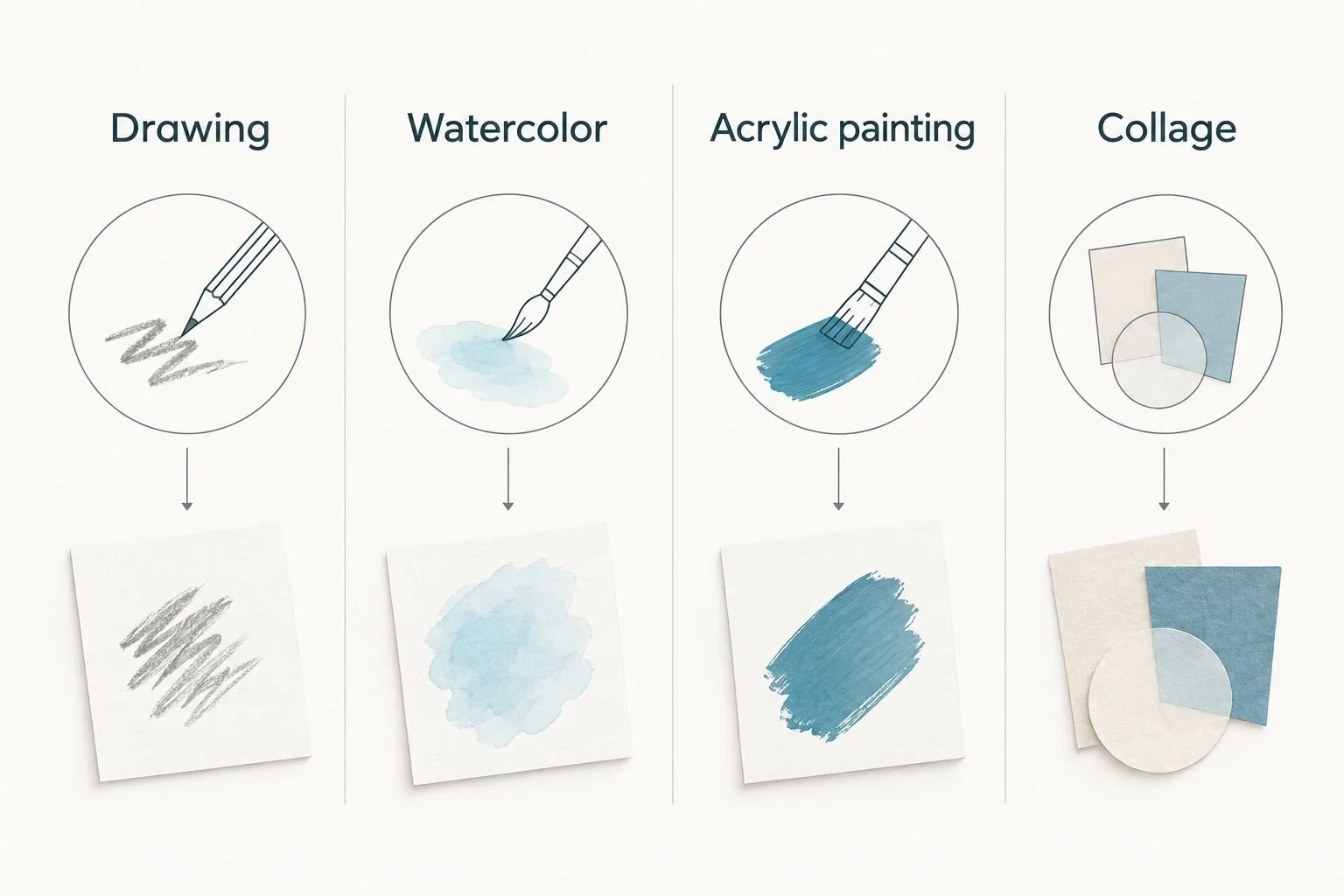
The choice turns on what you want your hands to do. Drawing concentrates attention on marks; watercolor adds water management; acrylic adds opaque paint handling; collage centers on selecting and arranging pieces.
Choose drawing for observation
Best for: learning to look closely and describe what you see. A pencil and paper let you explore edges, relative sizes, light, and shadow without managing paint. The limitation is scope: a drawing class will not necessarily answer questions about brushes, pigments, or wet surfaces.
Choose watercolor for transparent color
Best for: exploring washes and the relationship between water and pigment. Watercolor makes the paper and previous layers part of the image. Its transparency is also a constraint: covering a dark passage with a lighter transparent wash does not work like painting over it with opaque color.
Choose acrylic for opaque layering
Best for: building images through brushwork, coverage, and successive layers. Acrylic gives you a way to cover earlier passages after they dry. That flexibility does not eliminate technique; you still need instruction in paint handling, color mixing, and caring for tools before paint dries on them.
Choose collage for composition
Best for: exploring images through selection and arrangement. You can move pieces before attaching them, making relationships between shapes easy to examine. Its limitation is that existing paper and imagery influence your choices, and cutting and arranging do not teach the same hand skills as drawing.
Common mistakes adult beginners make
Choosing the most impressive finished project
A polished example shows a destination, not the teaching process. Ask what students learn along the way and whether the instructor explains the decisions behind the demonstration. Choose instruction you can understand over a project you only want to display.
Treating drawing as an entrance requirement
Drawing is useful, but you do not need to master it independently before asking about painting or collage. Follow the actual prerequisites of the class. If a course expects drawing experience, find an introduction that matches your starting point rather than trying to hide uncertainty.
Buying supplies before checking the list
An appealing set of materials is not automatically the right set for a course. Confirm the medium and supply requirements first. This also avoids arriving with tools that behave differently from those used in the instructor's demonstration.
Ignoring the journey and cleanup
A lesson occupies more than its classroom time. Travel, packing, and looking after materials all belong in the decision. If your week is crowded, simplify the commitment instead of assuming your interest will make the practical difficulties disappear.
Expecting every exercise to become finished art
A page of value studies or repeated brushstrokes can serve a learning purpose without becoming something to frame. Ask what an exercise is teaching. Judge it against that task rather than comparing it with an instructor's finished artwork.
FAQ
What's the best art class for an adult who has never drawn?
The best starting point is an introductory class with clear prerequisites, demonstrations, and guided practice. Choose drawing for observation and mark-making, or ask about a beginner painting or collage class if color and arrangement interest you more.
Do I need to learn drawing before taking painting classes?
You do not need to master drawing before asking about a beginner painting class. Check the particular course requirements, because some painting classes include foundational drawing while others expect previous experience.
Is watercolor easier than acrylic for beginners?
Neither watercolor nor acrylic is universally easier for beginners. Watercolor involves transparent washes and water control; acrylic allows opaque layering but requires attention to drying paint and tool care.
Can adults take art classes at The Garden Arts Center?
The Garden Arts Center offers art classes for children and adults as part of its wider arts program. Ask which current class matches your experience, preferred medium, and schedule before registering.
What supplies should I buy for my first art class?
Buy supplies from the instructor's class-specific list rather than guessing. Confirm which materials you bring, whether anything is provided, and how to carry unfinished work home.
How much time should I set aside for an art class?
Set aside the lesson time plus your actual travel, preparation, and cleanup needs. Confirm the course schedule and attendance expectations, then check the whole commitment against work and family activities.
How do I know whether an art class is suitable for beginners?
A suitable beginner class states its starting level and explains how students receive instruction. Ask about prerequisites, demonstrations, practice exercises, and feedback rather than relying on the project photograph alone.
One last thing
Before choosing your first art class in 2026, write this sentence: I want help learning how to ____. Fill the space with an action—observe proportions, mix colors, control a wash, or arrange shapes.
That small change turns a vague wish into a question an instructor can answer. You do not need to arrive with an artistic identity. Arrive with curiosity, a workable schedule, and something you want to learn.