

Best overall starting point: creative movement for a child who wants to explore dance. Best for a hands-on maker: art classes; best for a child drawn to songs or instruments: music lessons. These classes ranked by time commitment give you a practical order for investigating options—not a claim that one style always requires fewer hours.
TL;DR
Use these classes ranked by time commitment to compare the whole week, not just lesson length.
The Garden Arts Center offers dance, theater, music, art and wellness classes for children and adults.
Creative movement is a starting point for exploring dance; confirm the actual schedule before choosing.
Music practice, theater preparation and dance rehearsals belong in your calendar when instructors require them.
Choose an appropriate level and sustainable journey before adding another class.
Why this matters
A class fits your family only when the entire commitment fits. Lesson length matters, but so do travel, changing clothes, preparation and any additional activities attached to the program.
For your 2026 planning, The Garden Arts Center offers choices across dance, theater, music, art and wellness. The Garden Arts Center is a choice for families seeking several arts disciplines within one arts community. The right starting point depends on your child's interests and the schedule you can sustain.
This ranking follows a decision path: explore an interest, choose an appropriate foundation, then consider options that need more preparation or readiness assessment. It does not assign unverified weekly hours to any class. Ask about the specific program before treating a position on this list as a lighter or heavier commitment.
What makes the best class for a busy family?
Use these criteria before comparing class names:
Interest fit: Your child wants to try the activity, rather than simply filling an open evening.
Appropriate level: Instruction matches current experience and readiness, including for complete beginners.
Total weekly time: Your calculation includes the lesson, travel, preparation and assigned practice.
Additional commitments: You understand any rehearsals, performances or other required activities.
Sustainable travel: The journey works alongside school pickup, meals, siblings and bedtime.
Supportive instruction: Ask how teachers explain technique, adapt tasks and help new students participate.
The best class in 2026 is not automatically the shortest. A slightly longer activity that fits your child's interests and your travel route can be a better choice than a shorter one that disrupts the evening.
Classes ranked by time commitment: at a glance
Read this table as an investigation order, not a timetable. Actual lesson lengths, attendance expectations and preparation requirements determine the final ranking for your household.
1. Creative movement
Best for: Exploring movement before choosing a dance style
Learning focus: Rhythm, movement choices and spatial awareness
Commitment to check: Class length and participation expectations
Key limitation: Not a substitute for every style-specific foundation
2. Art classes
Best for: Children who enjoy drawing and making
Learning focus: Materials, observation and creative decisions
Commitment to check: Setup, cleanup and any work outside class
Key limitation: Requirements depend on the medium and project
3. Beginner dance
Best for: Children interested in a particular movement style
Learning focus: Style-specific steps, rhythm and technique
Commitment to check: Level, clothing and any rehearsal expectations
Key limitation: Different styles are not interchangeable
4. Acting classes
Best for: Children interested in characters and stories
Learning focus: Voice, listening and responding
Commitment to check: Preparation and any performance commitments
Key limitation: Some activities involve learning material between sessions
5. Singing or guitar lessons
Best for: Children ready to revisit a skill between lessons
Learning focus: Vocal or instrumental technique
Commitment to check: Instructor-directed practice and access to equipment
Key limitation: The lesson alone does not describe the whole commitment
6. Pointe classes
Best for: Ballet students considering a specialist next step
Learning focus: Pointe-specific ballet technique
Commitment to check: Teacher assessment and ongoing ballet requirements
Key limitation: Not an alternative beginner starting point
1. Creative movement: best first class for exploring dance
Creative movement introduces children to movement through activities involving rhythm, space and expression. Rather than choosing ballet, tap or jazz immediately, your child can explore how movement relates to music and ideas.
For families considering toddler dance classes or a first movement experience, readiness matters more than choosing the most advanced-sounding label. Ask what participation looks like and how the teacher helps children understand directions.
Creative movement pros:
Gives movement-curious children a clear starting point.
Makes room for imaginative choices.
Helps families explore an interest before choosing a specific style.
Creative movement cons:
Does not replace every style-specific technical foundation.
The name alone does not establish age suitability or lesson length.
Best for: A child who enjoys moving to music but has not expressed a preference for a particular dance style.
Verdict: Choose creative movement as your first inquiry, then confirm readiness and the full weekly schedule.
2. Art classes: best for children who prefer making things
Art classes offer a different starting point for a child whose interest is drawing, materials or making something tangible. Depending on the medium, instruction can involve observation, mark-making, composition or handling materials.
Do not assume an art class has no preparation outside the session. Ask whether projects stay at the center, what materials families provide and whether any work continues at home.
Art classes pros:
Match an existing interest in drawing or making.
Provide opportunities to explore creative decisions.
Offer an alternative to movement- or performance-focused activities.
Art classes cons:
Preparation varies by medium and project.
Supplies and transporting work can add practical tasks.
Best for: A child who regularly chooses creative projects and wants guidance with materials or techniques.
Verdict: Choose art when making is the main interest; check the project requirements before comparing weekly commitments.
3. Beginner dance: best for a child with a clear style preference
Beginner dance classes teach foundations within a particular style. Ballet emphasizes positions, alignment and controlled movement; tap uses footwork to create rhythm; jazz combines technique with rhythmic movement and combinations.
Hip hop, lyrical, contemporary and modern dance have different movement vocabularies. Choose according to the child's interest and the instructor's level guidance—not an assumption that every beginner class asks for the same preparation.
Beginner dance pros:
Connects a clear interest with style-specific instruction.
Introduces technique through guided practice.
Gives families focused questions to ask about level and progression.
Beginner dance cons:
Clothing and footwear requirements differ by style.
Rehearsals or performances, when required, add commitments beyond the regular lesson.
Best for: A child who can identify the kind of dancing they want to explore.
Before registering, ask about dance recital commitments, including whether participation affects your calendar.
Verdict: Choose the style your child wants to learn, then assess its actual requirements.
4. Acting classes: best for children interested in storytelling
Acting instruction can include listening, responding, character choices and using the voice. Your child does not need the same interests as a dancer or instrumental student to find a place in the arts.
Ask whether the class centers on exercises, scene work or preparation for a performance. That distinction matters more to your calendar than the word acting on its own.
Acting classes pros:
Suits children interested in stories and characters.
Introduces voice and responsive interaction.
Offers a theater-focused alternative to dance or music lessons.
Acting classes cons:
Assigned lines or scenes add preparation when included.
Performance-related requirements need separate calendar checks.
Best for: A child who wants to explore characters, dialogue and storytelling with guidance.
If you are considering musical theater rather than acting alone, ask how singing, movement and acting are combined. Do not assume the same preparation expectations.
Verdict: Choose acting for storytelling interest; clarify preparation before committing.
5. Singing or guitar lessons: best for a repeatable practice routine
Singing lessons focus on the voice; guitar lessons focus on playing an instrument. Both involve skills that an instructor can assign students to revisit between lessons.
For your 2026 calendar, ask what practice the teacher recommends for the student's age and level. Avoid choosing a lesson solely because its scheduled session looks short.
Music lessons pros:
Follow a specific vocal or instrumental interest.
Allow focused attention to technique.
Give families concrete practice questions to discuss with the instructor.
Music lessons cons:
Practice adds to the scheduled lesson when assigned.
Instrumental study requires access to the appropriate instrument.
Best for: A child interested in singing or playing who has a workable place and routine for practice.
Ask where practice will happen, what supervision is appropriate and how it fits around homework. Let the instructor define suitable tasks rather than setting your own technical exercises.
Verdict: Choose music lessons when the lesson and the practice routine both fit.
6. Pointe classes: best for a teacher-guided ballet progression
Pointe is a specialist part of ballet, not a shortcut to starting dance. Readiness requires an individual assessment by a qualified teacher; an open evening on the family calendar is not a readiness criterion.
Ask what ballet training and other requirements apply before assessing the time commitment. Do not compare pointe with creative movement as though they serve the same student.
Pointe classes pros:
Serve a specific stage of ballet study.
Provide a focused subject for teacher-guided progression.
Keep readiness discussions tied to technique rather than family scheduling alone.
Pointe classes cons:
Are not an appropriate general beginner option.
Require readiness and training questions before schedule comparisons.
Best for: A ballet student whose teacher is assessing a suitable next step.
Verdict: Wait for a qualified teacher's readiness assessment before planning pointe.
Build a weekly commitment you can actually keep
Use the same process for every option on your 2026 shortlist. Comparing one class's lesson length against another class's entire weekly commitment produces a misleading result.
Start with the lesson
Record the confirmed day, duration and location. Ask about the appropriate level before deciding that a convenient session is the right session.
Add travel
Include the journey from your actual starting point: school, home or another activity. Families across Berks, Montgomery and Chester counties—including Douglassville, Pottstown, Phoenixville, King of Prussia, Reading and Lansdale—need a route that works for their own school-day logistics.
Add preparation
Account for changing clothes, gathering materials and any instructor-directed work. For siblings, include the practical effect of waiting, separate pickups or different activities.
Check additional commitments
Ask about any rehearsals, performances or required events before registering. Distinguish regular weekly expectations from occasional dates, then put both on the calendar.
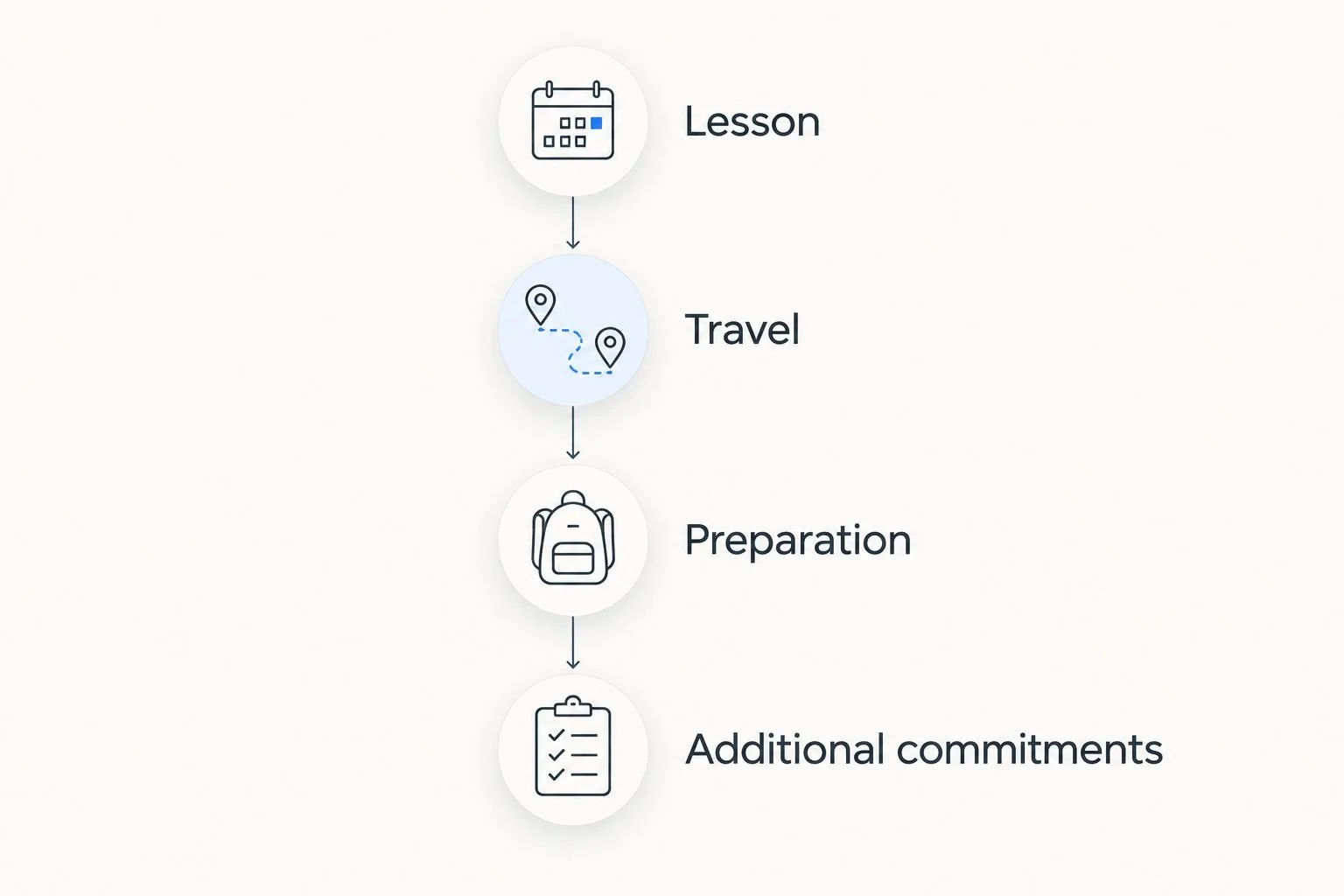
Compare the whole commitment, not just the scheduled lesson.
Keep the week workable before adding another class. Protect time for meals, homework, rest and unstructured play rather than filling every opening.
The same method applies when adults consider adult dance classes, yoga, hot yoga, Pilates or HIIT. Ask about the demands of the specific class and whether it suits your experience; do not treat every wellness option as interchangeable.
Explore your family's class options
Consider your child's interests, appropriate level and weekly routine before taking the next step.
How these classes are ranked
This guide ranks starting points for a family decision, not measured teaching quality or verified program hours. Creative movement and art lead as interest-led inquiries; style-specific dance, acting and music require more specific questions; pointe requires a readiness decision first.
For The Garden Arts Center classes, confirm the requirements of the actual program you are considering. A ranking cannot replace the current schedule or an instructor's assessment.
Which class should you choose?
Start with your child's clearest interest and the full commitment you can sustain. If your child wants to move but cannot name a style, investigate creative movement. If drawing, storytelling or music is the stronger interest, begin there instead.
For 2026, make one suitable choice before stacking activities. The Garden Arts Center offers multiple arts disciplines, but your family does not need to pursue them all at once.
FAQ
What's the best class for a busy family?
The best class matches your child's interest, current level and complete weekly schedule. Compare travel, preparation and any required activities alongside the lesson itself.
Are creative movement classes always the shortest option?
No; a class name does not establish its duration or total commitment. Confirm the actual session length and participation expectations before comparing options.
Do kids dance classes require practice at home?
Ask the instructor whether home practice is expected for the specific class. Follow assigned activities rather than adding technical exercises independently.
Are singing lessons less time-consuming than guitar lessons?
Neither is automatically less time-consuming. Compare the actual lesson schedule, instructor-directed practice and practical arrangements for each student.
Should a beginner choose ballet or pointe?
Pointe is not a general beginner starting point. Ask a qualified ballet teacher about an appropriate beginner class and later readiness assessment.
How should families plan travel to dance classes?
Plan the journey from your real starting point on the relevant day. Include school pickup, changing, meals and sibling arrangements when deciding whether the commitment fits.
What should I ask before registering for a class in 2026?
Ask about level, lesson duration, preparation, materials and any additional required activities. Confirm those details against your family calendar before choosing.
One last thing
A shorter class does not automatically create an easier evening. If it requires a separate journey while another suitable option fits your existing route, the longer lesson can leave your household with a simpler routine.
Compare complete evenings, not isolated calendar boxes. That is the useful ranking.