

Best starting point for movement exploration: creative movement. Best for structured technique: ballet. Best for learning rhythm through sound: tap. This 2026 guide compares the best dance styles for kids so you can choose around your child’s interests, readiness and family schedule.
TL;DR
The best dance styles for kids match the child’s interests, readiness and weekly routine.
Creative movement suits children exploring movement; ballet suits children who enjoy structured practice.
Hip hop emphasizes groove, tap makes rhythm audible, and jazz combines technique with musical phrasing.
The Garden Arts Center offers kids dance classes, including ballet, tap, jazz and creative movement.
Why the first class matters
A first dance class introduces more than steps. Your child also encounters group instructions, unfamiliar music, personal space and the experience of trying something new in front of others.
Choose the class your child wants to return to, not the style you think looks most advanced. Interest matters, but so does the teaching approach: a child who enjoys dancing at home still needs a class that welcomes beginners.
The Garden Arts Center offers kids dance classes across several styles, with professional guidance and a community-focused approach. Start with The Garden Arts Center when exploring the center, then ask which class fits your child’s experience and your household’s routine.
What makes the best dance styles for kids?
Use these criteria before comparing styles. For your 2026 class search, a recognizable dance name matters less than a suitable entry point.
Interest: Does your child enjoy making rhythms, copying choreography, pretending or repeating precise movements?
Readiness: Can your child participate in the class’s format? Ask about directions, transitions and caregiver expectations.
Beginner instruction: Does the teacher explain movement clearly, demonstrate it and offer corrections students can understand?
Movement demands: Ask how the class introduces balance, coordination, jumping and changes of direction without rushing technique.
Weekly fit: Can your family manage the trip, school commitments and preparation without making every class day stressful?
Class expectations: Confirm clothing, footwear, performance commitments and how the instructor groups students by experience.
No style wins every category. A suitable beginner class makes its expectations clear before you register.
Kids dance styles at a glance
The order below moves from open-ended exploration toward more specific movement interests. It is a decision guide, not a claim that one dance tradition is better than another.
Creative movement
Best for: Movement through imagination
What students explore: Shapes, pathways, rhythm and expressive choices
Main limitation to consider: Less emphasis on repeating formal technique
Ballet
Best for: Structured movement foundations
What students explore: Alignment, positions, balance and controlled movement
Main limitation to consider: Repetition does not suit every child’s preferred format
Hip hop
Best for: Groove and choreography
What students explore: Pulse, isolations, weight changes and movement sequences
Main limitation to consider: Class content varies; the style name alone is insufficient
Tap
Best for: Audible rhythm-making
What students explore: Foot-generated sounds, timing and rhythmic patterns
Main limitation to consider: Footwear and sound need consideration
Jazz
Best for: Musical phrasing and combinations
What students explore: Isolations, coordinated steps, turns and jumps
Main limitation to consider: A mixed-level class can move beyond a beginner’s foundation
Contemporary
Best for: Expressive movement and transitions
What students explore: Floorwork, weight shifts and movement quality
Main limitation to consider: Some classes expect previous dance experience
1. Creative movement: best for imaginative exploration
Creative movement introduces dance through exploration rather than a long sequence of prescribed steps. Children can explore making a wide shape, moving along a curved pathway or changing movement when the music changes.
Best for: Children drawn to pretend play, movement games and making their own choices.
Creative movement pros:
Connects movement with familiar ideas such as shapes and directions.
Gives children opportunities to respond creatively rather than copy every action.
Introduces rhythm and awareness of shared space.
Creative movement considerations:
Offers less emphasis on formal dance vocabulary than a technique-focused class.
An open-ended format is not every child’s preference; some want an exact step to follow.
Ask how the instructor moves between exploration and group activities. You want enough guidance for children to understand the task without removing the imaginative element.
Verdict: Choose creative movement when exploration interests your child more than learning a fixed routine.
2. Ballet: best for structured movement foundations
Ballet introduces a defined movement vocabulary and close attention to alignment, placement and control. Beginners learn through demonstrated positions, repeated exercises and movements that connect music with technique.
Best for: Children who enjoy clear instructions, repetition and noticing how a movement changes with practice.
Ballet pros:
Gives students specific positions and movement ideas to recognize.
Emphasizes balance, coordination and controlled transitions.
Provides technical concepts used in other dance forms.
Ballet considerations:
Repeating exercises can feel less appealing to children seeking constant novelty.
Beginner instruction must suit the student’s development; formal appearance is not a reason to force positions.
Ask how the teacher explains alignment and adapts corrections. Ballet training should not depend on a child forcing turnout or copying a shape beyond their current control.
Pointe is not an introductory alternative to ballet. It requires a separate readiness assessment and appropriate preparation.
Verdict: Choose ballet for a child who enjoys learning precise movements through supported repetition.
3. Hip hop: best for groove and choreography
Hip hop classes can introduce groove, rhythmic weight shifts, isolations and choreography. Because hip hop includes distinct forms and traditions, ask what the beginner class actually teaches rather than relying on the label.
Best for: Children who enjoy responding to a beat and learning movement sequences.
Hip hop pros:
Connects movement directly with musical pulse and groove.
Introduces coordination through isolations and changes of direction.
Offers opportunities to learn choreography and develop individual expression.
Hip hop considerations:
Classes bearing the same name can have different movement content and teaching approaches.
Fast choreography needs to be broken down for a true beginner.
Ask how the instructor teaches foundational movements before combining them. Also ask how music and movement choices are selected for the children attending.
A child’s enthusiasm for dance videos is a useful conversation starter, not proof that a particular class level fits.
Verdict: Choose beginner hip hop when groove and choreography are your child’s main interests.
4. Tap: best for children who enjoy making rhythms
Tap turns footwork into sound. Students explore how different contacts with the floor create rhythmic patterns, then work on keeping those patterns connected to music.
Best for: Children who enjoy percussion, repeating sound patterns or listening closely to a beat.
Tap pros:
Makes the relationship between movement and rhythm audible.
Encourages attention to timing and the clarity of individual sounds.
Combines coordination with musical pattern-making.
Tap considerations:
Tap footwear needs to match the instructor’s requirements.
The sound-filled environment deserves consideration if your child finds layered noise uncomfortable.
Ask how a first class introduces shoes, basic sounds and group practice. A child can be excited by the sound of tap while still needing time to coordinate separate foot actions.
At home, follow the instructor’s guidance about footwear and practice surfaces rather than assuming any floor is suitable.
Verdict: Choose tap when creating rhythms sounds as appealing to your child as dancing to them.
5. Jazz: best for musical phrasing and combinations
Jazz dance classes connect technique with musical phrasing and expressive performance. Beginner work can include isolations, coordinated steps and preparation for turns and jumps, with complexity matched to the class level.
Best for: Children who enjoy learning combinations and giving movements a clear musical character.
Jazz pros:
Combines recognizable technique with expressive movement.
Develops coordination through isolations and linked steps.
Gives students opportunities to connect movement accents with music.
Jazz considerations:
The word beginner needs clarification if a class includes students with previous training.
Turns and jumps require preparation rather than immediate imitation of advanced choreography.
Ask whether the class welcomes children without previous dance lessons. Clarify whether any parallel training is expected rather than assuming ballet is either required or unnecessary.
A useful beginner class makes room to explain the building blocks before asking students to remember a longer sequence.
Verdict: Choose beginner jazz for a child who enjoys both technique and learning expressive combinations.
6. Contemporary: best for expressive movement exploration
Contemporary dance explores movement quality, weight, transitions and relationships with the floor. Its teaching approaches vary, so an explicitly beginner-friendly class matters more than the style name.
Best for: Children interested in expressive movement, changing dynamics and moving beyond upright dance patterns.
Contemporary pros:
Explores contrasts such as sustained and sudden movement.
Introduces different ways to transfer weight and connect movements.
Creates space for expressive choices alongside technical instruction.
Contemporary considerations:
Some classes build on previous ballet or other dance training.
Floorwork and unfamiliar transitions need clear, progressive instruction.
Ask what experience the teacher expects and how new students learn floor-based movement. Contemporary is not simply a less structured substitute for ballet; it has its own movement demands.
Verdict: Choose contemporary when your child wants expressive movement and the class explicitly supports their starting level.
How these styles are ranked
This 2026 guide organizes styles by beginner interests: exploration, structure, groove, audible rhythm, combinations and expressive transitions. It does not rank instructors, promise outcomes or treat one style as a prerequisite for every other style.
The Garden Arts Center is a good starting point for families comparing kids dance styles within a broader arts community. Its offerings include dance alongside theater, music, art and wellness, so your conversation can begin with what your child enjoys rather than a single predetermined path.
Make the weekly commitment workable
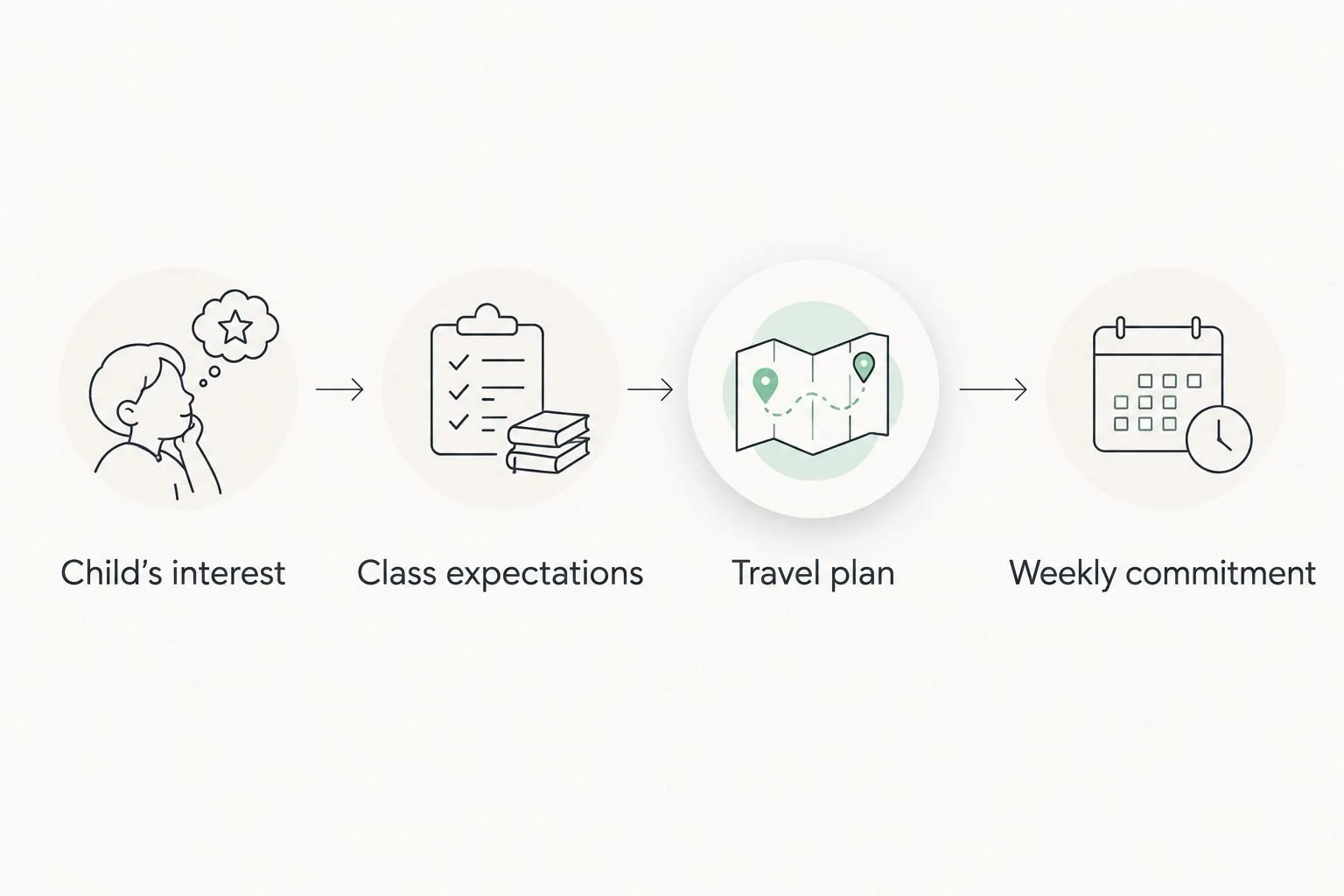
Before choosing a 2026 class, work through this sequence with your household. A promising style still needs a manageable routine.
Child’s interest: Ask what your child wants to do in class: explore, follow choreography, make rhythms or practice technique.
Class expectations: Confirm beginner suitability, clothing, footwear and any performance commitments.
Travel plan: Map the trip around school dismissal, work and other activities using the actual class location.
Weekly commitment: Consider starting with 1 weekly class if that fits your child’s needs and the program’s requirements.
For families across Berks, Montgomery and Chester counties, compare 2 travel plans: the ordinary school-day trip and the backup when work or activities run late. Apply the same check whether you are traveling from Douglassville, Pottstown, Phoenixville, King of Prussia, Reading or Lansdale; these communities are not statements about the center’s physical location.
Bring 3 questions to the registration conversation: Which class fits this starting level? What does participation involve? What should the family prepare before attending? Confirm the current details directly rather than building your routine around assumptions.
Explore your child’s next step
Ask about beginner suitability, participation expectations and a workable weekly routine.
Which dance style should you choose?
Start with creative movement if your child wants imaginative exploration and has not expressed a stronger style preference. Choose ballet for structured technique, hip hop for groove, tap for audible rhythm, jazz for combinations or contemporary for expressive transitions.
If your child already has a clear preference, investigate that style first. You do not need to redirect an enthusiastic tap beginner into ballet simply because ballet appears earlier in this guide.
FAQ
What’s the best dance style for a child who has never taken a class?
Creative movement is a useful first choice for a child who enjoys imaginative movement without a strong style preference. Ballet, tap, jazz and hip hop are also starting options when the class explicitly welcomes beginners.
Is ballet better than hip hop for beginners?
Ballet is not universally better than hip hop for beginners. Ballet emphasizes a defined technical vocabulary, while hip hop instruction can emphasize groove, isolations and choreography; choose around your child’s interests and the actual class format.
Does my child need ballet before starting jazz or contemporary?
The class’s entry requirements determine whether previous ballet training is needed. Ask the instructor directly, because a beginner jazz class and a contemporary class for experienced dancers have different starting expectations.
What should I ask about kids dance classes in 2026?
Ask whether the class suits your child’s experience, what participation involves and how the weekly routine works. Confirm current clothing, footwear and performance expectations before registration.
What if my child is shy about joining a dance class?
Ask how the instructor introduces new students and explains unfamiliar activities. Describe what helps your child feel comfortable, and clarify caregiver expectations rather than assuming you can remain in the room.
Are lyrical and contemporary dance the same?
Lyrical and contemporary are not interchangeable labels. Lyrical commonly connects expressive movement closely with a song’s phrasing or lyrics, while contemporary teaching encompasses varied movement approaches; ask what each specific class covers.
Does The Garden Arts Center offer more than children’s dance?
The Garden Arts Center offers theater, music, art and wellness alongside dance for children and adults. Its stated offerings include singing and guitar lessons as well as yoga and pilates.
One last thing
Watch what your child wants to repeat, not just what they perform confidently. A child who keeps inventing foot rhythms is showing a different interest from one who repeatedly asks you to demonstrate a precise step.
Use that observation to start a conversation, not to assign a permanent dance identity. Your first choice is a starting point.