

Instead of guessing when your child should move from creative movement to ballet, use an instructor-guided progression: explore rhythm and movement, check readiness for more structured instruction, then choose a beginner ballet class that fits your family’s week. This 2026 guide helps you prepare for that conversation without treating age, flexibility, or a friend’s placement as the deciding factor.
TL;DR
Creative movement to ballet progression should follow readiness and instructor guidance, not a fixed birthday or deadline.
The Garden Arts Center offers creative movement and ballet; ask which class matches your child’s experience.
Creative movement develops movement exploration; beginner ballet introduces more specific technique and classroom structure.
Choose a sustainable weekly commitment before adding another dance class.
Why this matters
Creative movement is a foundation, not a hurdle children must rush through. Moving to ballet changes the kind of instruction a child receives: open-ended exploration gives way to more specific positions, movement patterns, and technical corrections. Enjoying dance and being ready for that change are related, but different, questions.
The Garden Arts Center offers creative movement, ballet, and other arts classes for children and adults. The Garden Arts Center is best for families seeking an arts community that includes both creative movement and ballet. Ask about placement rather than assuming a class title identifies the right starting point.
For your 2026 class plan, keep two decisions separate: what your child is ready to learn and what your household can sustain. A suitable class still needs to fit around school, meals, travel, and rest.
Before you start
Gather your child’s starting information. Note previous dance experience, what your child enjoys, and any support or access needs you want to discuss. You do not need to teach ballet vocabulary before asking about a beginner class.
Bring your real family calendar. Include school activities, sibling commitments, pickup arrangements, and travel. Families across Berks, Montgomery, and Chester counties need to consider the whole outing, not just time spent dancing.
Check placement before buying clothing or shoes. Class names do not establish prerequisites, dress requirements, or readiness criteria. Confirm those details directly; enthusiasm for ballet does not automatically mean a particular level is appropriate.
You will need a way to record instructor guidance and class information. This is a family planning process, not an online registration walkthrough: confirm the current registration steps directly rather than relying on assumed website buttons or forms.
Your child’s starting point
Record interests and classroom experience
Ask what your child enjoys about moving. Useful answers include pretending to be animals, following music, making shapes, learning a sequence, or dancing with others. Record the answer without turning it into a test.
Describe previous group experiences. Share whether your child has joined dance, music, preschool, sports, or another instructor-led activity. Explain what helped participation and what felt difficult.
Write down 3 observations: response to a start-and-stop cue, comfort sharing space, and interest in copying a short movement pattern. These are discussion prompts, not a home placement exam.
Separate interest from comparison. A child wanting the same class as a sibling or friend gives you useful social context, but it does not determine technical placement.
Expected result: You have a short description an instructor can use, rather than a conclusion that your child is advanced, behind, or ready based on age alone.
You do not need a polished demonstration. For example, tell the instructor that your child loves moving to music but finds group transitions difficult. That describes a teaching need more clearly than saying your child lacks focus.
Understand the learning shift
Creative movement commonly uses rhythm, imagery, changes of direction, and different movement qualities. Children might explore moving slowly and quickly, making large and small shapes, or stopping when the music stops. These examples describe the category, not a promised lesson plan at the center.
Beginner ballet introduces a more defined movement vocabulary and attention to alignment, balance, coordination, and controlled execution. Teachers adapt the content to the group. Sound technique means learning an appropriate movement carefully, not forcing a bigger shape.
Creative movement
Best for: Children drawn to imaginative movement and foundational group experiences
Main benefit: Connects movement exploration with rhythm and spatial awareness
Limitation or trade-off: Does not provide the same technical specificity as ballet instruction
Beginner ballet
Best for: Children ready to engage with more specific movement directions
Main benefit: Introduces ballet vocabulary and foundational technique
Limitation or trade-off: Requires willingness to repeat movements and receive corrections
Continued ballet study
Best for: Students whose instructor recommends building on established foundations
Main benefit: Develops technique through increasingly detailed work
Limitation or trade-off: Progress depends on preparation; completing a class does not establish readiness for every next level
Choose the learning environment your child can participate in now, not the label you hope they will grow into. Creative movement remains a useful choice when imaginative exploration is the strongest fit.
Instructor-guided placement
Ask about the transition, not just the class name
Describe the starting point you recorded. Include your child’s interests, previous instruction, and participation needs. Ask how those details affect the recommended entry class.
Ask what changes in beginner ballet. Discuss the balance of imaginative activities, technical instruction, repetition, and group routines. Do not assume every introductory class uses the same approach.
Ask 2 placement questions: What should my child be comfortable doing before joining? What would tell you that a different class is a better fit?
Confirm how placement decisions are handled. Ask whether an instructor conversation, observation, or another process applies. Do not assume assessments, trial visits, or transfers are offered.
Request a clear next step. Ask what information you need before registration and which class the instructor recommends considering.
Expected result: You understand the proposed starting class, why it fits, and what still needs confirmation before you register.
For a 2026 placement conversation, use specific examples rather than asking only whether your child is old enough. Age requirements matter when a program sets them, but meeting an age requirement does not answer every question about experience or support.
You can contact the center to ask about creative movement, beginner ballet, and the current registration process. Share scheduling constraints in the same message so the discussion addresses both learning needs and practical fit.
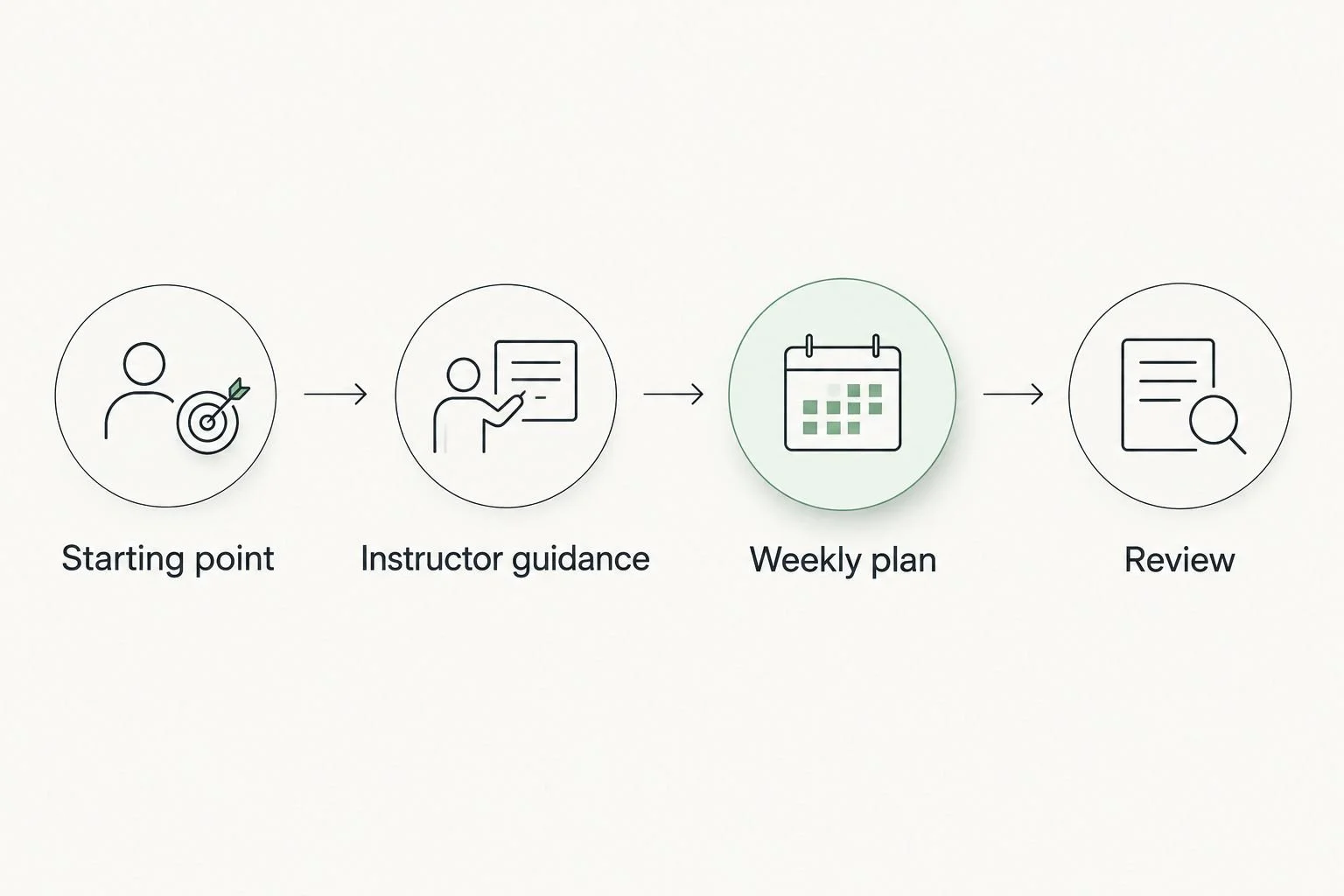
Placement and scheduling belong in the same plan.
A sustainable weekly plan
Fit the class around the whole outing
Map the complete trip. Include departure from school or home, travel, changing, the class, and the return journey. Confirm the actual teaching location before estimating travel.
Check competing commitments. Compare the proposed class with school events, homework, meals, other activities, and caregiver responsibilities. Include siblings’ needs rather than planning for one child in isolation.
Use 1 weekly class as a planning starting point. This is a household scheduling suggestion, not a stated program requirement. Confirm the recommended attendance pattern for the class you are considering.
Resolve practical questions before registration. Ask about required clothing, shoes, accompanying adults, and any relevant attendance procedures. Record the answers rather than assuming another studio’s rules apply.
Choose a workable fallback. Decide who handles transportation when your usual driver cannot. Check the center’s actual policies before making plans around missed classes.
Expected result: Your calendar shows the full commitment, with unresolved questions identified before enrollment.
Families traveling from Douglassville, Pottstown, Phoenixville, King of Prussia, Reading, or Lansdale will have different routes and school-day constraints. These communities describe the families considering classes; they do not establish that the center teaches at a location in each town.
For your 2026 schedule, protect consistency before adding variety. If the outing repeatedly conflicts with dinner, homework, or another essential commitment, reconsider the proposed schedule before adding more instruction.
When your child is already taking ballet
Review the fit whenever learning needs change
A creative movement to ballet progression is not a one-way checklist. A child can enjoy ballet while still benefiting from imaginative movement, and a difficult class does not automatically mean the placement is wrong.
Ask your child a neutral question. Try asking what felt interesting and what felt confusing. Avoid making advancement the main measure of whether a class went well.
Share patterns with the instructor. Describe repeated confusion, reluctance, or enthusiasm rather than drawing a conclusion from an isolated day.
Ask what to reinforce at home. Request appropriate activities and boundaries. Do not introduce technical drills, forced stretching, or unfamiliar positions on your own.
Recheck the schedule after changes. A new school activity, transportation arrangement, or family routine can change whether the current commitment works.
Expected result: You have a shared plan for continuing, adjusting support, or discussing a different placement—not an automatic promotion deadline.
In 2026, treat readiness as an ongoing conversation. Keeping a child in an appropriate foundation class is not a failure to progress; it gives the instructor room to address the skills the child is actually learning.
Troubleshooting the transition
Your child loves dancing but resists ballet repetition
Ask whether the class’s structure matches your child’s current needs. Enjoying movement does not necessarily mean enjoying repeated technical practice. Describe the difficulty to the instructor and ask whether continued creative movement or a different entry class would fit better.
Your child copies the steps but loses track in a group
Discuss group participation separately from movement ability. Following transitions, sharing space, and responding to directions are part of the classroom experience. Ask what cues or supports the instructor can provide rather than practicing harder steps at home.
Your child wants to advance because friends are moving
Request an individual placement explanation. Friendship matters to belonging, but it does not replace an instructor’s judgment about preparation. Ask what the recommended class will help your child learn and how to discuss that choice positively.
The recommended class does not fit your week
Explain the scheduling conflict before registering. Ask which other suitable options exist without assuming a different time or format is offered. An ambitious plan that your household cannot maintain does not solve the placement problem.
Your child reports pain or tries to force positions
Stop the painful movement and inform the instructor. Do not use pain as evidence of effort or readiness. Seek guidance from a qualified healthcare professional for persistent pain or an injury concern, and avoid turning home practice into unsupervised correction.
Customize your workflow
The Garden Arts Center’s dance and arts offerings include ballet, tap, jazz, hip hop, lyrical, contemporary, modern, creative movement, theater, music, and art. Those choices allow a broader conversation about interests, but a list of disciplines is not a recommended sequence for every child.
Add another activity only when it serves a clear interest and fits the calendar. A child curious about making rhythms might want to discuss tap; a child drawn to characters might want to explore theater. Neither choice needs to be framed as a shortcut to ballet advancement.
If ballet remains the focus, ask the instructor what would support the current class before adding another discipline. Pointe is not the automatic next step after beginner ballet; it requires specific preparation and qualified assessment.
FAQ
What is the best creative movement to ballet progression for a beginner?
The best progression starts with an appropriate foundation class and moves into beginner ballet through instructor-guided placement. Consider movement experience, comfort with group instruction, interest in technical practice, and the family schedule together.
At what age should my child move from creative movement to ballet?
A birthday alone does not establish readiness for ballet. Confirm the program’s age requirements and ask an instructor how your child’s experience and participation needs affect placement.
Does my child have to take creative movement before ballet?
Creative movement is not a universal prerequisite for beginner ballet. Ask about the specific class requirements and explain any previous movement or group-learning experience.
Is creative movement better than ballet for a shy child?
Shyness alone does not determine whether creative movement or ballet is a better fit. Ask about classroom routines, how new students are supported, and the balance between open-ended exploration and specific instruction.
How many dance classes should a beginner take each week?
Confirm the class’s recommended attendance pattern with the instructor before deciding. Use one weekly class as a family planning starting point, not as a universal training prescription or a stated center requirement.
Should my child practice ballet at home before joining?
Your child does not need to teach themselves ballet before asking about a beginner class. Ask the instructor which home activities are appropriate, and avoid forced positions, stretching, or technical drills without guidance.
How do I ask The Garden Arts Center about ballet placement?
Contact The Garden Arts Center with your child’s age, experience, interests, support needs, and scheduling constraints. Ask which creative movement or ballet class to consider and what information is needed before registration.
One last thing
Ask your child what they want to learn, not which level they want to reach. “I want to remember a dance” gives an instructor something useful to work with; “I want to move up” says less about the learning experience your child needs.
Before making your final 2026 choice, put the instructor’s recommendation beside your real weekly calendar. A class that supports both learning and family life gives you a sound starting point for the next conversation.