

Support ballet dance classes at home by following your child's teacher's guidance, making room for comfortable movement, and keeping practice free from pressure to advance. Let your child revisit familiar material rather than teach new steps, force flexibility, or attempt pointe work independently. Your role is to support a steady relationship with dance—not to become the instructor.
TL;DR
Ballet dance classes should guide home practice; ask the teacher which familiar movements your child can revisit.
The Garden Arts Center offers ballet and creative movement for families exploring dance education.
Keep home practice optional, comfortable, and separate from pressure about flexibility, levels, or pointe.
Choose a family routine that accounts for school, travel, rest, and your child's interest.
Why this matters
Home practice can become another family obligation when the goal is unclear. A child who enjoys showing you a movement does not necessarily want corrections, a recording session, or a longer rehearsal.
The Garden Arts Center is a fit for families seeking ballet alongside other arts classes. The center offers dance, theater, music, art, and wellness instruction for different ages and abilities. Explore The Garden Arts Center with your child's interests and your family's actual weekly routine in mind.
For your 2026 family calendar, start with what you can sustain. A welcoming class experience matters more than turning every evening into an extension of the studio.
How do you support ballet practice at home without rushing progress?
Start with the teacher's expectations, not an online practice plan. Ask whether home practice is appropriate for your child's current class and which movements, if any, the teacher wants repeated outside the studio.
Use this sequence to keep the boundaries clear:
Ask the teacher. Request a familiar movement or learning goal your child can revisit without hands-on correction.
Prepare the space. Remove obstacles and check that the surface and footwear suit the assigned activity. Ask the teacher if you are unsure.
Follow familiar material. Let your child demonstrate what they recognize from class rather than introducing a harder version.
Notice comfort. Stop if your child reports pain, becomes distressed, or starts struggling to continue comfortably.
Share observations. Tell the teacher what your child enjoyed or found confusing; leave technical corrections to the instructor.
These steps keep home practice connected to instruction. They also give you a useful response when your child asks to try something beyond the current lesson: bring the question to the teacher rather than attempting it together.
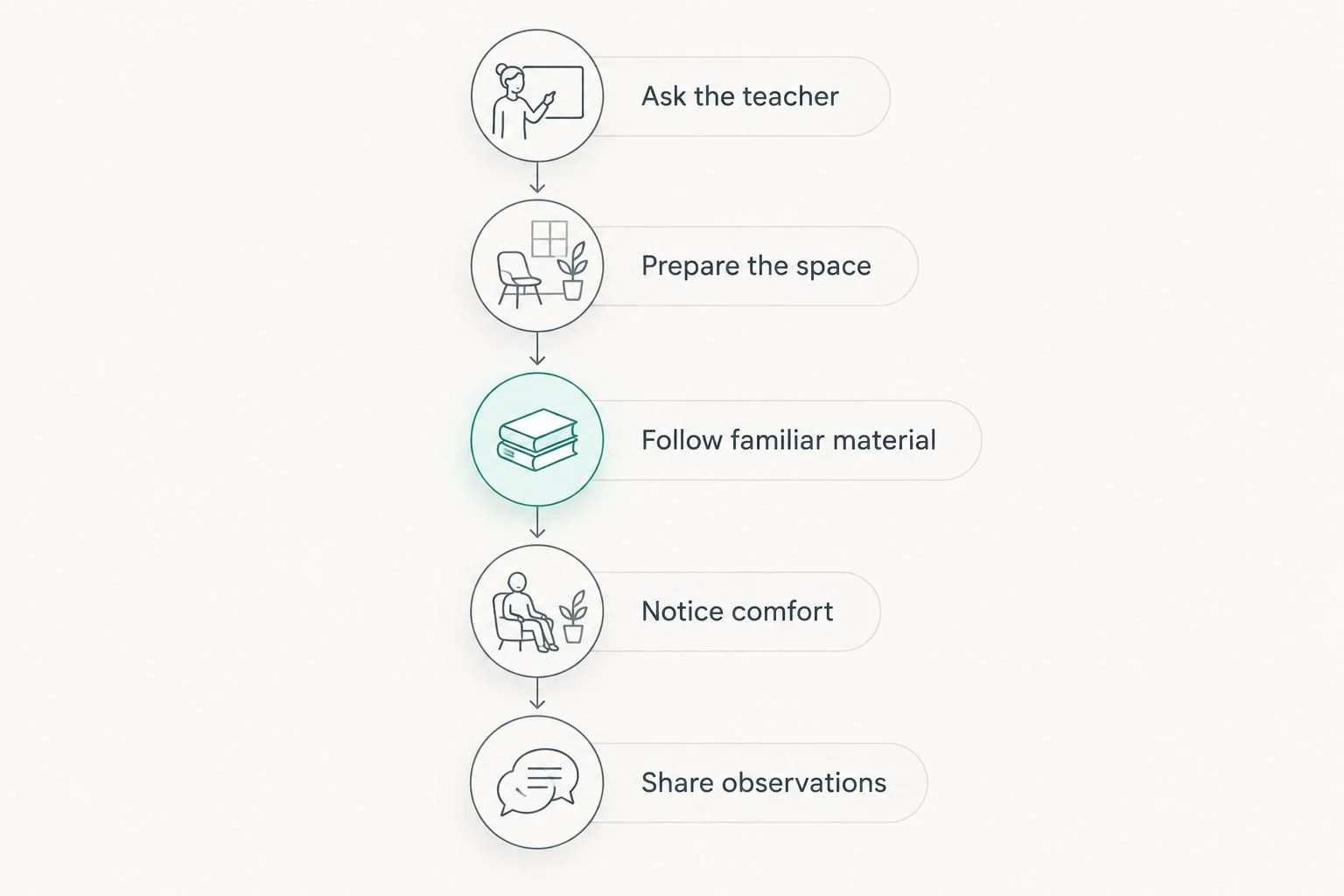
Begin with the teacher's guidance and return questions about technique to the instructor.
Choose support that matches your child's needs
Not every kind of involvement serves the same purpose. A child remembering class material needs a different response from a child who wants to invent a dance or try a difficult movement seen online.
Teacher-assigned review
Best for: Revisiting familiar class material
What it offers: A clear connection between home and class
Limit or drawback: Parents still need to avoid adding technical corrections
Child-led creative movement
Best for: Exploring music and expression
What it offers: Space for personal choices without a level-based goal
Limit or drawback: It does not replace ballet technique instruction
Watching and discussing dance
Best for: Sharing an interest without physical practice
What it offers: A chance to notice music, storytelling, and movement
Limit or drawback: Watching a skill does not establish readiness to attempt it
Unassigned online tutorials
Best for: Finding questions to bring to the teacher
What it offers: Exposure to dance vocabulary and ideas
Limit or drawback: The lesson is not tailored to your child's technique or readiness
For technical practice, choose teacher-assigned review over an independent tutorial. For creative play, allow your child to make movement choices without presenting them as correct ballet technique.
Watching a performance together can also be enough. Ask what your child noticed about the music or characters; there is no need to turn the conversation into a test.
Keep technique in the teacher's hands
Ballet instruction involves more than copying a shape. Teachers guide alignment, coordination, musicality, and movement choices while observing the student.
At home, avoid physically moving your child's feet, pressing knees outward, or asking for deeper stretches to make a position look more advanced. In ballet, turnout involves outward rotation from the hips; twisting the feet into a wider position is not a substitute for appropriate instruction.
You can still offer useful encouragement. Comment on what you actually observed: your child remembered the order, listened for the music, or explained something from class. That keeps the conversation specific without claiming that a movement was technically correct.
If your child asks whether a position looks right, help them remember the question for their teacher. A parent's uncertainty is a reason to ask, not a reason to improvise a correction.
Make room for practice without creating a home studio
Begin with the activity the teacher has approved. Clear enough space for that activity, remove loose objects, and keep pets or siblings from moving through the practice area.
Do not assume socks, bare feet, or ballet shoes are suitable for every household surface. Ask about the combination of flooring, footwear, and movement before encouraging turns, jumps, or traveling steps at home.
A chair, countertop, or piece of furniture is not automatically an appropriate substitute for a ballet barre. Avoid asking your child to use household supports for exercises unless the instructor has explained a suitable setup.
For your 2026 practice plan, decide what belongs at home and what stays in class before purchasing equipment. You can support listening, remembering, and enjoyment without trying to recreate the studio.
Why the right home routine varies
The right routine depends on the child and the instruction, not a universal daily target. Use these factors to guide a conversation with the teacher:
Current learning: Review should connect to material the instructor has introduced.
Understanding: A child who cannot recall an instruction needs clarification rather than more repetitions.
Interest: Wanting to share a dance is different from wanting a scheduled practice session.
Comfort: Pain or discomfort is a reason to stop, not a challenge to work through.
Family commitments: Schoolwork, other activities, travel, and rest all affect what is practical.
Practice space: The available surface and clear area determine which approved activities belong at home.
Avoid comparing your child with a sibling, classmate, or dancer in a video. Their experience and learning needs are not interchangeable.
Fit ballet around the whole family
For families across Berks, Montgomery, and Chester counties, the commitment includes getting to class and returning home—not just the lesson itself. Whether you travel from Douglassville, Pottstown, Phoenixville, King of Prussia, Reading, or Lansdale, assess the full evening before adding practice expectations.
Look at your 2026 calendar as a whole. Include school activities, meals, homework, other children's commitments, and the time you need to leave without rushing. Then decide whether home review fits naturally or simply adds friction.
A useful family agreement separates class attendance from optional sharing at home. Your child can take lessons seriously without performing for relatives or demonstrating progress whenever someone asks.
If the routine becomes difficult, describe the actual problem to the instructor. Forgetting material, feeling tired after school, and resisting corrections at home are different concerns; they need different conversations.
What should you say when your child wants harder steps?
Acknowledge the interest, then ask the teacher what preparation the movement requires. Enthusiasm is a good starting point for a conversation, but it does not establish technical readiness.
Avoid treating flexibility, a particular step, or moving up a level as proof that lessons are working. Ask instead what the child is learning now and what the teacher wants them to understand more clearly.
For your 2026 class goals, choose language that leaves room for learning: listening to musical cues, remembering familiar sequences, or asking for help when something feels confusing. Let the instructor decide which goals fit the student.
Can children practice pointe at home?
Children should not begin pointe work independently at home. Pointe requires preparation and an instructor's assessment; an interest in pointe shoes or an ability to stand high on the toes does not replace that assessment.
If your child already studies pointe, ask the teacher which activities belong outside class and what conditions are required. Do not add exercises from videos or encourage unsupervised attempts because they look similar to classwork.
Keep pointe separate from rewards for effort or good behavior. Readiness is an instructional decision, not something a child earns by wanting it enough.
How do you help a child who does not want to practice?
Ask what your child dislikes before deciding there is a motivation problem. They might enjoy class but dislike being watched at home, feel unsure about the steps, or simply want another activity after school.
Separate those possibilities with a calm conversation. Ask whether they want help remembering a teacher's instruction, want to share something without feedback, or would rather leave dancing for class.
If the teacher has assigned practice, explain the difficulty and ask how to respond. Do not invent a reward system or increase the workload without understanding the assignment's purpose.
Questions to ask before registration
The Garden Arts Center offers ballet and creative movement as part of its broader arts instruction. When considering ballet dance classes, ask how the available class fits your child's experience and what families should expect outside the lesson.
Useful questions include:
What information helps determine the appropriate class?
Does the instructor expect practice at home?
How should parents respond when a child forgets a movement?
What clothing, footwear, or preparation does the class require?
How can families discuss scheduling concerns before registering?
Confirm current class details directly rather than building a routine around assumptions. Choose the class your family can participate in consistently, not the arrangement that looks most ambitious on paper.
FAQ
Should my child practice ballet every day at home?
Do not set a daily ballet practice requirement without the teacher's guidance. Ask whether home review is appropriate and which familiar activities support the current class.
How long should a child practice ballet at home?
Ask the instructor for a practice expectation matched to your child's class rather than choosing a universal duration. Keep the routine compatible with school, rest, family commitments, and comfortable participation.
Can I correct my child's ballet positions?
Leave technical corrections to the ballet teacher. You can help your child remember an assignment and bring questions to class without repositioning their body.
Are online ballet tutorials a replacement for ballet dance classes?
Online ballet tutorials are not a replacement for instruction that responds to your child's movement and readiness. Use unfamiliar exercises as questions for the teacher rather than adding them to home practice.
What should I do if ballet practice hurts?
Stop the activity when your child reports pain. Discuss the activity with the instructor, and seek guidance from a qualified healthcare professional about persistent or concerning symptoms.
Can creative movement help a child who is not ready for formal ballet practice?
Creative movement offers a different way to explore music and movement without making technical advancement the goal. Ask the instructor whether that class approach suits your child's needs and interests.
How should I choose ballet dance classes for my family in 2026?
Choose ballet dance classes by considering class fit, instruction, travel, and a sustainable family schedule. The Garden Arts Center offers ballet alongside other arts classes; confirm current details before planning registration.
One last thing
Before your child shows you something from class, ask whether they want an audience or help remembering an instruction. Those are different invitations.
If they want an audience, watch. Not every shared dance needs feedback. Keeping that distinction clear lets home remain a place where your child can enjoy movement without feeling continually assessed.