

Instead of juggling unrelated lessons, build a vocal lessons to musical theater pathway around singing first, then add acting and movement as your child’s needs become clear. Use the steps below to connect those skills with a weekly routine your family can sustain in 2026.
TL;DR
The Garden Arts Center suits families seeking singing, acting and dance within an arts community.
Build a vocal lessons to musical theater pathway around comfortable singing, clear storytelling and coordinated movement.
Choose the next class by the skill your child needs, not by adding every discipline at once.
Confirm placement, travel and registration details before committing to a weekly routine.
Why this matters
Musical theater connects three tasks: singing music, communicating a character’s intentions and moving through a scene. A child can enjoy singing yet need help understanding lyrics; another can act confidently but lose the musical phrase when movement begins.
Choose the next lesson by the task that needs attention, not by the longest list of classes. For your 2026 plan, start with a clear picture of your child’s interests and experience. The guide to choosing vocal lessons for a young singer helps frame that first conversation.
The Garden Arts Center offers vocal lessons, acting and dance, giving families several disciplines to discuss when planning musical theater preparation. That range does not make every class necessary. Your child’s starting point and your family’s schedule should determine the combination.
Before you start
Bring a starting picture. Note your child’s age, previous singing or dance experience, favorite songs and what they enjoy about performing. Bring any school production instructions you already have.
Prepare your calendar and questions. Identify school activities, transport responsibilities and realistic practice opportunities. Ask about current lesson formats, placement, instructor guidance and registration requirements directly.
Check the song before building a plan around it. A familiar recording is not automatically suitable for a young singer. Ask the vocal instructor to assess the song, its key and its demands before your child repeatedly practices it.
You do not need an audition date to begin. You do need a shared goal: exploring performance, preparing for a school production or developing an existing interest. Keep that goal specific enough to guide decisions without turning every lesson into an audition rehearsal.
Your starting-point plan
Ask your child what they want to do. Separate enjoying a soundtrack from wanting to sing, act or dance in front of others. All are useful starting points, but they suggest different first conversations.
Describe one observable task. Instead of writing “become confident,” write “sing a familiar phrase without stopping” or “explain who the character is addressing.” Ask an instructor whether that task is appropriate.
Choose a starting focus. For a child whose main interest is singing, discuss vocal lessons first. If the immediate difficulty is understanding a scene or following movement, ask whether acting or dance deserves earlier attention.
Set a review point with the instructor. Review the plan when the instructor has enough experience with your child to recommend a next step. Do not assume a fixed number of lessons establishes readiness.
Expected result: You can explain why the first class fits your child and what question the instructor will help answer next.
Use this comparison to distinguish the disciplines. These are general learning purposes, not promises about a particular class syllabus.
Vocal lessons
Best for: Children primarily interested in singing
What instruction can address: Pitch matching, phrasing, diction and comfortable vocal production
Limitation: Singing alone does not teach scene interaction or choreography
Acting classes
Best for: Children who need help communicating a character
What instruction can address: Listening, responding, intention and spoken text
Limitation: Acting alone does not establish singing technique
Dance classes
Best for: Children who need movement foundations
What instruction can address: Rhythm, coordination, spatial awareness and style-specific technique
Limitation: Dance alone does not address vocal production or lyric interpretation
None replaces the others. The useful question is which discipline addresses the task your child faces now.
Your song-and-story plan
Ask the vocal instructor to select or approve material. Share your child’s interests, but leave decisions about suitable range and vocal demands to professional guidance. Avoid choosing a song only because its biggest note sounds impressive.
Connect the words to a situation. Ask who is speaking, who is listening and what the character wants. Let your child explain the answer in ordinary language before adding gestures.
Practice the assigned phrase or passage. Follow the instructor’s directions rather than repeatedly attempting the entire song. Keep any backing track, sheet music or lyric materials organized and consistent with the assigned version.
Bring a specific observation back. Report what happens: forgotten words, uncertainty about an entrance or difficulty finishing a phrase. A concrete observation gives the instructor more to address than “practice went badly.”
Expected result: Your child works on musical and dramatic meaning together, using material the instructor has judged appropriate.
For a 2026 home routine, treat practice time as a planning choice, not a performance standard. You might reserve 5 minutes to review lyrics or discuss the character, then ask the instructor what actual singing practice is suitable. That example is not a prescribed vocal exercise or a required lesson policy.
Do not coach your child to copy every sound from a cast recording. Professional performances reflect individual voices and dramatic choices; imitation is not a substitute for instruction suited to your child.
Your movement-and-rehearsal plan
Ask what movement foundation comes next. Share the vocal instructor’s observations with the relevant teacher. A child who loses the beat needs a different starting task from a child who keeps time but struggles to remember a sequence.
Match the class to the learning goal. Discuss rhythm, coordination, alignment and movement vocabulary. Ballet, jazz, tap and creative movement develop different skills; none is a universal prerequisite for every beginner’s musical theater experience.
Learn the parts before combining them. Have the child understand the words, musical entrance and movement separately under instructor guidance. Combine only the assigned material, rather than adding improvised choreography to every practice.
Keep feedback narrow. Ask which correction matters now. Give your child room to work on that correction without receiving simultaneous instructions about volume, feet, facial expression and posture.
Expected result: You have a teacher-guided way to connect singing, storytelling and movement without treating every repetition as a full performance.
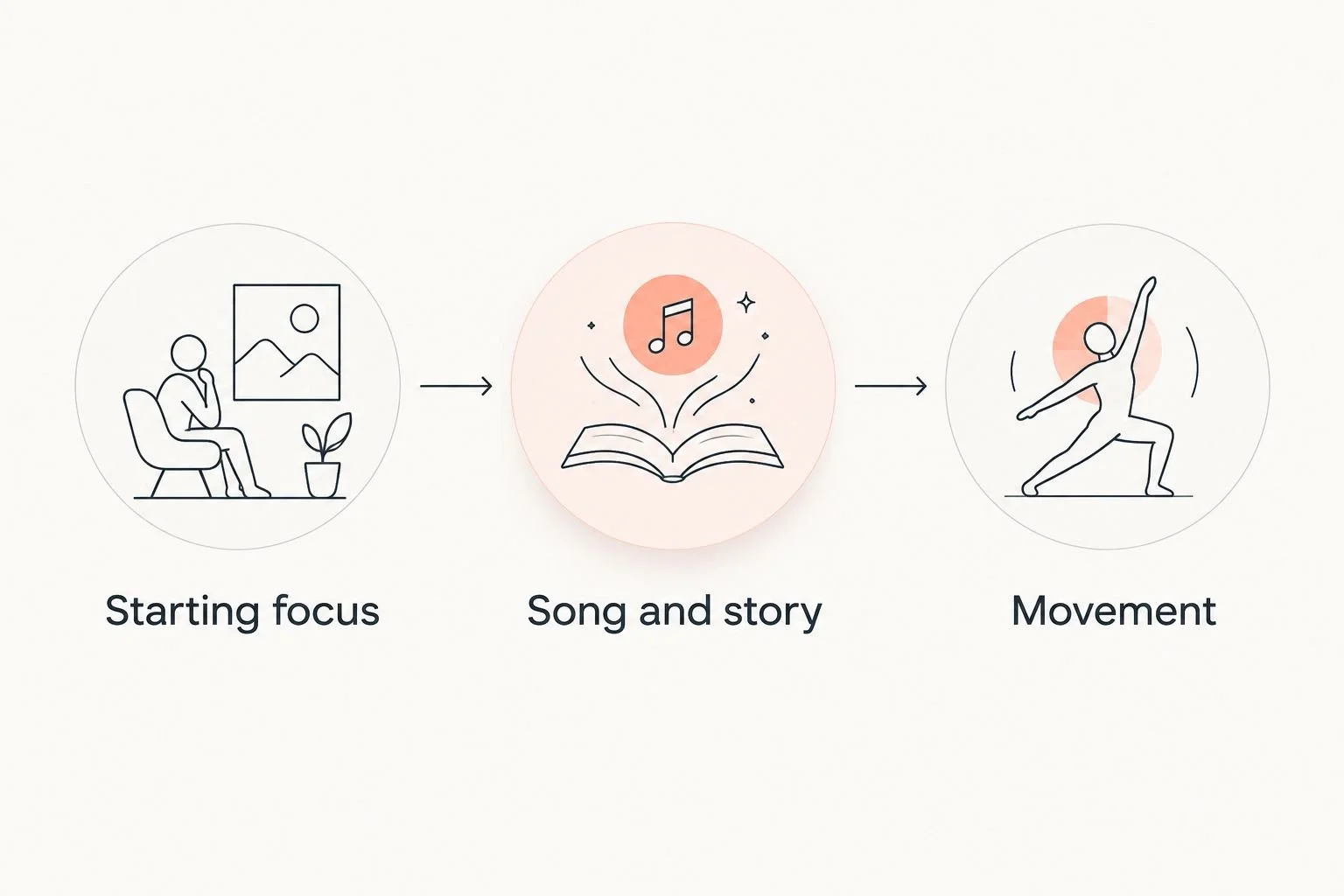
Choose a starting focus before combining singing, storytelling and movement.
Creative movement can be a useful discussion point for a younger child beginning to explore rhythm and space. Jazz, ballet or tap deserves consideration when its particular technique matches the student’s learning needs. Ask about placement rather than treating a dance style’s name as proof of suitability.
Sound technique matters more than looking stage-ready immediately. Keep the focus on understanding instructions and coordinating the assigned task, not on adding tricks or copying advanced choreography.
Your family-calendar plan
Map the full commitment. Include preparation, travel, the class itself and the trip home. For families across Berks, Montgomery and Chester counties, the journey belongs in the decision—not just the lesson time.
Check the actual route. Whether you travel from Douglassville, Pottstown, Phoenixville, King of Prussia, Reading or Lansdale, verify the teaching location and your route before choosing a class. These communities are family planning areas, not a statement that the center has locations in each town.
Protect a manageable starting routine. Consider starting with 1 weekly commitment if several activities already compete for time. This is a planning option, not a statement about lesson frequency or attendance requirements.
Confirm the details before registration. Ask about the appropriate class, current schedule, required materials and next registration step. Use the contact page to begin that conversation.
Expected result: Your 2026 class plan accounts for school, transport and preparation instead of depending on an unrealistically empty calendar.
Try a practical calendar check: reserve 10 minutes to walk through a proposed class day with everyone responsible for transport. Decide who handles pickup, what happens around meals and whether siblings’ activities create a conflict. The exercise reveals scheduling questions without assuming any particular journey length.
The Garden Arts Center is an option for families seeking several arts disciplines, but a broader offering still requires careful scheduling. Ask what fits before planning a multi-class routine.
Another route: start with a school production
A school production can reverse the order of planning. Instead of building toward an unspecified future performance, you begin with the actual instructions and use lessons to address relevant skills.
Bring the production materials. Share the song selection, scene instructions and any stated movement requirements with the instructor. Do not assume an audition requires a full song or a particular dance style.
Identify the immediate task. Separate learning notes from interpreting lyrics, remembering dialogue and learning choreography. Ask which task should receive attention first.
Keep preparation within the instructions. Use the requested material and format. Avoid extra choreography or vocal embellishments unless they are appropriate to the task and supported by instruction.
Reassess afterward. An audition or production can reveal a new interest, but it should not automatically trigger more classes. Ask your child what they enjoyed and discuss the next learning goal.
For a production scheduled in 2026, use that production’s current written requirements. Previous instructions or another school’s expectations do not establish what your child needs to prepare.
Troubleshooting
Your child sings comfortably until movement starts
Separate the assigned movement and music again. Ask the teachers which element should be simplified before recombining them; do not respond by demanding more volume or faster repetitions.
Your child remembers notes but cannot explain the song
Return to the words as spoken text. Ask who is listening and what the character wants, then bring any uncertainty to the instructor. Bigger gestures do not solve an unclear dramatic intention.
Practice becomes an argument
Check whether the assignment is understood and manageable. Tell the instructor exactly where the disagreement begins, and keep parent feedback to the teacher’s stated priority rather than supplying a new lesson at home.
The weekly routine repeatedly breaks down
Review travel, school demands and preparation before assuming motivation is the problem. Ask about the current options and attendance expectations directly; do not build a plan around unconfirmed makeups or schedule changes.
Singing causes pain or persistent hoarseness
Stop singing rather than practicing through discomfort. Tell the instructor and seek appropriate medical advice for persistent symptoms; an article or rehearsal adjustment cannot diagnose a voice problem.
Customize your workflow
Keep one shared note with the current song, the teacher’s practice directions and the next question to ask. Update it after lessons so home practice follows current guidance rather than an assignment your child has already moved beyond.
If singing is enjoyable but dramatic choices remain unclear, discuss acting. If the story is clear but coordinated movement is difficult, discuss dance. Add instruction to address an identified need, not to collect class names.
Bring that short plan to The Garden Arts Center and ask which next step fits your child’s experience. For your 2026 pathway, professional guidance and a sustainable routine matter more than completing every discipline at once.
FAQ
What is a vocal lessons to musical theater pathway?
A vocal lessons to musical theater pathway connects singing instruction with acting and movement as a student’s needs develop. Start with a suitable learning goal, then ask instructors when and how to combine disciplines.
Should my child take singing lessons before musical theater?
Singing lessons are a useful starting point when singing is your child’s main interest or the skill needing attention. A child whose immediate challenge is scene work or movement needs a placement conversation rather than an automatic singing-first rule.
Does my child need ballet before trying musical theater?
Ballet is not a universal prerequisite for beginning musical theater. Ask which movement foundation matches your child’s age, experience and the requirements of the class or production.
How much should my child practice singing at home?
Follow the vocal instructor’s practice directions rather than a generic daily target. Ask what to practice, how to recognize a useful repetition and when to stop; never ask a child to sing through pain.
What should we bring when asking about lessons?
Bring your child’s experience, interests, family scheduling constraints and any written production requirements. Ask the instructor to assess song suitability instead of assuming a favorite recording is the right practice material.
Can we begin if our family only has room for one class?
You can plan an initial focus around one class and discuss the next step later. Confirm the actual lesson structure and expectations before deciding whether that commitment fits your family.
Does The Garden Arts Center offer disciplines related to musical theater?
The Garden Arts Center offers vocal lessons, acting and dance among its arts classes. Ask directly which current options and placement recommendations match your child’s musical theater interests.
One last thing
Ask your child to explain a song’s situation without singing it. That simple conversation separates knowing the tune from understanding the story—and gives you a useful question to bring to the next lesson, not another correction to deliver at home.