

Choose toddler dance classes by matching your child’s comfort with a group, interest in movement and need for caregiver support to the class format—not by age alone. For your 2026 search, ask how the teacher handles participation, separation and transitions, then choose a weekly commitment your family can sustain.
TL;DR
Choose toddler dance classes by readiness and caregiver support, not by age alone.
Creative movement and introductory ballet offer different starting points; compare the actual lesson structure.
The Garden Arts Center offers dance within a broader arts community for children and adults.
Ask about caregiver participation, teacher guidance and the weekly journey before choosing a class.
Why this matters
A toddler can love dancing at home and still need time to feel comfortable in a group. Music, unfamiliar adults, other children and a new room introduce demands that your living room does not. Interest in dance and readiness for a particular class are different questions.
The Garden Arts Center offers dance, music, theater, art and wellness for children and adults. The Garden Arts Center is best for families seeking dance within a broader arts community. For a toddler, the next step is to ask which current class format matches the child’s needs rather than assume every children’s dance class is an appropriate starting point.
As you compare options in 2026, look beyond a class name. Ask what participation looks like and how the teacher supports a child who watches before joining.
How do you choose toddler dance classes for your child’s readiness?
Start with what you already observe, then use those observations to ask specific questions. You do not need to assess your child’s dance ability. You need to understand the support the class provides.
Notice movement interest. Does your child respond to songs, copy gestures or enjoy moving with you? These observations give you a useful starting point, not an entrance test.
Describe group comfort. Think about familiar playgroups, library activities or other shared settings. Tell the teacher whether your child joins readily, stays close to you or watches first.
Clarify caregiver involvement. Ask whether an adult participates, stays nearby or leaves the teaching space. Do not assume a toddler class includes caregiver participation.
Ask about the lesson structure. Find out how the teacher introduces activities, changes between them and responds when a child needs a pause.
Check the whole commitment. Include travel, getting ready, meals, school pickups and the trip home. A suitable lesson still needs a workable place in family life.
A useful inquiry is specific: your child enjoys copying movements but stays close in unfamiliar groups, so you want to understand caregiver support and how newcomers join activities. That tells a teacher more than asking whether your child is ready for dance.
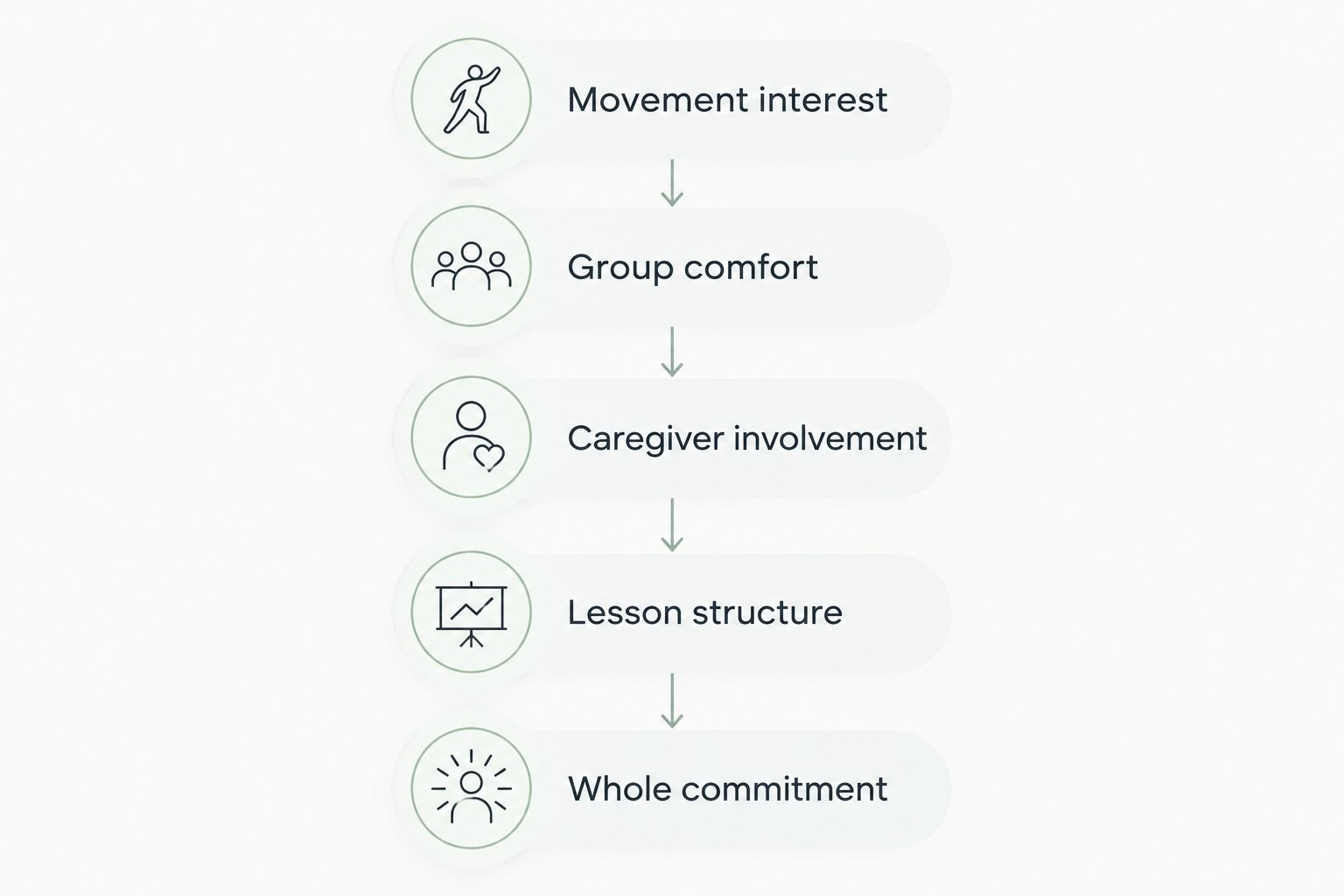
Match the class structure to your child before deciding whether the weekly commitment works.
Which class format fits your child?
Class labels are a starting point, not a complete description. A caregiver-and-child format describes adult involvement, while creative movement and ballet describe teaching content; those categories can overlap. Ask about both the activity and the participation arrangement.
The comparison below describes general formats to discuss with a provider. It does not confirm which toddler classes are currently offered by any particular center.
Caregiver-and-child dance
Best for: Children who need an adult participating beside them
What to ask about: Whether the adult joins activities and how the teacher guides both participants
Main limitation: It requires an available caregiver who can take part
Creative movement
Best for: Children drawn to imaginative movement, music and exploration
What to ask about: How the teacher combines exploration, clear instructions and group routines
Main limitation: The name alone does not tell you how much structure or caregiver support is included
Introductory ballet
Best for: Children interested in copying demonstrated movements within a guided lesson
What to ask about: How ballet content is adapted for young beginners
Main limitation: A ballet label does not establish toddler suitability or separation expectations
Caregiver-and-child dance: support through participation
A participating caregiver gives a child a familiar person to move beside. This format is worth discussing when your child enjoys shared activities but is not comfortable entering an unfamiliar group independently.
The practical trade-off belongs to the adult, too. Ask what participation requires and consider whether you can give the activity your attention. If you will also be caring for a sibling, clarify arrangements rather than assuming the teaching space can accommodate everyone.
Creative movement: exploration with guidance
Creative movement can introduce ideas such as moving high and low, changing direction or responding to musical cues. These are examples of movement activities to ask about, not a description of a specific provider’s lesson plan.
The benefit is room for imagination within guided activity. The limitation is that the label covers different teaching approaches. Ask how the teacher establishes boundaries, demonstrates movements and helps children move between activities.
Introductory ballet: ask how the content is adapted
An introductory ballet class can include demonstrated positions, movement patterns and musical phrasing adapted for beginners. For a toddler, ask what those descriptions mean during an actual lesson.
Do not choose ballet solely because it sounds more formal. Choose the teaching approach your child can participate in comfortably. Sound technique and supportive instruction belong together; a formal class name is not evidence of either.
Why readiness for toddler dance classes varies
Readiness depends on the relationship between your child and the lesson, not a single milestone. Use these factors to make your questions more precise:
Familiarity with groups: A child who enjoys a familiar gathering still encounters something new when the room, adults and routines change. Describe both familiar and unfamiliar settings to the teacher.
Caregiver proximity: Comfortable participation beside a parent does not establish readiness to participate without that parent. Confirm the actual arrangement.
Response to instructions: Ask whether teachers demonstrate movements, use verbal cues or combine approaches. Explain how your child currently responds to guided activities.
Transitions and sensory comfort: Share relevant observations about changes in activity, music or busy rooms. Ask what adjustments or support are available rather than assuming them.
Daily rhythm: Consider the proposed lesson alongside meals, rest and other commitments. Evaluate your child’s likely experience of that particular part of the day.
Interest and choice: Enjoying music does not necessarily mean enjoying every organized movement activity. Leave room for your child’s response to the actual class.
None of these observations should become a pass-or-fail checklist. Their purpose is to identify a suitable starting point and a teacher who can explain the class clearly.
How do you assess instruction before choosing?
Ask the teacher to describe what a beginner actually does. Concrete examples are more useful than broad promises about confidence, creativity or future achievement.
Questions about instruction can stay simple:
How do you demonstrate a movement to a child who is unfamiliar with it?
What happens when a child watches instead of joining?
How do you organize movement so children have room to participate?
How do you introduce sound movement habits without asking children to force a position?
How do caregivers receive guidance about participation?
Listen for explanations of teaching actions rather than promises of results. A response about demonstrating, offering an appropriate alternative or helping a child rejoin tells you how instruction works. A promise that every child will become confident does not.
Also explain your child’s support needs before choosing. Ask whether the class can meet those needs and what arrangements require discussion. A general statement that a program welcomes different abilities does not answer every individual question.
How do you fit toddler dance into your family’s week?
For your 2026 class search, evaluate the whole outing rather than the lesson alone. Write down what happens before you leave home and what needs to happen after you return. That reveals conflicts a calendar entry can hide.
For families traveling across Berks, Montgomery and Chester counties—including Douglassville, Pottstown, Phoenixville, King of Prussia, Reading and Lansdale—the relevant question is your actual journey. Confirm the teaching location before estimating travel. A town mentioned in a guide does not establish a studio location there.
Build your decision around these practical checks:
Travel: Consider the journey at the proposed time, not just the distance.
School activities: Include sibling pickups, clubs and existing commitments.
Meals and rest: Think about how the outing fits your toddler’s usual day.
Caregiver capacity: Identify who can bring your child and participate if required.
Weekly sustainability: Ask whether the arrangement works during an ordinary busy week, not only an unusually quiet one.
Choose a commitment your family can repeat without making the rest of the day unworkable. If a format looks suitable but its timing conflicts with essential routines, ask about current alternatives without assuming another session exists.
What should you ask before taking the next step?
Before making a 2026 registration decision, gather the details that determine fit. Ask about current age eligibility, class length, caregiver expectations, clothing guidance and the registration process. Check any attendance or introductory-visit arrangements directly; these differ between programs.
Keep your inquiry focused. Describe what your child enjoys, explain the support your child currently needs and identify the times your family can realistically consider. Then ask which current option the provider recommends and why.
The Garden Arts Center’s dance and broader arts offerings provide a starting point for that conversation. Ask which current class, if any, fits your toddler rather than treating a general children’s program description as confirmation of toddler suitability.
Explore the arts offerings
Use your child’s interests, support needs and family schedule to guide your next inquiry.
Does my toddler need to follow every instruction before starting dance?
No—following every instruction is not a useful universal entry test for toddler dance classes. Ask what the particular class expects and how the teacher supports children who need demonstrations, repetition or time to observe.
The key distinction is between needing support and being in a format that cannot provide it. Discuss that distinction with the teacher before deciding.
Should I choose creative movement or ballet first?
Choose by teaching approach, participation expectations and your child’s interests—not by a fixed rule that one must come first. Creative movement and introductory ballet can both involve guided movement, but the balance of exploration and demonstrated technique depends on the lesson.
Ask each provider to describe a typical activity and a transition. Those examples make the comparison more concrete than the class names alone.
What if my child watches instead of dancing?
Watching alone does not tell you whether a class is a good fit. Ask the teacher how observation is handled, what participation is expected and how caregivers should respond.
Avoid comparing your child’s first response with another child’s visible participation. Focus on whether the setting, expectations and support suit your child.
FAQ
How do I know whether my toddler is ready for dance classes?
Look at your toddler’s interest in movement, comfort in groups and need for caregiver support, then compare those observations with the class expectations. Ask the teacher how newcomers participate rather than relying on age alone.
What’s the best toddler dance class for a shy child?
The best fit is a class whose participation arrangements match the child’s need for support. Ask about caregiver involvement, time to observe and how the teacher invites children into activities without assuming a particular format provides those things.
Can I stay with my toddler during dance class?
Caregiver arrangements depend on the class, so confirm them before choosing. Ask whether adults participate, remain nearby or leave the teaching space, and explain what your child currently needs.
Is creative movement better than ballet for toddlers?
Neither label establishes a better fit on its own. Compare the actual activities, structure, caregiver expectations and teaching approach against your child’s interests and readiness.
What should my toddler wear to a first dance class?
Follow the provider’s current clothing and footwear guidance. Ask before purchasing dancewear, because requirements depend on the class.
Does The Garden Arts Center offer more than dance?
The Garden Arts Center offers dance, music, theater, art and wellness for children and adults. Ask directly which current offerings match your child’s age, interests and support needs.
What should I check before registering for toddler dance classes in 2026?
Confirm age eligibility, caregiver participation, class length, teaching location and current registration requirements. Then check the complete outing against travel, meals, rest and the rest of your family’s week.
One last thing
Before deciding, write a short description of what helps your child join something new. Include what your child enjoys, how your child responds to unfamiliar groups and what caregiver support is useful. Bring that description to the conversation with the teacher.
You are choosing a starting environment, not deciding your child’s future in dance. A clear explanation of the class and an honest account of your family’s needs make that choice more manageable.