

Ballet dance classes teach beginners through teacher demonstrations, simple exercises, individual corrections, and repeated practice, progressing from posture and supported movements toward independent dancing. Beginners learn how to bend, stretch, balance, and move to music before combining those skills into longer sequences. For children, the teaching approach should match their developmental readiness rather than rush toward advanced steps or pointe work.
TL;DR
Ballet dance classes build beginner technique through posture, controlled movement, repetition, and teacher feedback.
Choose kids dance instruction that matches your child's readiness, not a promise of rapid advancement.
The Garden Arts Center suits families seeking ballet within a broader arts community.
Creative movement emphasizes exploration; beginner ballet adds more specific positions, vocabulary, and technical corrections.
Why this matters
A beginner's progress is not measured by how high a leg lifts or how quickly a child memorizes French terms. Look for understanding: can your child follow a correction, move without forcing a position, and recognize the rhythm of an exercise?
For families considering The Garden Arts Center in 2026, the useful starting point is the child's readiness and your weekly routine. A class needs room in both: enough attention for instruction and enough breathing space around school, travel, meals, and rest.
How do ballet dance classes teach technique to beginners?
Beginner ballet instruction breaks a complex movement into manageable parts. A teacher demonstrates the action, explains its purpose, watches students try it, and gives a correction they can apply on the next attempt. Repetition gives that correction somewhere to go.
The sequence below describes common teaching methods, not a fixed lesson plan or a promise about any particular class.
Establish posture. Students practice standing tall without stiffening their shoulders or locking their knees.
Introduce basic actions. Teachers demonstrate movements such as plié, a bend of the knees, and tendu, a stretch of the working foot along the floor.
Use support where appropriate. Barre exercises help students practice while holding a stable support; younger children's lessons can use other age-appropriate formats.
Remove support gradually. Center work asks students to organize their bodies without holding the barre.
Connect movement and music. Students link familiar actions into short phrases, practicing timing, direction, and coordination.
Good beginner instruction makes the movement understandable before making the combination complicated. A child who needs another demonstration needs teaching, not pressure to keep up silently.
What does each part of class contribute?
Demonstration
What beginners practice: Watching the direction, shape, and timing of a movement
Benefit: Gives students a visible example
Limitation to watch for: Watching alone does not show whether a student understands
Supported practice
What beginners practice: Bending, stretching, and balancing with a stable handhold
Benefit: Lets students focus on particular actions
Limitation to watch for: Gripping or leaning on support changes the task
Center practice
What beginners practice: Standing and moving without a handhold
Benefit: Connects alignment with independent balance
Limitation to watch for: Combinations need to remain manageable
Traveling steps
What beginners practice: Moving through space with direction and rhythm
Benefit: Adds coordination and spatial awareness
Limitation to watch for: Speed should not replace clear execution
Corrections and repetition
What beginners practice: Applying a specific adjustment on another attempt
Benefit: Turns feedback into practice
Limitation to watch for: Too many instructions at once make the priority unclear
Posture and turnout come before bigger movements
Posture in ballet is active, not rigid. Beginners learn to organize the head, shoulders, trunk, pelvis, knees, and feet so they can move from a stable starting position. Teachers return to these relationships throughout class rather than explain them once and consider them finished.
Ballet uses 5 basic foot positions, but recognizing their names is different from performing them with control. A beginner does not need to force every position into an idealized shape. Teachers select and adapt exercises to the student's stage of learning.
Turnout means outward rotation of the legs from the hip joints. It is not simply pointing the toes sideways. Forcing the feet farther outward than the legs can support creates a mismatch between the feet and knees.
For parents, the practical question is simple: does the teacher help children work within their current movement range? Avoid treating a wider foot position as evidence of better instruction. Sound technique starts with a position the student can control.
Basic exercises teach more than their names suggest
A plié teaches a beginner to bend and straighten the knees while maintaining organization through the body. The teacher watches how the knees track with the feet and whether the student can keep the action controlled. The goal is not merely to bend lower.
A tendu teaches the working foot to extend along the floor and return with attention to the pathway. Students practice the relationship between a moving leg and a supporting leg. A small movement gives the teacher a clear opportunity to see what needs attention.
A relevé introduces rising onto the balls of the feet and lowering with control. Beginners learn that coming down matters as much as going up. Balance, foot placement, and coordination all remain part of the exercise.
A basic sauté introduces a jump and its landing. In a simple version, students leave the floor from 2 feet and return to 2 feet, using plié as part of takeoff and landing. Jump height is not the first priority; the preparation and return need attention too.
These exercises are useful because they isolate actions that return in more complex dancing. Their limitation is equally clear: repeating a familiar exercise without useful feedback does not tell a student what to improve.
How supported practice becomes independent dancing
The barre is a practice aid, not the purpose of ballet. With a handhold, students can concentrate on a particular movement; away from it, they must manage balance and coordination without that support. A teacher adjusts the difficulty rather than assuming the same exercise transfers unchanged.
A balance on 1 foot, for example, asks the student to organize the supporting side while placing the other leg. Adding arm movements changes the coordination demand. Adding a direction change introduces another task, so each addition needs a clear teaching purpose.
The progression is straightforward:
Supported practice: learn the action with a stable handhold when appropriate.
Center practice: repeat manageable movements without holding support.
Traveling steps: carry familiar skills through space.
Movement phrases: connect actions while maintaining timing and control.
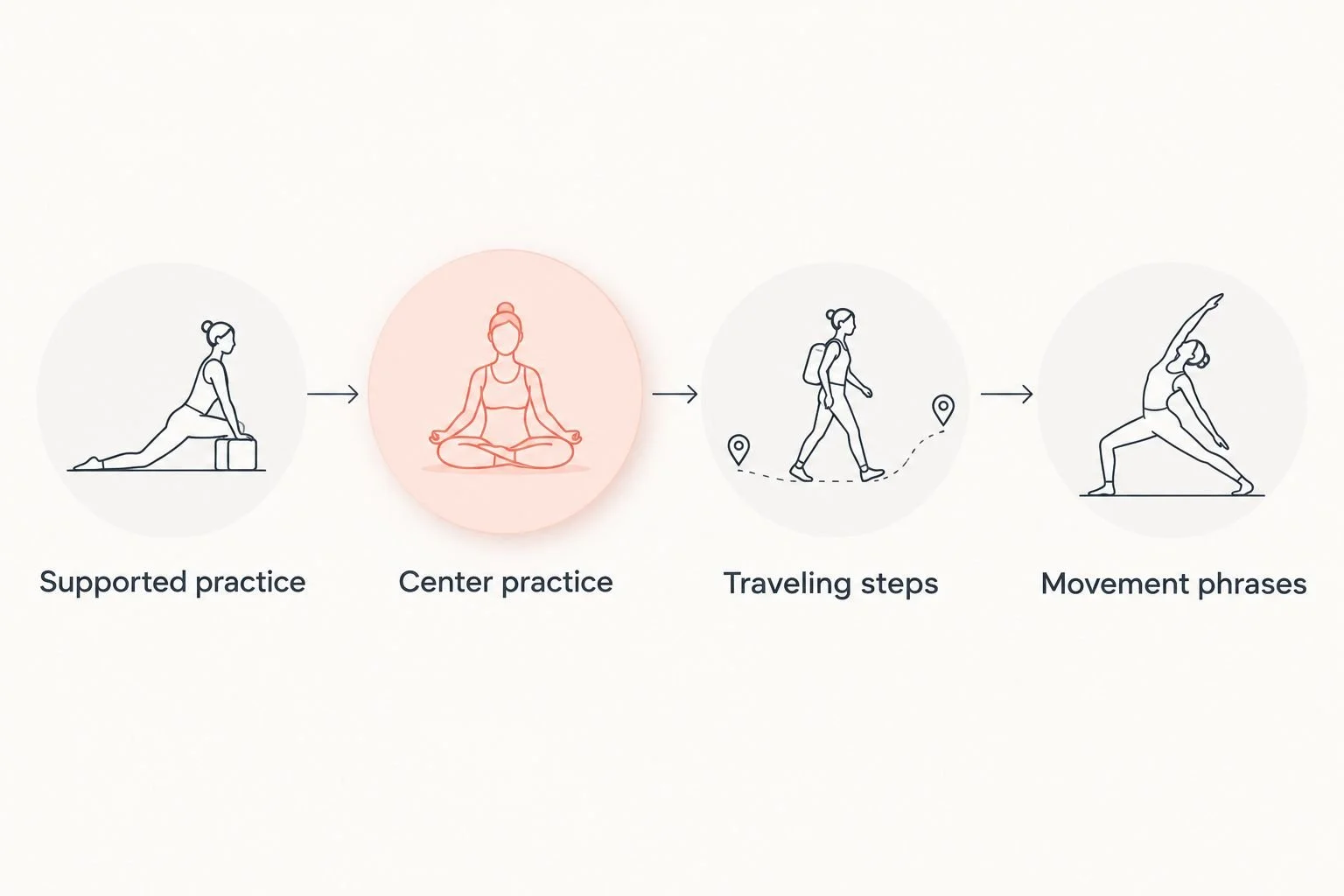
Each stage adds a task without replacing the need for clear basic technique.
This progression is not a race or a universal timetable. A student can practice traveling steps while still needing reminders about posture. Learning includes returning to an earlier task with better understanding.
Why beginner ballet instruction varies
The right teaching approach depends on the learner, not just the class title. When comparing beginner options for 2026, ask how instruction responds to these factors:
Developmental readiness: young children need explanations and activities they can understand and follow.
Previous experience: a first-time dancer and a student returning after a break bring different familiarity with class routines.
Attention and coordination: following a demonstration, remembering a sequence, and coordinating limbs are separate learning tasks.
Current movement range: teachers need to work with the student's available rotation, balance, and control rather than force a shape.
Class emphasis: creative exploration and formal technical practice organize a lesson differently.
Learning needs: a student might understand an action through a demonstration, a spoken cue, or another carefully explained attempt.
Variation is not a reason to accept vague teaching. Ask what students are learning and how the teacher decides when to add difficulty. The answer should describe skills, not promise a fixed speed of advancement.
How can parents recognize useful corrections?
Useful feedback names an action the child can attempt. A teacher might ask a student to soften the shoulders, keep a knee aligned with the toes, or lower from a rise with more control. Each instruction points toward something observable.
Praise has a place, but it should not be the only feedback. A welcoming environment and specific correction belong together: children need permission to make mistakes and guidance about what to change.
After class, ask your child what they practiced rather than whether they were the best. Questions such as which movement felt clearer or what the teacher helped them notice keep the conversation on learning. Avoid turning home into a second technical lesson with corrections you have not been trained to give.
Should my child start with ballet or creative movement?
Choose according to readiness and the kind of instruction your child can engage with. Creative movement generally emphasizes exploration through movement, rhythm, imagination, and space. Beginner ballet introduces more specific positions, vocabulary, and technical expectations, although younger children's ballet teaching can also use imaginative activities.
Creative movement
Best for: Children starting with exploration and movement-based play
What it emphasizes: Rhythm, space, expression, and following movement prompts
Trade-off: Less emphasis on formal ballet vocabulary and positions
Beginner ballet
Best for: Students ready to practice specific actions and respond to corrections
What it emphasizes: Posture, basic steps, coordination, and musical timing
Trade-off: Repetition and detailed instruction require sustained attention
Neither title guarantees a match. Ask about the lesson's expectations and how the teacher supports a child who is new to group instruction. Choose the starting point that invites participation without skipping foundations.
Does a beginner need pointe shoes?
No—beginner ballet does not require pointe shoes. Pointe work is a separate stage that requires a teacher's assessment of readiness, including technique, strength, alignment, and control. Enthusiasm or a birthday alone does not establish readiness.
For a first class, request the actual clothing and footwear instructions before purchasing anything. Ballet footwear and pointe shoes serve different purposes; do not substitute one for the other or introduce pointe practice at home.
How do you fit ballet into a family schedule?
For your 2026 class search, evaluate the full weekly commitment rather than only the time spent dancing. Getting out the door, traveling, changing clothes, eating, and returning home all affect whether the routine works.
Families across Berks, Montgomery, and Chester counties can use the same planning approach. Whether you travel from Douglassville, Pottstown, Phoenixville, King of Prussia, Reading, or Lansdale, check the actual destination and route before choosing a class. A town mentioned in a search result does not establish where a provider holds lessons.
Before taking the next registration step, confirm:
The class's intended age or experience level.
The current teaching location and meeting schedule.
How travel fits around school dismissal and other activities.
Clothing and footwear requirements.
The registration process and any relevant participation policies.
The Garden Arts Center is best for families seeking ballet within a broader arts community. Its offerings include dance, theater, music, art, and wellness. That breadth gives families several artistic interests to consider, but it does not replace checking the details of a particular ballet class.
Explore your family's next class
Consider your child's interests, then confirm class placement, schedule, and registration details.
FAQ
What do beginners learn first in ballet dance classes?
Beginners learn posture, basic movement patterns, coordination, and how to follow musical timing. Teachers introduce actions such as plié and tendu through demonstrations, practice, and specific corrections.
Can my child start ballet without any dance experience?
A beginner class is intended to introduce students to ballet rather than require existing ballet technique. Confirm the particular class's placement expectations and explain any previous movement or group-class experience.
How long does it take to learn beginner ballet technique?
Beginner ballet technique develops through repeated practice, with progress depending on the student and the instruction. Ask about specific skills being taught rather than expecting every child to advance on the same timetable.
Is creative movement better than ballet for a preschool beginner?
Creative movement is the better starting point when a child needs exploratory, play-based movement rather than detailed technical instruction. Compare the actual class expectations with your child's readiness instead of choosing from the title alone.
Should a beginner practice ballet technique at home?
Home practice should follow the teacher's guidance and stay within movements the student understands. Do not force turnout, attempt pointe work, or add technical exercises from unrelated online demonstrations.
What should I ask before registering for ballet in 2026?
Before registering for ballet in 2026, confirm placement, teaching location, schedule, clothing, footwear, and registration requirements. Include travel and school commitments when deciding whether the weekly routine is sustainable.
Does The Garden Arts Center offer more than ballet?
The Garden Arts Center offers dance alongside theater, music, art, and wellness classes. Families can consider those interests while confirming the current details of the class they want to pursue.
One last thing
For your 2026 class decision, ask what a beginner is learning when an exercise looks simple. A careful bend, a controlled lowering, or a clear change of direction can reveal more about instruction than an impressive-looking pose.
Choose a setting where your child can ask questions, receive understandable corrections, and keep participating comfortably. The foundation is not a performance to rush through; it is the material students keep using as their dancing grows.