

Creative movement dance classes introduce rhythm through listening, clapping, stepping, and playful movement that connects music to the body. Children explore a steady beat, changes in speed, and simple sound patterns before those ideas become more formal dance combinations. The emphasis is on noticing and responding—not getting every movement right on the first try.
TL;DR
Creative movement dance classes introduce rhythm through listening, clapping, stepping, and imaginative movement.
A steady beat stays regular; a rhythm pattern changes how sounds and movements fit around that beat.
Choose kids dance classes that explain activities clearly and make room for beginners to participate.
The Garden Arts Center offers creative movement alongside ballet and other arts classes for families exploring dance.
Why this matters
A child who loves moving to music does not need to arrive knowing dance counts. Creative movement gives that interest a place to begin, with simple ways to connect what children hear to what they do.
The Garden Arts Center is a fit for families seeking creative movement within a broader arts community. Its offerings include dance, theater, music, art, and wellness for different ages and abilities. You can explore The Garden Arts Center as you consider which kind of instruction suits your child.
For your 2026 class search, focus on how the teacher introduces an activity, supports participation, and explains the next step. A class description should help you understand the learning experience, not leave you guessing from the class name alone.
How do creative movement dance classes introduce rhythm?
Creative movement connects sound with actions children can recognize: walking, clapping, swaying, pausing, and changing direction. These activities separate musical ideas into manageable experiences rather than asking a beginner to listen, remember choreography, and coordinate unfamiliar steps all at once.
The examples below describe ways to explore rhythm. They are not a promised lesson plan for a particular class.
Clapping a pulse
What children explore: Keeping an even beat
Best for: Hearing a pattern before traveling
Strength: Makes the beat audible
Limitation: Does not include whole-body movement
Walking to music
What children explore: Matching steps to a pulse
Best for: Connecting listening with movement
Strength: Gives each beat a physical action
Limitation: Traveling adds a coordination task
Moving and freezing
What children explore: Hearing starts, stops, and silence
Best for: Practicing a clear musical response
Strength: Makes musical changes noticeable
Limitation: Stopping alone does not teach every rhythm skill
Copying a sound pattern
What children explore: Repeating a short sequence
Best for: Listening before responding
Strength: Separates the example from the response
Limitation: Longer patterns add a memory task
Moving with an image
What children explore: Connecting sound with an imagined action
Best for: Children who enjoy pretend play
Strength: Offers more than one movement response
Limitation: Needs a clear musical cue to remain a rhythm activity
A teacher might introduce one idea through several activities. The same pulse can be clapped, stepped, or expressed through a gentle sway; the musical idea stays consistent while the movement changes.
First, children notice the steady beat
The beat is the regular pulse beneath music. A child can explore it by tapping hands on knees or taking an even step each time the pulse returns.
For a simple home example, count 4 beats evenly while tapping. The purpose is to hear regular spacing, not to test how quickly your child learns the count. Counting aloud is one way to make the pulse clear; movement can also happen without spoken numbers.
Next, children explore rhythm patterns
Beat and rhythm are related, but they are not interchangeable. The beat provides a regular reference; rhythm describes the arrangement of sounds and silences around it.
Try 2 claps followed by a pause, then repeat the same pattern. Your child can listen first and answer afterward. Keep the example recognizable rather than adding more sounds each time a response is different.
Then, children connect listening with movement choices
A rhythm activity becomes a dance experience when children use more of their bodies and space. They might step to a pulse, stretch through a sustained sound, or pause when the music stops.
The instruction matters. “Walk with the beat” gives a different task from “move however the music makes you feel.” Both have a place in creative movement, but only the first explicitly asks the child to match a pulse.
What does a rhythm activity look like from start to finish?
A clear activity gives children something to hear, something to try, and a chance to return to the idea. You do not need elaborate equipment to understand that sequence.
Listen first. Let the child hear the sound or musical phrase before adding instructions.
Find the beat. Demonstrate an even tap, clap, or step.
Try a pattern. Introduce a short sound-and-silence sequence for the child to echo.
Add movement. Transfer the idea into stepping, swaying, or another comfortable action.
Pause and repeat. Return to the same task before changing the music or movement.
This sequence illustrates a teaching approach, not a required order for every lesson. A teacher can adapt the movement while keeping the listening goal clear.
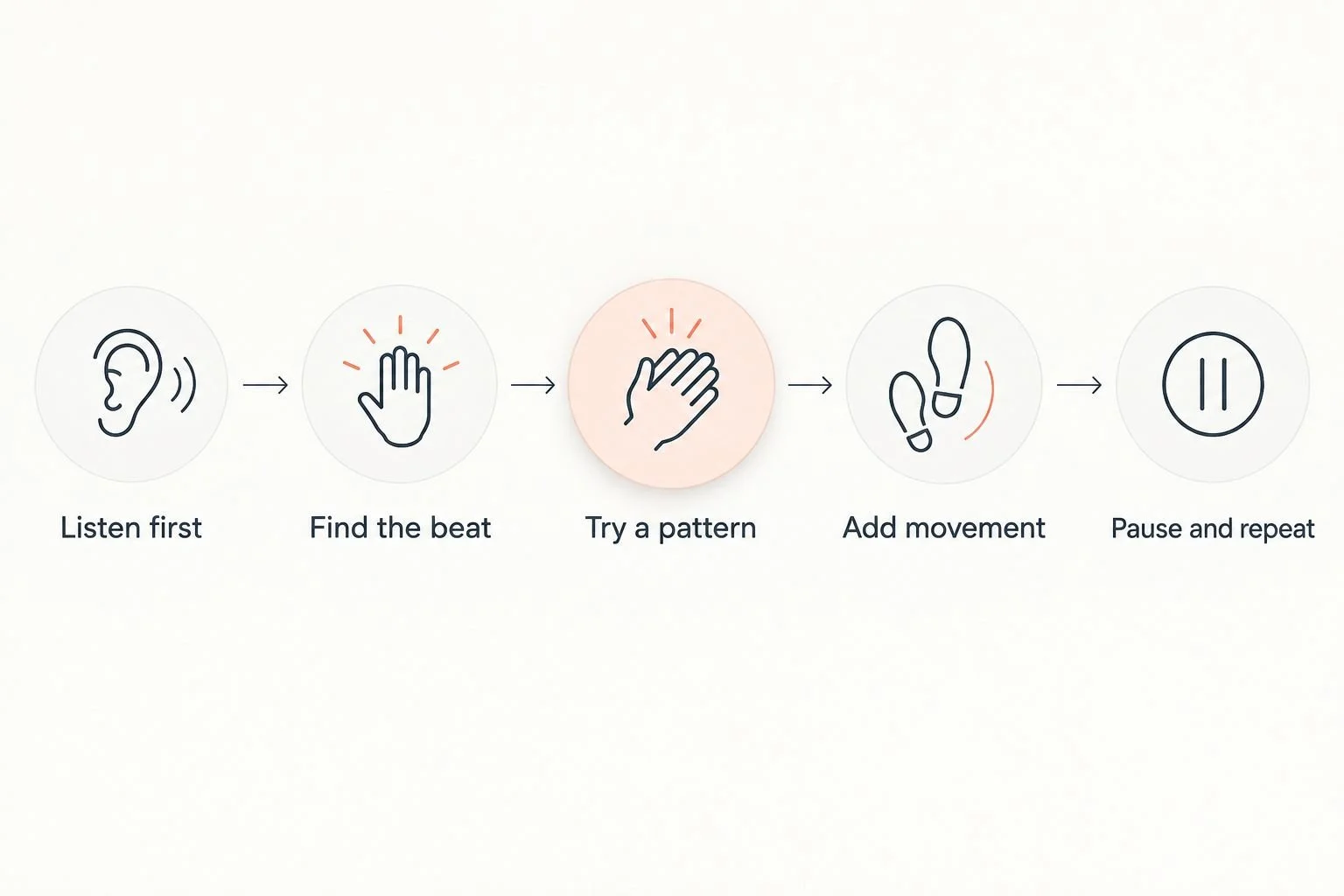
Keep the musical idea clear before adding another movement task.
For example, a teacher can demonstrate 8 beats of even stepping without requiring a child to memorize a longer dance. The count describes the example, not an age-based standard or an achievement a beginner must reach.
Look for a clear connection between the instruction and the music. An energetic activity is not automatically a rhythm lesson; children need an understandable sound or timing cue to respond to.
Why rhythm activities vary between classes
Creative movement is a broad class description. When comparing 2026 programs, ask what the teacher means by rhythm work rather than assuming every class uses the same activities.
Useful questions concern these practical differences:
Movement demands. Clapping in place and stepping across a room involve different coordination tasks. Ask how the teacher introduces traveling movement.
Musical focus. An activity can emphasize steady beat, changing speed, sound patterns, or silence. Ask which idea children are exploring.
Instruction format. A demonstration, a spoken cue, and an imaginative story give children different ways to understand a task.
Pattern complexity. Repeating a familiar sound sequence differs from remembering a new sequence while moving. Ask how instructions are broken down.
Participation support. Ask how the teacher responds when a child watches first, loses the beat, or needs an instruction demonstrated again.
None of these questions requires you to assess your child like a dance examiner. They help you understand whether the class provides an approachable starting point and a clear path through each activity.
How can you tell whether a class suits your child?
Start with your child's interests and comfort with group instruction. Enjoying music, pretend play, or movement gives you something useful to discuss with a teacher; none is proof that a particular class will be the right fit.
Ask what beginners actually do. An answer such as stepping with a pulse or copying a clapped pattern is more informative than a broad promise about confidence or musicality.
Look for instruction that welcomes beginners
Ask how unfamiliar movements are demonstrated and whether the teacher offers another way to try a task. A child who finds traveling difficult might understand a musical idea through a stationary movement first; discuss appropriate adaptations rather than assuming they are available.
Supportive instruction also leaves room for learning. Missing a cue should prompt guidance, not become evidence that your child does not belong in dance.
Separate creative exploration from formal technique
Creative movement emphasizes exploring movement and responding to ideas, sounds, and space. Ballet introduces a specific dance vocabulary and technique. The two can connect, but their class names do not describe identical experiences.
If your child is drawn to ballet, ask how a beginner class introduces posture, positions, and movement safely. If imaginative tasks are the stronger attraction, ask how creative movement combines that interest with clear listening and coordination activities.
Ask about the next step without rushing it
You do not need to choose a long-term dance pathway before the first class. Ask how the teacher discusses future class placement and what information helps families make that decision.
For 2026 registration, confirm current class descriptions, placement guidance, and requirements directly. Avoid treating another family's experience as a substitute for information about the class your child would attend.
How do you fit creative movement into the family week?
A suitable class needs a workable journey as well as an appealing description. When planning your 2026 week, account for school pickup, travel, food, changing clothes, and the trip home—not just the lesson itself.
Families across Berks, Montgomery, and Chester counties face different travel considerations. Whether you are comparing options from Douglassville, Pottstown, Phoenixville, King of Prussia, Reading, or Lansdale, check the actual teaching location and your own route. These communities describe the families considering classes, not verified center locations.
Before registration, discuss:
Which weekday leaves enough room around school and other activities.
Who handles transportation when the usual driver is unavailable.
Whether siblings have overlapping commitments.
Which attendance expectations and term dates apply to the specific class.
Choose a weekly commitment your household can sustain. An appealing class can still be a poor schedule match, and asking practical questions is part of choosing thoughtfully.
Does my child need to count music before starting?
Your child does not need to arrive counting music to begin exploring rhythm. Clapping, stepping, and responding to a clear cue let a beginner work with timing without first explaining it verbally.
Ask the teacher about the class's actual entry expectations. A class label alone does not establish prerequisites or placement rules.
Can you practice rhythm at home without dance equipment?
You can explore rhythm at home with your voice, hands, and a comfortable space. Clap a short pattern, let your child answer, and take turns choosing the next pattern.
Keep movement within the space you have. Avoid turning the activity into a speed challenge or correcting every response; the useful task is listening and trying again.
Is creative movement only useful before ballet?
Creative movement is not only preparation for ballet. Listening, making movement choices, and responding to musical cues are worthwhile parts of the activity itself.
At The Garden Arts Center, creative movement sits alongside ballet and other dance offerings. Ask about each class's purpose before deciding that one must automatically lead to another.
FAQ
How do creative movement dance classes teach rhythm to beginners?
Creative movement dance classes connect musical cues with clapping, stepping, swaying, and pauses. Beginners explore a steady beat and short patterns through understandable movement tasks rather than starting with complex choreography.
What's the difference between beat and rhythm in a dance class?
Beat is the regular musical pulse; rhythm is the arrangement of sounds and silences around it. A child can step to the beat while clapping a different rhythm pattern.
Does my child need dance experience for creative movement?
Confirm entry requirements with the teacher rather than assuming dance experience is required or unnecessary. Describe your child's experience and ask how the specific class introduces beginners to its activities.
What should I ask before choosing a creative movement class?
Ask what children do, how instructions are demonstrated, and how the teacher supports a child who needs another explanation. Also confirm placement guidance, clothing requirements, the teaching location, and attendance expectations.
Can a child who watches first still explore rhythm?
A child can listen to a musical cue before attempting the movement response. Ask how the teacher handles watching, gradual participation, and repeated demonstrations in the particular class.
How can I practice dance rhythm with my child at home?
Start with an even clap or tap, then invite your child to copy a short pattern. Take turns leading and keep the task focused on listening rather than perfect performance.
How do I choose a class that fits our family schedule in 2026?
Choose a class only after checking the lesson details, actual location, travel route, and commitments around it. Include school pickup, changing time, meals, and sibling activities in your weekly plan.
One last thing
Silence belongs in a rhythm lesson, too. A pause is part of a sound pattern, not simply an interruption between activities. When you clap with your child, leave a deliberate gap and see how it changes the pattern you are sharing.
For your 2026 class decision, ask a teacher one concrete question: how will a new student experience the beat? An understandable example tells you more than a promise of rapid progress—and gives your family something useful to picture before registration.