

Young performers’ musical theater dance training is movement instruction that connects dance technique with character and storytelling, with the aim of helping children communicate through movement onstage. When choosing musical theater dance classes in 2026, look for instruction that fits your child’s experience and interests, then check whether the weekly commitment works alongside school, travel, and family life.
TL;DR
Choose musical theater dance classes that teach movement foundations, character, and storytelling at your child’s level.
The Garden Arts Center suits families seeking dance, theater, and music in a welcoming arts community.
Compare musical theater dance, jazz dance, and acting by what your child wants to learn.
Confirm class expectations and the full weekly travel commitment before registering.
Why musical theater dance matters for young performers
Musical theater asks a performer to communicate more than steps. A change in posture, a deliberate pause, or a movement directed toward another character can help tell the audience what is happening. Dance instruction gives children a way to explore those choices while learning how to move with control.
A child who loves singing might need help moving while staying connected to a character. A confident dancer might want to make choreography feel like part of a story rather than a sequence of shapes. Those are different starting points, and a useful class conversation begins with that distinction.
The Garden Arts Center is best for families seeking dance, theater, and music within a welcoming arts community. Explore The Garden Arts Center as you identify which area your child wants to develop; confirm the specific class format and expectations before choosing.
For families planning activities in 2026, the practical question is not simply whether a child likes performing. It is whether the instruction matches the child and whether getting there fits the household’s week. A suitable class needs both educational fit and a sustainable routine.
How to choose musical theater dance classes
Identify performance interests
Start with a conversation, not a registration form. Ask your child what they enjoy when watching or taking part in a musical: learning dances, playing a character, singing, or being part of a group. An answer such as wanting to dance during a song points toward a different learning need than wanting to speak more clearly onstage.
Write down 3 questions before comparing classes: what does your child want to learn, what experience do they bring, and what support helps them participate? Keep the answers concrete. Enjoying a particular musical does not establish a dance level, and being outgoing does not mean a child already understands stage movement.
Ask your child to describe a favorite performance moment.
Separate interest in singing from interest in dance.
List previous dance, acting, or music experience accurately.
Note any participation or access needs to discuss with the instructor.
Check class foundations
Read each class description for what children actually practice. Musical theater dance commonly connects choreography with musical phrasing, performance choices, and storytelling. Jazz or ballet foundations can support movement skills, but a class title alone does not explain the curriculum or establish whether beginners belong there.
Ask how instruction introduces unfamiliar steps and how students connect movement to a scene or character. Useful examples include changing the quality of a walk to suggest a character, keeping a group entrance together, or repeating a short phrase with a different intention. These are examples to ask about, not a statement of any center’s specific lesson plan.
Choose a class whose learning goals you can describe in plain language. A show title or performance theme is not enough information on its own.
Ask which movement foundations the class teaches.
Confirm whether previous dance experience is expected.
Ask how character and storytelling enter the instruction.
Distinguish regular class learning from audition preparation.
Confirm instructional fit
Contact the provider with your child’s interests and experience before deciding. Ask how the instructor explains movement, adapts a task, and gives corrections. Sound technique and supportive instruction belong together; children need clear guidance without being expected to know vocabulary they have not learned.
For families considering musical theater dance classes, The Garden Arts Center offers related areas of study in dance, theater, and music. Ask which class best matches your child’s goal and whether the relevant instruction is combined or separate. Do not assume that a broad arts offering means every subject is included in a single class.
For your 2026 shortlist, prioritize an understandable explanation of class content over broad promises about confidence or future performance success.
Describe your child’s experience without assigning an advanced level yourself.
Ask how beginners receive explanations and corrections.
Discuss accommodations or participation needs directly.
Confirm whether singing, acting, and dancing are taught together.
Ask what preparation, if any, is expected outside class.
Plan weekly travel
Map the commitment yourself before adding it to the family calendar. Include the trip from the actual starting point: school, home, a caregiver’s workplace, or another activity. The route that looks convenient from home might not be the route your family uses on class day.
Families across Berks, Montgomery, and Chester counties have different travel considerations. Whether you are starting in Douglassville, Pottstown, Phoenixville, King of Prussia, Reading, or Lansdale, confirm the teaching address rather than assuming a provider has a location in your town.
Compare 2 travel routes if your school-day and home-day starting points differ. Then test whether 1 weekly commitment fits before adding another performing arts activity. These are planning choices, not attendance requirements.
Include school dismissal and pickup responsibilities in your plan.
Check travel at the time you would actually leave.
Allow room for meals, homework, and changing clothes.
Account for siblings’ activities and caregiver availability.
Ask about current attendance expectations before registering.
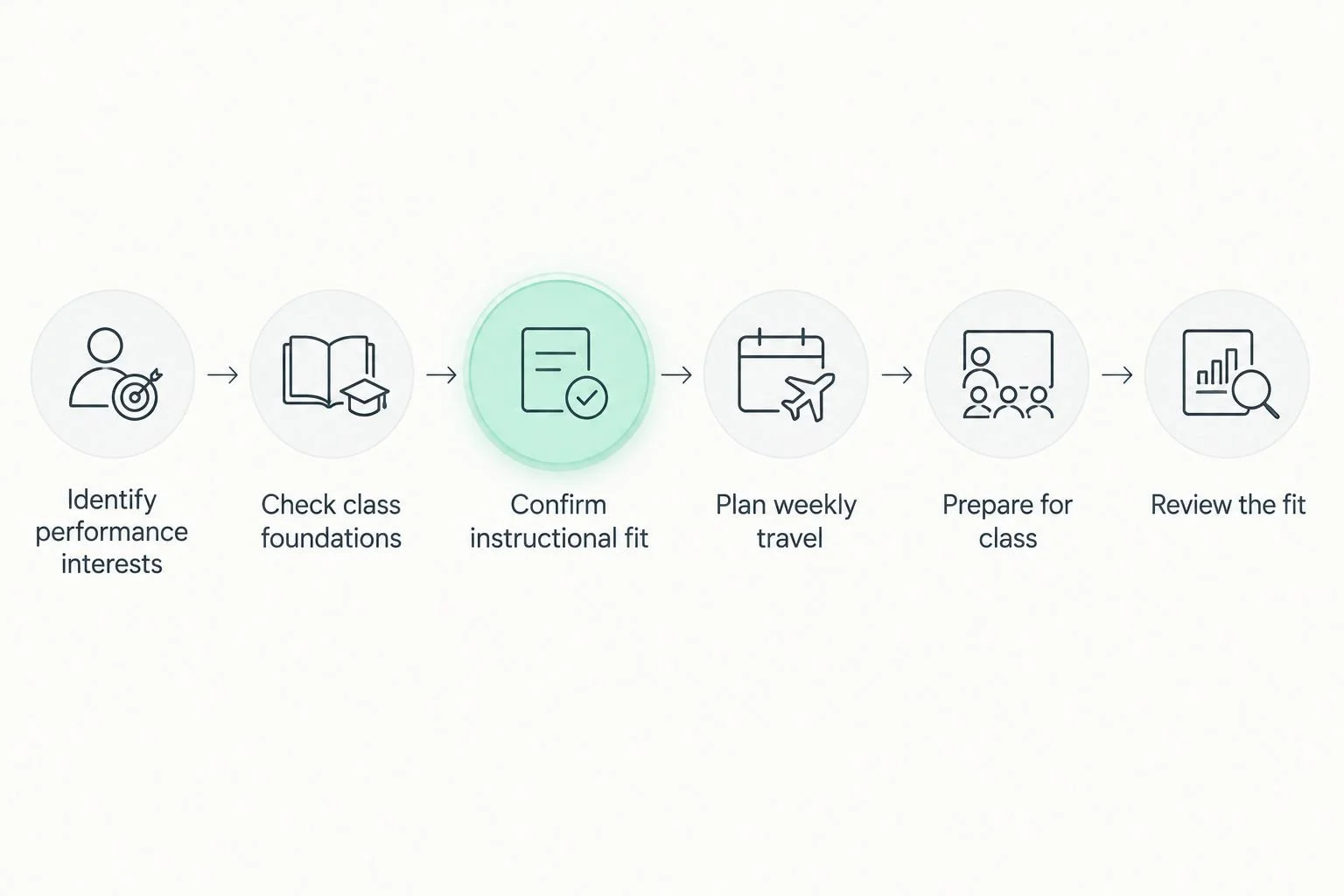
Match the instruction to your child before fitting the class into the family calendar.
Prepare for class
Use the provider’s instructions to prepare rather than purchasing clothing or shoes based on another studio’s requirements. Dance footwear, movement clothing, and items brought into the room depend on the class. Ask what is needed and wait for a clear answer before making assumptions.
Explain the learning process to your child in ordinary terms: the instructor demonstrates, students try, and everyone keeps practicing. Your child does not need a polished performance ready for a class unless the provider specifically requires preparation. Confirm any such expectations directly.
If your child is nervous, identify the unfamiliar part. Entering a new room, remembering steps, and participating with other children are separate concerns; naming the concern makes the conversation with the instructor more useful.
Request the current clothing and footwear instructions.
Ask whether anything must be prepared beforehand.
Explain how students listen, try movements, and ask questions.
Share relevant concerns with the instructor before class.
Review the fit
After your child has participated, ask about the experience rather than demanding a performance demonstration. Questions about something they practiced, something they enjoyed, and something they found difficult give you more useful information than asking whether they were the best dancer.
Review the family routine too. A child can enjoy the teaching while the journey makes the day difficult. For your 2026 activity plan, consider the class experience and the household commitment together rather than treating travel as an afterthought.
Judge fit by the learning experience, clear communication, and a workable routine—not by instant polish. If a concern appears, discuss that concern directly with the instructor before deciding what needs to change.
Ask your child to name something they learned or practiced.
Distinguish unfamiliar work from an unclear expectation.
Discuss instructional questions with the teacher.
Reassess travel, meals, homework, and sibling commitments.
Revisit the original reason your child wanted to participate.
Compare options for your young performer
The right option depends on the skill your child wants to develop. These are learning pathways to compare, not a claim that every provider offers every format. Class descriptions and a direct conversation should establish what is included.
Musical theater dance
Best for: Children who want to connect movement with a character or story
Main benefit: Brings choreography and performance choices together
Key limitation: Singing and acting instruction are not automatically included
Jazz dance
Best for: Children interested in dance technique, rhythm, and choreography
Main benefit: Focuses attention on movement vocabulary and execution
Key limitation: A jazz class does not necessarily teach scenes or character development
Ballet
Best for: Children interested in ballet technique and structured movement study
Main benefit: Develops ballet-specific placement, coordination, and vocabulary
Key limitation: Does not replace musical theater storytelling or vocal instruction
Creative movement
Best for: Children exploring movement through imaginative activities
Main benefit: Provides a way to explore movement without centering a show routine
Key limitation: Does not substitute for a class’s stated technical prerequisites
Acting or singing lessons
Best for: Children whose main interest is character work or vocal study
Main benefit: Directs instruction toward the child’s primary performance interest
Key limitation: Does not replace dance instruction
For 2026, choose by the stated learning goal rather than assuming one class covers every part of musical theater. Musical theater dance is the strongest match when movement-based storytelling is the goal; singing or acting instruction is the better starting point when that is the child’s main interest.
A related arts setting gives families several subjects to consider, but separate subjects can also mean separate commitments. Ask The Garden Arts Center which learning pathway matches your child’s interests before planning multiple activities.
Explore your child’s arts interests
Review the center’s arts offerings, then ask which class matches your child’s experience and family routine.
Common mistakes families make
Treating musical theater dance as a singing class
A musical theater label does not establish how much vocal instruction a dance class includes. Ask what happens during class and which skills receive direct teaching. If singing is your child’s main interest, compare the actual vocal instruction rather than assuming it comes with choreography.
Choosing by enthusiasm instead of entry expectations
Loving stage performances is a reason to explore, not proof of readiness for a particular level. Share your child’s actual experience and ask about prerequisites. Avoid treating a familiar song or show as evidence that the movement will be familiar too.
Filling the calendar before checking the journey
A class can fit an empty calendar square while conflicting with pickup, dinner, homework, or another child’s activity. Plan the whole journey and preparation time. An activity becomes a family commitment well before the child enters the teaching room.
Measuring progress only by remembered choreography
Remembering a routine is only part of dance learning. Listening to musical cues, understanding a correction, and making a deliberate character choice also matter. Ask the instructor what the class is working on so your expectations match the teaching rather than an imagined end product.
FAQ
What are musical theater dance classes for kids?
Musical theater dance classes teach children to connect movement with character, music, and storytelling. The balance of dance technique and performance work varies by class, so ask what the curriculum includes.
Does my child need dance experience before starting?
Your child needs the experience required by the specific class, not a universal background in dance. Describe any previous instruction and ask whether the class welcomes beginners or expects particular movement skills.
Will musical theater dance classes include singing lessons?
Singing lessons are not automatically included in musical theater dance classes. Ask whether the class teaches vocals directly or whether singing instruction is offered separately.
Is musical theater dance better than jazz for my child?
Musical theater dance fits a goal of movement-based storytelling, while jazz fits a goal of studying jazz technique and choreography. Compare the actual class descriptions because the subjects can overlap without having identical learning goals.
How do I fit a dance class around school and other activities?
Plan the full commitment, including pickup, travel, meals, homework, and changing clothes. Confirm the teaching address and current class expectations before deciding whether the weekly routine works for your family.
What should my child wear to musical theater dance class?
Your child should follow the provider’s current clothing and footwear instructions. Ask before buying dance shoes or other items, because requirements depend on the class.
What should I ask The Garden Arts Center before registering?
Ask The Garden Arts Center which class matches your child’s interests, experience, and participation needs. Confirm the content, teaching address, preparation requirements, and weekly commitment rather than assuming dance, acting, and singing are combined.
One last thing
Before choosing a class, ask your child what they want to understand—not just what they want to perform. Wanting to tell a story with movement, learn a dance phrase, or explore a character gives you a clearer starting point than wanting to be onstage.
For your 2026 decision, bring that answer to the class conversation alongside your real family calendar. The next step is a clear match between the child, the instruction, and the week you can sustain.