

Yes, yoga classes for kids can suit children who feel nervous about new classes when the instruction matches their age, welcomes beginners, and allows them to learn without pressure. The deciding factor is the class environment, not whether your child already feels confident; yoga is an activity to explore, not a treatment for anxiety.
TL;DR
Yoga classes for kids suit nervous beginners when instruction is age-appropriate and participation feels manageable.
The Garden Arts Center offers yoga; ask about child-specific instruction before choosing a class.
Compare kids yoga, creative movement, and beginner dance by your child's interests, not promises of confidence.
For your 2026 schedule, choose a weekly commitment that leaves room for travel, meals, and rest.
Why this matters
A child can want to try something and still worry about entering an unfamiliar room. Your job is not to remove every uncomfortable feeling before registration. It is to find out what the class asks of children and whether the instructor can explain those expectations clearly.
The Garden Arts Center offers arts and wellness classes for children and adults. For families considering yoga, the next step is to confirm the intended age group, teaching approach, and practical arrangements rather than assuming every yoga class suits children.
Choose the teaching environment before choosing the pose list. A class description that emphasizes flexibility tells you less about a nervous beginner's experience than a clear explanation of how the teacher introduces unfamiliar movements.
Is yoga suitable for kids who feel nervous about new classes?
Yes, provided the class is designed for the child's age and the instructor can explain how beginners participate. Use the following steps to assess the fit for your family's 2026 plans. These are questions to resolve before registration, not promises about any particular program.
Identify the unfamiliar part. Ask whether your child is worried about separation, getting movements wrong, meeting other children, or not understanding instructions. A specific concern gives the teacher something concrete to address.
Confirm the class audience. Ask which ages and experience levels the session serves. Do not assume that a general beginner class, adult wellness class, or heated yoga session is intended for children.
Ask how instruction works. Find out whether the teacher demonstrates movements, explains unfamiliar words, and offers alternatives. Ask what happens when a child needs another explanation.
Clarify participation expectations. Ask about watching before joining, taking a pause, and parent presence. Treat each as a question, not an assumed policy.
Check the whole evening. Include school pickup, travel, changing, meals, and the trip home. A suitable class still needs a workable place in family life.
You do not need to present your child as unusually shy or difficult. Describe the situation plainly: unfamiliar groups feel hard, and you want to understand the first visit before deciding.
Which starting point fits your child's interests?
Yoga is not automatically the best starting point just because a child is quiet. Some children would rather move to music than spend time holding a position; others prefer exploring movement without learning a dance sequence. Ask your child what sounds interesting before comparing class descriptions.
Kids yoga
Best for: Children interested in poses and body awareness
What students explore: Positions, balance, and attention to comfortable breathing
What to check: Whether the class is child-specific and how instructions are adapted
Creative movement
Best for: Children drawn to imaginative movement
What students explore: Moving through space, responding to prompts, and exploring rhythm
What to check: How much direction, independent exploration, and group participation the class includes
Beginner dance
Best for: Children who want to move to music and learn steps
What students explore: Rhythm, coordination, and the foundations of a chosen style
What to check: Whether placement matches age and experience, and how beginners receive corrections
Each option has a trade-off. Yoga will not appeal to every child, creative movement is different from learning a specific dance technique, and beginner dance introduces style-specific vocabulary. None deserves a confidence-building promise.
The best first class is one your child wants to explore and your family can attend sustainably. If your child dislikes the activity itself, a reassuring introduction does not solve that mismatch.
Why comfort in a new class varies
A nervous child's experience depends on more than the activity's name. Use these factors to compare the answers you receive from instructors:
Interest: Does your child want to try the actual activity, or mainly want to please an adult?
Instruction: How does the teacher demonstrate, explain, and repeat unfamiliar tasks?
Expectations: What does participation involve, and how are mistakes handled?
Transitions: What happens at arrival, separation, and collection?
Physical needs: What should the instructor know about discomfort, injuries, or needed adjustments?
Family rhythm: Does the journey leave enough room for food, rest, and other responsibilities?
Avoid reducing the decision to whether your child is outgoing. A child who talks easily can still feel unsure about physical movement, while a quieter child can enjoy following a clear demonstration.
For a 2026 class search, write down the factors that matter most to your family. Use those same criteria for each conversation so that an appealing description does not replace practical answers.
Does my child need to be flexible before starting yoga?
No, a child does not need to arrive able to perform advanced poses to consider beginner yoga. Ask the instructor what the class expects and how movements are adjusted for beginners rather than treating flexibility as an entrance test.
Avoid asking your child to demonstrate a difficult position at home to prove readiness. A more relevant conversation is whether your child wants to follow movement instructions and feels comfortable telling an adult when something hurts.
Will yoga stop my child feeling nervous?
Yoga does not guarantee that your child will stop feeling nervous. Treat participation as an opportunity to explore movement, not a test of whether your child can become calm on demand.
If worry regularly prevents your child from attending school, sleeping, or joining everyday activities, discuss it with a qualified healthcare professional. A class instructor can explain participation and teaching, but an extracurricular activity does not replace individual mental health care.
Build a weekly plan your family can keep
Before adding yoga to your 2026 calendar, map the entire commitment rather than the lesson alone. Start with 1 weekly class as a planning option, then assess the travel and household arrangements it would require. This is a suggested starting point, not an attendance rule or a recommended clinical dose.
Families across Berks, Montgomery, and Chester counties need to consider the actual journey from home or school. Whether you travel from Douglassville, Pottstown, Phoenixville, King of Prussia, Reading, or Lansdale, verify the teaching address and route before making plans. Those town names describe family starting points, not confirmed center locations.
Use this sequence to test the fit:
School finish: Identify where your child will be before the journey begins.
Travel: Check the route at the time you would actually use it.
Class: Confirm the session details directly rather than relying on assumptions.
Home routine: Include the return trip, food, homework, and bedtime.
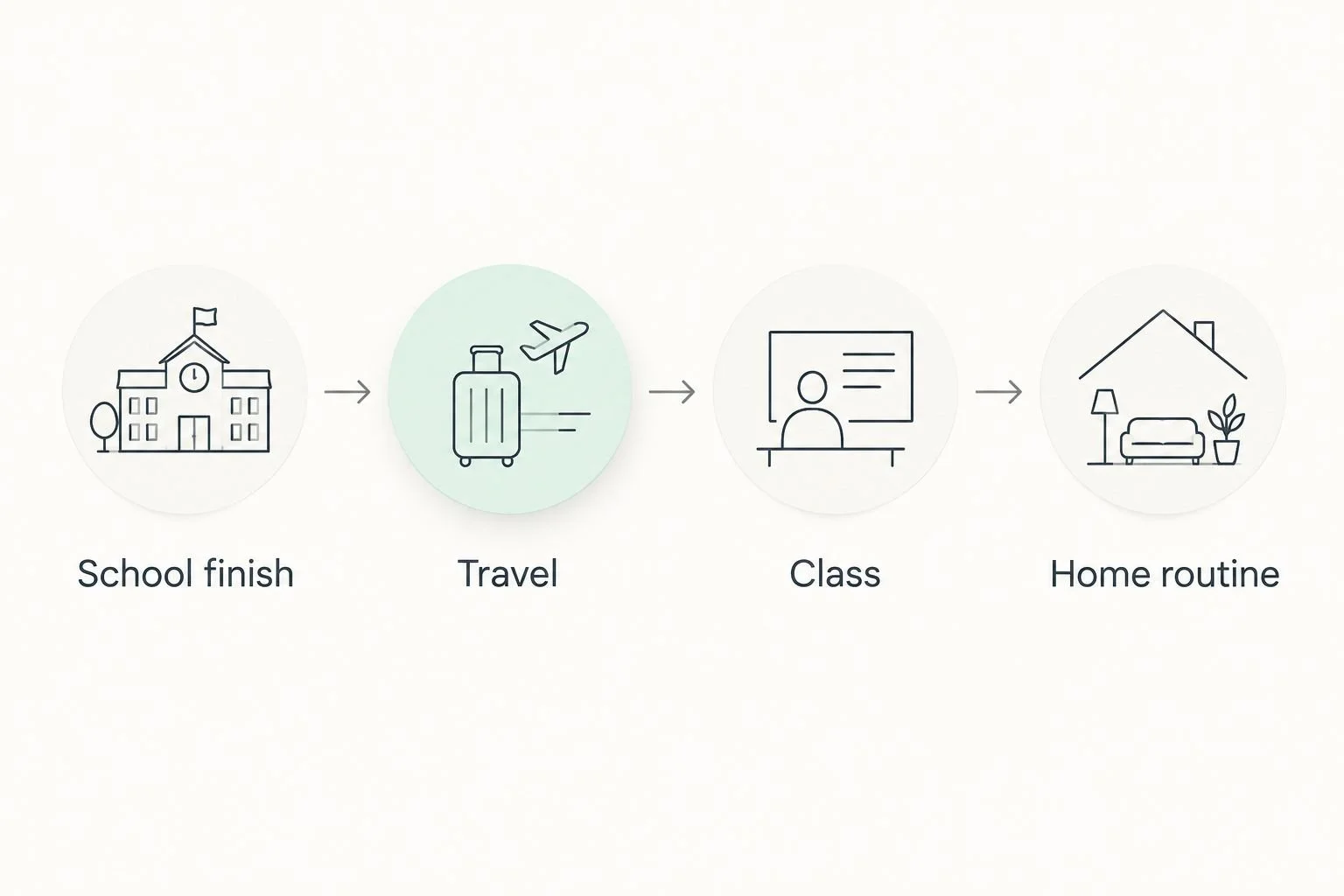
Plan the whole family commitment, not just the time spent in class.
A workable plan also accounts for siblings and existing activities. If the evening depends on a rushed collection or a missed meal every week, reconsider the arrangement before asking your child to manage it.
Leave the decision open until the practical questions have answers. Choosing a different day or waiting for a better fit is a scheduling decision, not a judgment about your child's willingness to try.
Talk about participation without making confidence the assignment
Ask what your child would like to understand before arriving. Keep the conversation concrete: where to go, who gives instructions, and what to do when something is confusing. You can ask the instructor these questions without promising your child a particular response.
When building self-esteem in children, keep your feedback tied to an observable action rather than an identity label. You can acknowledge that your child asked a question or explained a preference without deciding that they are now brave, confident, or good at yoga.
Avoid turning the first visit into a public report. Your child does not need to recount the experience to every relative or demonstrate a pose afterward. Ask privately what felt clear, what felt confusing, and what they would want to know before returning.
There is also room for an honest no. If your child dislikes yoga itself, explore another activity rather than treating a change of interest as failure. If the activity appeals but the arrival feels difficult, focus your next conversation on that transition.
What should you ask the instructor before registering?
Bring specific questions instead of asking only whether the class is good for shy children. The answer should describe the teaching approach, not promise a personality change.
Which age group and experience level is this class intended for?
What does a typical session ask children to do?
How do you introduce a movement that a child has never seen?
What should a child do if a position feels uncomfortable?
How do you respond when a beginner needs another explanation?
What are the arrangements for arrival, parent presence, and collection?
What clothing, equipment, and registration steps should families confirm?
Listen for answers that you can explain back to your child. General reassurance is less useful than knowing how the teacher handles a missed instruction or an uncertain first attempt.
The Garden Arts Center is best for families seeking arts and wellness classes within a broader arts community. For yoga classes for kids, however, confirm child-specific instruction directly; the center's wider offerings do not establish the format of an individual yoga session.
Use the contact page to ask about age suitability, instruction, and the details your family needs before registration. The right next step is a clear conversation, not a rushed commitment.
How should you judge the first experience?
Separate enjoyment, instruction, and logistics when you reflect on a first class. A child can enjoy movement but dislike a rushed journey; equally, an easy trip does not make an unsuitable teaching format appropriate.
Use 3 questions for your family conversation: What did you enjoy? What did you not understand? What would you want to know next time? These are discussion prompts, not a scorecard, and your child does not need an immediate answer to each one.
For your 2026 plans, look for a commitment that remains workable after the novelty wears off. Do not measure success by whether every nervous feeling disappears. A more practical decision is whether your child wants to return, understands what participation involves, and can communicate a concern to the instructor.
If something remains unclear, ask before another visit. You do not need to wait for a major problem to request an explanation.
FAQ
Are yoga classes for kids a good choice for a shy child?
Yoga classes for kids can suit a shy child when the child likes the activity and the instruction matches their age and experience. Ask how the teacher introduces unfamiliar movements and responds to uncertain beginners.
Can my child join yoga without any experience?
A child without experience needs a class intended for beginners in their age group. Confirm placement and participation expectations with the instructor before registering.
Can I stay with my child during yoga?
Parent presence depends on the class arrangements. Ask directly before attending, and explain the confirmed plan to your child rather than promising you can stay.
What if my child wants to watch before joining in?
Ask whether observing is permitted before offering that option to your child. Watching arrangements and participation expectations need confirmation from the instructor.
Is kids yoga the same as hot yoga?
Kids yoga and hot yoga are not interchangeable descriptions: one identifies an audience, while the other describes a heated practice environment. Do not assume a heated or adult session is suitable for your child.
Should I choose yoga or creative movement for my nervous child?
Choose according to your child's interests and the actual teaching format, not nervousness alone. Yoga explores poses and body awareness; creative movement explores movement through prompts, space, and rhythm.
Does The Garden Arts Center offer a suitable yoga class for my child?
The Garden Arts Center offers yoga, but your child's class fit needs direct confirmation. Ask about the intended age group, beginner instruction, and practical arrangements before registration.
One last thing
The most revealing question after class is not whether your child was good at yoga. Ask whether they knew what to do when they needed help. The answer gives you a specific topic for the next conversation with the instructor.
Make understanding the goal of the first visit, not instant confidence. Your child can leave with mixed feelings and still give you useful information about the activity, the teaching, and the family schedule.