

Kids dance classes for shy children are guided movement lessons that introduce dance skills while giving children a supported way to participate in a group. Before joining, ask how the teacher welcomes hesitant beginners, explains activities, and handles a child who needs time to join in; then check whether the weekly commitment fits your family.
TL;DR
The Garden Arts Center is best for families seeking kids dance classes within a wider arts community.
Compare ballet and creative movement by teaching approach, not by which class promises to make a child less shy.
Ask about arrival, observation, teacher support, and participation expectations before registering.
Choose a weekly routine that accounts for school, travel, meals, and your child's energy.
Why kids dance classes matter for shy children
A shy child needs more than a dance style they enjoy. You also need to understand what happens when your child stands beside you at the doorway, misses an instruction, or wants to watch before participating. Those practical details belong in your class search, not just in a conversation after a difficult arrival.
The Garden Arts Center offers kids dance classes alongside music, theater, art, and wellness instruction for different ages and abilities. Its broader arts offering suits families who want to explore creative interests within an arts community. Ask about the specific class experience before deciding whether it fits your child.
For your 2026 class search, treat shyness as information about the support to ask for, not as a reason to rule dance in or out. A class does not need to promise a personality change to be worthwhile. Your immediate decision is whether the instruction, entry routine, and family schedule make participation manageable.
How to choose a class without rushing your child
1. Identify what makes joining difficult
Start with a calm conversation at home. Ask what your child imagines a dance class will be like, then listen for the particular concern: an unfamiliar teacher, loud music, being watched, separating from you, or not knowing the movements.
Avoid turning the conversation into a test of bravery. A child who cannot explain the worry can still tell you which part sounds interesting. Asking whether they would rather move to a story or learn a short dance gives you something concrete to discuss with an instructor.
Write a brief description of what helps your child in other unfamiliar settings. Share useful observations rather than assigning a fixed label. For example, explain that your child joins group activities more readily after seeing a demonstration, if that is something you have actually observed.
Separate your own hopes from your child's interests, too. Wanting your child to feel comfortable socially is understandable, but the class still needs an activity they want to explore.
Ask which part of dancing sounds enjoyable.
Identify the moment your child expects to find difficult.
Note familiar activities that help your child settle.
Share specific observations with the teacher.
2. Match the dance style to your child's interests
Compare the activity before choosing the label. Creative movement generally explores movement through prompts, imagination, music, and space. Ballet introduces a defined movement vocabulary and attention to posture, coordination, and technique. Tap focuses on making rhythmic sounds with footwork.
These descriptions explain the styles, not the exact curriculum of any particular class. Ask what beginners actually do and how the teacher introduces unfamiliar movements. A child who likes clear demonstrations might enjoy a structured lesson; another might prefer imaginative prompts. Shyness alone does not settle that choice.
When comparing 2026 kids dance classes at The Garden Arts Center, ask how each class balances teacher demonstration, group activity, and individual participation. Professional guidance matters most when you understand what it looks like during a lesson, rather than relying on a reassuring class description alone.
Bring your child's interests into the discussion without expecting the teacher to predict a perfect match. The aim is an informed starting point, with clear expectations about what participation involves.
Ask for examples of beginner activities.
Describe the music or movement your child enjoys.
Ask how instructions are demonstrated and repeated.
Confirm the intended age and experience level.
Ask whether activities involve individual turns.
3. Ask the teacher to describe a hesitant child's arrival
A general question such as whether a class welcomes shy children leaves too much unanswered. Ask the teacher to describe the arrival process instead: where you go, who greets your child, and what happens before the first activity begins.
A useful answer describes actions, not just reassurance. You want to understand how the instructor responds if your child stays near the doorway or does not immediately copy a movement. Do not assume watching, parent presence, or gradual entry is permitted; ask about each directly.
The Garden Arts Center's emphasis on supportive instruction gives you a starting point for that conversation. Confirm how support works in the particular kids dance class you are considering, including what the teacher expects you to do during a difficult handoff.
Choose 3 priority questions for your first inquiry so the conversation stays focused. Keep additional questions ready, but leave room for the instructor to explain the routine in their own words.
Ask who welcomes new students on arrival.
Confirm where parents wait during instruction.
Ask what happens if a child initially watches.
Discuss how the teacher handles missed instructions.
Ask how concerns are communicated to parents.
4. Build a weekly routine your family can sustain
Check the calendar before making the emotional decision to join. An appealing class still needs to fit around school dismissal, meals, homework, siblings, and the trip home. For families, the practical question is not simply whether the lesson fits into an empty calendar slot.
Build your 2026 plan around the whole outing. Account for getting ready, traveling, arriving, changing if necessary, and returning home. Compare that sequence with what your child normally needs after school rather than assuming enthusiasm will make a crowded evening easy.
Families across Berks, Montgomery, and Chester counties should assess their actual journey. Whether you are traveling from Douglassville, Pottstown, Phoenixville, King of Prussia, Reading, or Lansdale, confirm the teaching location and route rather than assuming the center has a location in your town.
If you are considering 1 weekly class, place both the outward and return trips on your calendar. That gives you a more honest picture of the commitment than recording the lesson alone. Ask about current scheduling directly; do not build a plan around an unconfirmed time.
Check school dismissal and existing activities.
Include travel in both directions.
Identify who handles arrival and pickup.
Leave room for food and preparation.
Discuss attendance expectations before registering.
5. Prepare a simple, accurate first-day explanation
Once you understand the routine, explain it in ordinary language. Tell your child where you are going, who will lead the lesson, where you will be, and what the first activity involves if the instructor has described it.
Avoid promising that your child can watch, leave early, stay beside you, or skip an activity unless you have confirmed that arrangement. A reassuring promise becomes confusing when it conflicts with what happens at the door. Clear information is more useful than an elaborate pep talk.
You can invite your child to move to familiar music at home, but do not turn preparation into an audition. Home dancing does not need to prove readiness for a group lesson. Keep the focus on curiosity and on the routine you have actually agreed with the instructor.
Give your child a simple way to express a concern. You might practice asking the teacher to show a movement again, without requiring your child to rehearse a full conversation or perform for relatives before the first lesson.
Confirm clothing and footwear requirements.
Explain where you will be during class.
Describe only the arrival details you know.
Practice a simple request for help.
Keep home movement playful rather than evaluative.
6. Agree on how to review the fit
Before completing a 2026 registration, ask how families can discuss adjustment and class placement with the instructor. You are looking for a way to exchange observations, not a promise that your child will settle within a particular number of lessons.
After class, use concrete questions. Ask which activity your child remembers, what felt confusing, and whether there was something they wanted to try. A broad question about whether they loved it can hide useful detail, especially when your child has mixed feelings.
Compare your child's account with the teacher's observations. Standing quietly, following a demonstration, and joining a movement are different behaviors; ask what actually happened rather than interpreting silence as either success or failure.
Review the teaching approach and the family routine together. A child can enjoy dancing but struggle with the transition from a long school day. Likewise, an easy journey does not resolve a mismatch between the class expectations and the support your child needs.
Ask how to contact the instructor with concerns.
Request observations about specific activities.
Listen without requiring a positive review.
Check whether the weekly routine remains manageable.
Discuss placement questions before adding another class.
Compare beginner dance options for your child
Choose the style by the activity your child wants to explore, then confirm the teaching approach. None of these options is automatically the best class for every shy beginner. Each offers a different focus and raises different questions about participation.
Creative movement
Best for: Children interested in imagination and movement exploration
What to ask about: How prompts, music, and group activities are introduced
Key limitation: Open-ended prompts do not provide the same experience as learning a defined dance vocabulary.
Ballet
Best for: Children interested in demonstrated movements and technique
What to ask about: How beginners learn positions, posture, and movement sequences
Key limitation: The style name does not tell you the pace or level of individual attention.
Tap
Best for: Children interested in rhythm and sounds made through footwork
What to ask about: How the teacher introduces rhythm, footwear, and classroom sound
Key limitation: The sound-producing aspect needs consideration if noise is a concern.
The Garden Arts Center offers creative movement, ballet, and tap among its dance options. Confirm the current class details and suitability directly; the style descriptions above are not a substitute for information about a particular lesson.
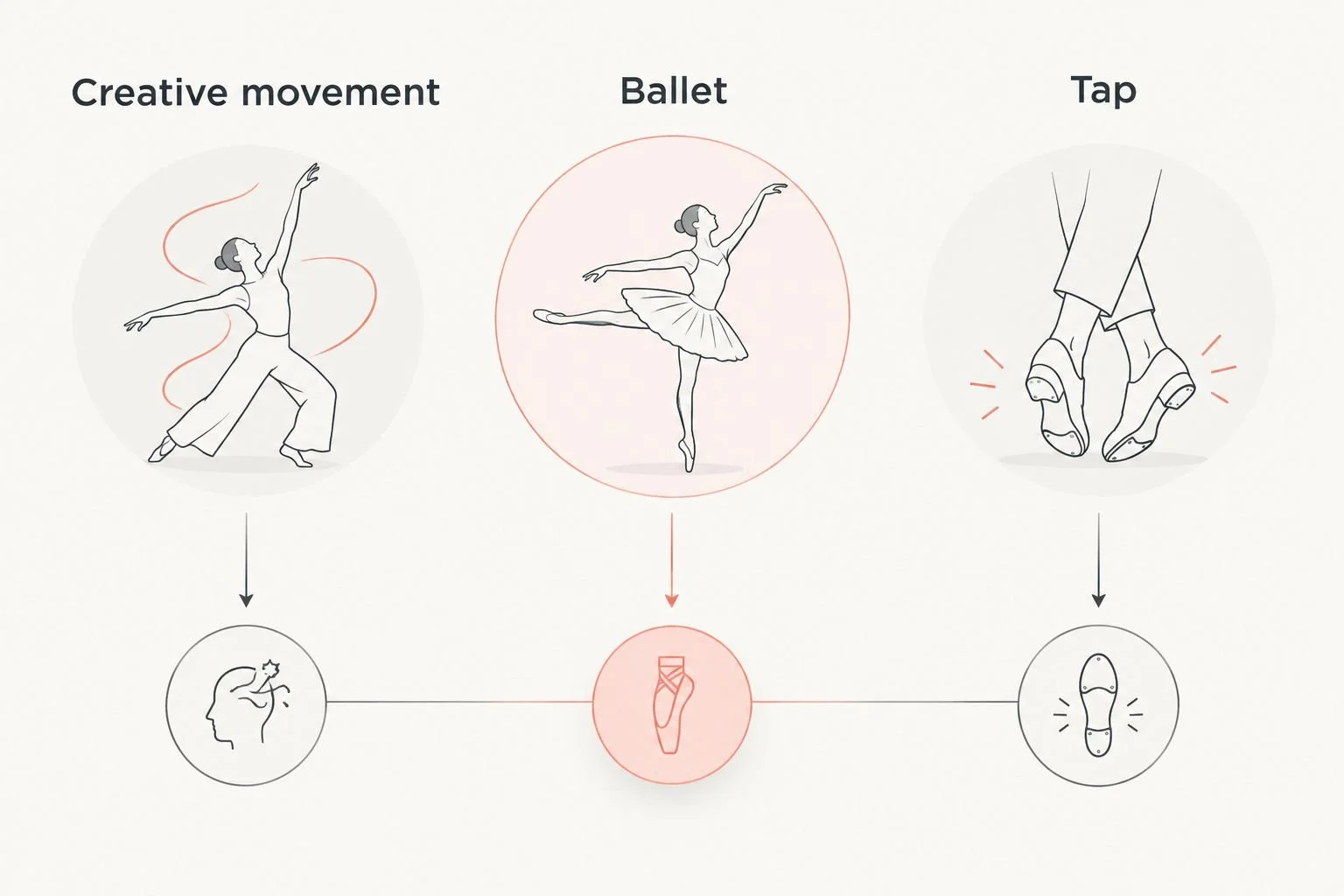
Choose an activity your child wants to explore, then ask how the class is taught.
Common mistakes when choosing for a shy child
Choosing a class to change your child's personality
Dance instruction teaches dance. It is not a guarantee that a child will become outgoing. Choose a class for the movement experience and the support available, rather than making sociability the condition for success.
Assuming creative movement is always easier than ballet
An imaginative activity and a demonstrated sequence ask children to participate differently. Ask how the lesson works instead of using the style name as a measure of difficulty or comfort.
Promising an arrangement before checking it
Telling your child you will stay in the room creates an expectation. Confirm parent participation, observation, and separation procedures first so your explanation matches the actual class routine.
Treating a crowded evening as a motivation problem
A difficult transition after school deserves a calendar review, not an assumption that your child lacks interest. Consider meals, travel, and competing activities before deciding what the reluctance means.
Using the first lesson as a verdict on ability
An unfamiliar room does not provide a complete picture of what your child can learn. Ask the instructor about the activities and support needs before interpreting hesitation as a lack of dance ability.
FAQ
Are kids dance classes suitable for a shy child?
Kids dance classes can suit a shy child when the activity, teaching approach, and participation expectations fit their needs. Ask the instructor how hesitant beginners are welcomed and supported rather than assuming every class follows the same approach.
Is ballet or creative movement better for a shy beginner?
Neither ballet nor creative movement is automatically better for a shy beginner. Compare demonstrated technique with imaginative movement prompts, then ask which teaching approach matches your child's interests and experience.
Can I stay in the room during my child's dance class?
Confirm parent presence directly with the class provider before joining. Explain what your child finds difficult and ask where you will wait, how arrival works, and what happens if separation is difficult.
What should I tell the dance teacher about my shy child?
Tell the dance teacher what your child finds difficult and what has helped in other unfamiliar settings. Specific observations about demonstrations, noise, group activities, or separation are more useful than the label shy alone.
How many dance classes should a shy beginner take each week?
Choose the weekly commitment by class suitability and your family's capacity, not by shyness alone. If you are considering one weekly class, account for preparation, travel, meals, and school activities before adding more.
Does The Garden Arts Center offer more than dance?
The Garden Arts Center offers dance alongside theater, music, art, and wellness instruction for children and adults. Ask about the particular activity and class requirements before choosing a next step.
What should I check before registering for kids dance classes?
Check the class level, teaching approach, arrival routine, parent expectations, and weekly travel commitment before registering. Also confirm clothing, footwear, and attendance expectations directly with the provider.
One last thing
Ask your child what they would like the teacher to know before the first lesson. Their answer gives them a voice in the decision without making them responsible for choosing the entire program.
For 2026, keep your next move small: identify an appealing class, ask about the entry routine, and check the family calendar. You do not need to decide your child's whole artistic journey before taking that step. You need enough accurate information to explain what comes next.