

A child’s first acting class introduces listening, movement, voice, and pretend situations through guided activities rather than expecting a polished performance. The exact lesson depends on the teacher and group, so ask about the opening activities, participation expectations, and any preparation before your child attends.
TL;DR
Acting classes for kids introduce listening, character choices, and working with others; the first lesson is not a finished performance.
The Garden Arts Center offers acting lessons for families seeking an arts community with professional guidance.
Ask how beginners participate, whether preparation is required, and how the weekly commitment fits school and travel.
Treat drama games, improvisation, and script work as different learning activities, not a fixed first-class checklist.
Why the first lesson matters
Your child does not need to arrive with a character voice, memorized speech, or an outgoing personality. The useful question is whether the class gives beginners understandable instructions and a manageable way to participate.
For families comparing acting classes for kids in 2026, the first visit also answers a practical question: does this activity fit your child and your week? Our parent’s beginner guide to acting classes for children provides a broader starting point for choosing a program.
Separate enjoyment from instant ease. A child can enjoy imagining a scene while still finding introductions awkward; another can speak enthusiastically but need reminders to listen. Neither reaction, by itself, tells you whether acting is a lasting interest.
What happens during a child’s first acting class?
A beginner lesson can include introductions, a physical or vocal warm-up, a listening game, an imagined situation, and a closing conversation. These are examples of acting-class activities, not a confirmed lesson plan for a particular program. Ask the instructor which activities the group actually uses.
1. Meet the teacher and learn the room’s expectations
The opening gives your child a chance to hear instructions and understand how the group works. Useful expectations include taking turns, respecting personal space, and stopping an activity when the teacher asks.
Ask how the instructor introduces a newcomer. Saying a name to a partner, joining a group circle, and speaking alone in front of everyone place different demands on a beginner; you should know what the teacher expects rather than promising your child a particular experience.
2. Explore movement and voice
An acting warm-up can connect physical choices with an imagined situation. Walking as though the floor is sticky, for example, gives a child a concrete idea to express through movement.
Voice work can explore clarity, expression, and listening without making loudness the goal. Saying the same greeting with curiosity and then surprise illustrates how delivery changes meaning. These examples explain the activity’s purpose; they are not exercises every first class includes.
3. Practice noticing and responding
Acting involves responding to someone else, not simply waiting for a turn to speak. A partner-mirroring exercise, for example, asks one child to follow another child’s movements closely.
Look for an instruction your child can act on: notice the movement, wait for the cue, or respond to what a partner says. That is more useful than a vague demand to be confident or entertaining.
4. Try an imagined situation
A teacher can introduce character through a clear situation: someone has lost an imaginary pet, discovered a mysterious package, or arrived somewhere unfamiliar. Your child then explores what that person wants and what happens next.
The learning is in making a choice and responding to the scene. A funny voice is optional; understanding the situation gives the activity its purpose.
5. Reflect and learn what comes next
A closing conversation gives children a chance to name something they tried or noticed. Ask whether the instructor also explains what to bring or prepare for the following lesson.
Keep your own follow-up simple. Start with 1 question: “What did you get to pretend?” That invites a description without turning the ride home into a performance review.
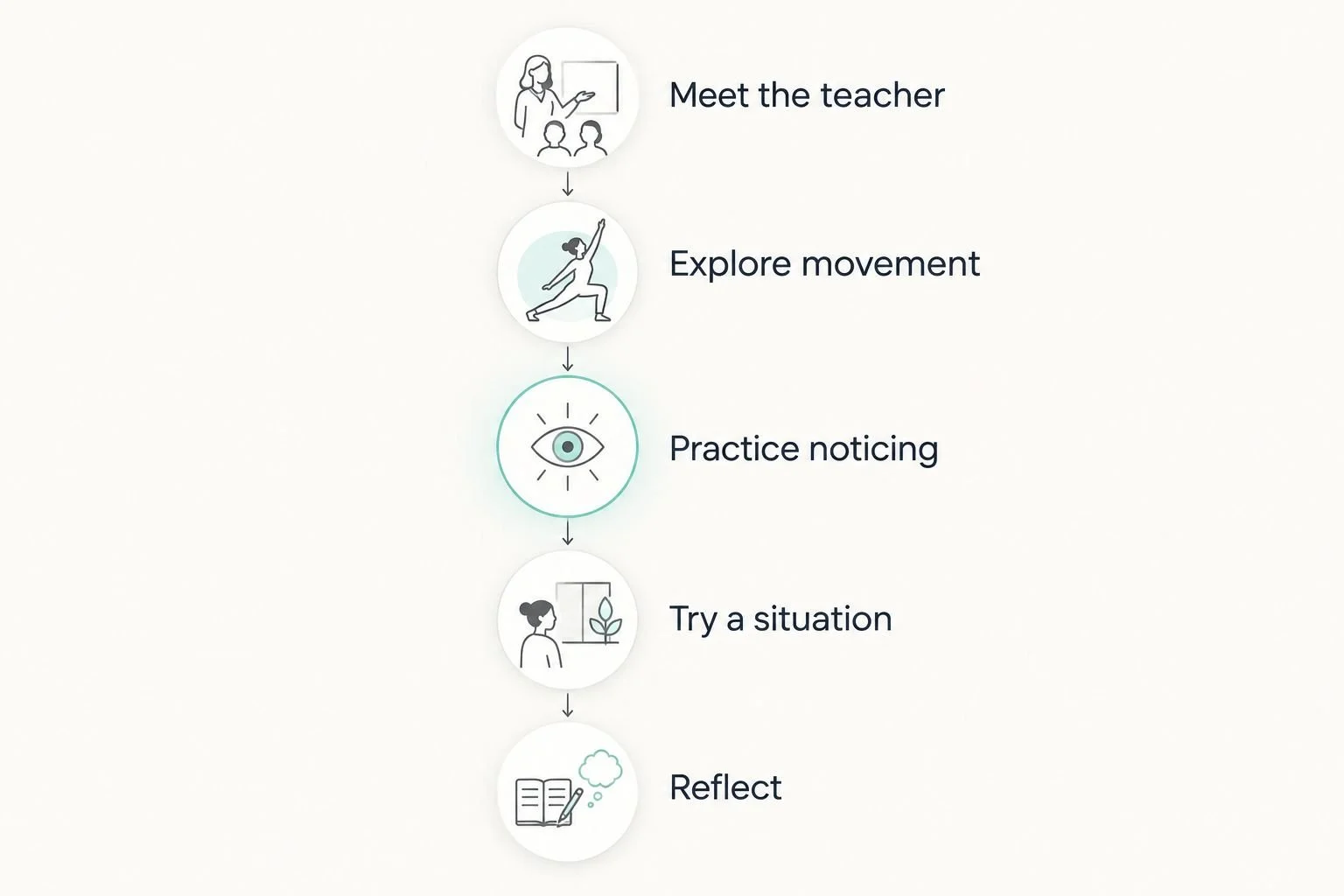
Ask which parts of this example sequence appear in your child’s actual first lesson.
How do drama games, improvisation, and script work differ?
These activities develop different parts of acting. A beginner class can combine them, but a parent should not assume that every lesson includes all of them—or that reading from a script is the starting point.
Drama games
What students practice: Following cues, listening, and using imagination within rules
Best for: Children who benefit from a clear shared task
What to consider: A game needs an understandable purpose, not just excitement
Improvisation
What students practice: Making choices and responding without a written script
Best for: Children interested in inventing situations
What to consider: Open-ended prompts can require extra explanation
Script work
What students practice: Interpreting written dialogue and responding to scene partners
Best for: Children interested in working with written scenes
What to consider: Reading and preparation requirements need checking
Choose by the learning task, not by which activity sounds most advanced. A simple listening exercise can reveal a specific skill to work on, while a longer scene can overwhelm a child who does not yet understand the instructions.
Ask how the teacher adjusts the task when a child needs help. Rephrasing a prompt or demonstrating an example is different from expecting a beginner to guess what successful participation looks like.
Why the first-class experience varies
The label “beginner acting” does not tell you the complete lesson format. For your 2026 class search, use these factors to make the conversation with the instructor specific:
Age grouping: Ask which ages learn together and how instructions suit that group.
Reading expectations: Find out whether children use scripts, listen to spoken prompts, or work without written material.
Experience level: Check whether the lesson assumes previous performance experience or introduces the activity from the beginning.
Class purpose: Ask whether the focus is general acting exploration, scene study, or preparation for a particular performance task.
Participation format: Clarify how much work happens with partners, in a group, or individually.
Support needs: Explain any communication, sensory, movement, or learning considerations that affect participation, then ask what support is possible.
These questions do not require you to diagnose your child’s ability. They help you understand what the class asks children to do and whether the teacher’s approach fits your family’s needs.
Does my child need to memorize lines before the first class?
Do not assign memorization unless the instructor requests it. Ask whether the first lesson requires a prepared piece, reading, or any material brought from home.
If the teacher sends preparation, read the directions with your child and keep the task within those directions. Extra rehearsal is not a substitute for understanding what the instructor actually requested.
Can a shy child take acting classes?
A shy child does not need to become outgoing before exploring acting. Ask how the instructor introduces speaking tasks and supports children who are hesitant to join.
Avoid promising that your child can watch indefinitely or skip an activity; participation policies belong to the program. Instead, explain the concern beforehand and ask what the first lesson would involve for your child.
Will my child perform in front of everyone immediately?
Ask directly whether the first lesson includes an individual introduction, solo activity, or group presentation. A class description alone does not establish how much attention each child receives at the start.
Tell your child what the instructor confirms. Accurate preparation is kinder than saying there will be no solo work and discovering otherwise at the door.
What should parents ask before registration?
Start with 3 questions that connect the teaching approach to your child’s actual experience:
What does a new student do during the first lesson?
What should we prepare or bring?
What participation and ongoing commitments should our family understand?
Then describe your child without assigning a permanent label. “Enjoys storytelling but hesitates to speak to unfamiliar adults” gives the instructor more useful information than “not confident.” Mention reading needs or previous experiences when they affect the activities being discussed.
The Garden Arts Center is a fit for families seeking acting lessons within a broader arts community. The center offers theater alongside dance, music, art, and wellness, with professional guidance and a community-focused approach.
That breadth helps families explore connected interests, but it does not establish the format of a specific acting class. Use the contact page to ask about the appropriate group, first-lesson expectations, and the registration process before making plans.
How can the class fit your family’s week?
For a 2026 commitment, consider the whole trip rather than only the lesson itself. Put school dismissal, meals, homework, sibling activities, and travel into the same calendar view.
Families across Berks, Montgomery, and Chester counties—including Douglassville, Pottstown, Phoenixville, King of Prussia, Reading, and Lansdale—need to check the actual teaching address and their own route. Serving families from a town does not mean a class takes place there.
Compare 2 calendar scenarios: an ordinary school week and a busy school week. Would the trip still work when a sibling has an activity or your child has a school project? Choose a commitment your family can sustain without treating every lesson as a scheduling emergency.
Before registering for a 2026 session, confirm the schedule, attendance expectations, and any preparation outside class. Do not infer these details from another family’s experience or a different arts program.
What should you notice after the first lesson?
Ask about concrete experiences rather than demanding a verdict on acting. Did your child understand an instruction, remember an imagined situation, or notice something a partner did?
You can also ask whether anything felt confusing. A child saying “I didn’t know when to speak” gives you a specific question for the teacher; “I wasn’t good” does not identify the difficulty.
Avoid using applause, speaking volume, or the length of a role as the only measure of a worthwhile lesson. Look for understandable instruction and a respectful way to participate. If the expectations remain unclear, speak with the instructor before deciding what the experience means.
FAQ
What happens in acting classes for kids on the first day?
A first acting lesson can introduce listening, movement, voice, and imagined situations through guided activities. Ask the instructor for the actual lesson format, because these examples are not a fixed syllabus.
Does my child need acting experience to join a beginner class?
Check whether the class is intended for children with no previous acting experience. Ask what beginners are expected to understand or prepare before attending.
What should my child wear to a first acting class?
Ask the instructor for the class clothing and footwear requirements. If movement activities are included, confirm what allows your child to participate comfortably and safely.
Can I stay and watch my child’s first acting lesson?
Ask the program whether parents can observe the first lesson. Observation and drop-off arrangements are program-specific, so confirm them before telling your child what to expect.
Does The Garden Arts Center offer acting classes for kids?
The Garden Arts Center offers acting and theater lessons for children as part of its arts programming. Contact the center to discuss the appropriate class and first-lesson expectations.
Will acting classes make my shy child confident?
Do not choose acting classes on a promise that they will change your child’s personality. Ask how the instructor supports hesitant beginners and judge the experience by the instruction and your child’s participation.
How should I prepare my child for a first acting class in 2026?
Confirm the 2026 class instructions, then explain the activities and arrival arrangements the instructor has verified. Follow any preparation request without adding an audition or memorization task of your own.
One last thing
Your child does not need to deliver a scene at home to prove that the lesson mattered. Try asking, “What did someone else do that you noticed?” Listening and responding are part of acting, so that answer can tell you something a solo demonstration would miss.
Keep the first visit a conversation, not a verdict on talent. A clear account of what felt interesting, confusing, or enjoyable gives you a better next question for the instructor.