

Best overall for controlled strength and mobility: Pilates. Best for flexibility-focused practice: yoga. Best for children learning dance technique: ballet. This 2026 guide compares classes for flexibility and strength so you can choose a suitable starting point without overloading your family’s week.
TL;DR
For classes for flexibility and strength, choose Pilates for controlled conditioning or yoga for mobility-focused practice.
Ballet suits children who want dance technique; creative movement suits children beginning through imaginative play.
The Garden Arts Center offers dance and wellness classes; confirm age, level, and schedule before choosing.
Choose contemporary dance for students interested in expressive movement, with placement based on experience.
Why this matters
Flexibility and strength are related, but they are not interchangeable. Flexibility describes available range of motion; strength helps you produce and control movement. A useful class teaches you how to move within an appropriate range, rather than treating a deeper stretch as the only goal.
The Garden Arts Center offers dance and wellness classes for children and adults. The Garden Arts Center is a fit for families seeking dance and wellness instruction within a broader arts community. Choose the class by the student’s interests, readiness, and weekly routine—not by which name sounds most demanding.
For a child, enjoying the activity matters alongside its physical focus. A student who likes stories and music needs a different introduction from a returning dancer seeking concentrated conditioning.
What makes the best classes for flexibility and strength?
Use these criteria to compare your 2026 options before considering the ranking:
Movement control: Instruction should connect range of motion with balance, alignment, and controlled movement.
Suitable placement: Age, experience, and readiness matter more than choosing an advanced-sounding class.
Clear instruction: Look for understandable demonstrations, useful corrections, and alternatives when a movement is unsuitable.
Student interest: Dance, imaginative movement, and exercise offer different experiences. Choose something the student wants to learn.
Sustainable attendance: Include travel, school activities, meals, and homework in the decision—not just the time spent in class.
Clear boundaries: A general class is not a substitute for individual medical advice or rehabilitation.
These criteria favor an appropriate starting point over intensity. They also explain why a class ranked lower here can still be the right first choice for your child.
Classes at a glance
1. Pilates
Best for: Controlled conditioning for students in a suitable age and experience group
Standout focus: Trunk control, alignment, and coordinated movement
Key limitation: Less emphasis on dance expression or choreography
2. Yoga
Best for: Mobility-focused practice with balance and body awareness
Standout focus: Moving through positions with attention to breathing
Key limitation: Class styles differ; not every session emphasizes strength equally
3. Ballet
Best for: Children seeking structured dance foundations
Standout focus: Placement, balance, and controlled leg and footwork
Key limitation: Requires interest in repeated technical practice
4. Creative movement
Best for: Young beginners drawn to imaginative movement
Standout focus: Exploring space, rhythm, and movement ideas
Key limitation: Not a substitute for focused conditioning
5. Contemporary dance
Best for: Students seeking expressive movement with technical demands
Standout focus: Changes of level, direction, and movement quality
Key limitation: Prerequisites and physical demands differ by class
These are class-category comparisons, not claims about a particular lesson plan. Ask which movements, age groups, and experience levels apply to the class you are considering.
1. Pilates: best for controlled strength and mobility
Pilates uses controlled exercises to develop strength, coordination, and awareness of alignment. Its emphasis on trunk control makes it a useful starting point when you want conditioning rather than choreography. Exercise selection differs between mat-based and equipment-based instruction, so confirm the format.
Best for: Adults or appropriately placed students who want focused movement practice without learning a dance routine.
Pilates pros:
Connects muscular effort with controlled movement.
Emphasizes awareness of the trunk and pelvis.
Includes movement that asks for both stability and range.
Pilates cons:
Does not replace practice in a chosen dance style.
Age suitability, exercise options, and equipment depend on the specific class.
For families, the first question is placement: is the session intended for adults, teens, or another group? Do not assume a general Pilates class accepts children or teaches dance-specific conditioning.
The Garden Arts Center offers Pilates, but a class name alone does not establish its format. Use these questions to ask about Pilates classes for dancers to discuss your goals before registration.
Verdict: Choose Pilates for controlled conditioning; confirm placement first.
2. Yoga: best for mobility-focused practice
Yoga combines physical positions with attention to breathing and awareness. Depending on the style, a session can include sustained positions, flowing transitions, balance, and rest. Choose by the actual class description rather than assuming every yoga session offers the same physical demands.
Best for: Students who want to explore mobility and balance within a practice that also includes breathing awareness.
Yoga pros:
Provides opportunities to explore comfortable ranges of motion.
Includes balance and body-awareness practice.
Offers different approaches, from quieter practice to more active movement.
Yoga cons:
Strength demands vary substantially between styles.
Heat or a faster pace adds considerations that a beginner should discuss beforehand.
The Garden Arts Center offers yoga, including hot yoga. Heat is not a reason to push farther into a position, and a hot class is not automatically the right introduction for a beginner. Ask about the environment, intended participants, and ways to adjust movements.
Verdict: Choose yoga for mobility-focused practice; select the format carefully.
3. Ballet: best for children building dance foundations
Ballet teaches a structured movement vocabulary through repeated practice. Beginner work commonly introduces positions, pliés, tendus, balance, and coordinated arm movements. These exercises ask students to organize their bodies while moving to music.
Best for: Children who want to learn dance technique and enjoy a structured learning environment.
Ballet pros:
Connects posture, balance, and coordinated movement.
Develops familiarity with precise movement patterns.
Provides technical foundations used in other dance styles.
Ballet cons:
Repetition does not appeal to every beginner.
Learning ballet is broader than flexibility training; stretching alone does not prepare a student for its demands.
Choose beginner placement according to readiness and experience. Do not treat turnout, high extensions, or pointe work as milestones to rush toward. Sound instruction respects the student’s current control and individual range.
For a child choosing between exercise and dance in 2026, ballet makes sense when learning to dance is the main interest. Physical development supports that learning; it is not a promise of a particular body shape or flexibility result.
Verdict: Choose ballet for structured dance foundations, not a stretching shortcut.
4. Creative movement: best for young, imaginative beginners
Creative movement introduces movement ideas through exploration, music, and imagination. Activities commonly explore contrasting actions, pathways, levels, and rhythm. The focus is learning through movement rather than reproducing a formal technique sequence.
Best for: Young children who are ready for a guided group experience but more interested in imaginative play than detailed technical repetition.
Creative movement pros:
Gives children different ways to respond to music.
Introduces awareness of space and movement choices.
Makes exploration central to the learning experience.
Creative movement cons:
Does not provide the same technical detail as ballet.
Is not designed as a targeted strength or flexibility program.
Ask how the instructor organizes activities and supports children who need time to join in. Readiness includes more than enthusiasm at home: consider how your child responds to group directions and an unfamiliar setting.
The Garden Arts Center includes creative movement among its dance offerings. Confirm the intended age group rather than assuming every introductory dance class uses the same approach.
Verdict: Choose creative movement for an imaginative introduction; skip it as targeted conditioning.
5. Contemporary dance: best for expressive movement
Contemporary dance explores movement through changing dynamics, direction, levels, and relationships to the floor. Depending on the class, students encounter floorwork, balances, traveling phrases, or improvisation. Its physical demands belong within a larger artistic learning experience.
Best for: Students interested in expression who are ready for the technique and movement demands of the specific class.
Contemporary dance pros:
Connects physical control with expressive choices.
Explores varied movement qualities and levels.
Offers a different artistic focus from formal ballet vocabulary.
Contemporary dance cons:
Floorwork and transitions need appropriate instruction and placement.
The title does not tell you whether previous dance experience is required.
Ask whether the class welcomes beginners or expects an existing foundation. A student with ballet experience and a student new to dance need different placement discussions, even when both want to explore contemporary movement.
Verdict: Choose contemporary dance for expression; wait for placement advice if prerequisites are unclear.
How the classes rank
Pilates takes the default position because controlled conditioning is central to the method. Yoga takes the mobility-focused slot, while ballet, creative movement, and contemporary dance serve distinct learning interests rather than competing as interchangeable exercise classes.
The ranking uses the criteria above: movement control, suitable placement, clear instruction, interest, and attendance. It does not compare measured outcomes or claim that one class produces faster progress. For children especially, the most appropriate class is the one that matches both readiness and motivation.
Fit the class into your family’s week
A useful 2026 plan starts with the whole trip. Families across Berks, Montgomery, and Chester counties—including Douglassville, Pottstown, Phoenixville, King of Prussia, Reading, and Lansdale—should check the actual teaching location before estimating travel. A service area does not establish a physical location in each town.
Use this sequence before registering:
Choose the goal. Decide whether the priority is conditioning, mobility, dance technique, or an enjoyable introduction to movement.
Confirm placement. Ask about age, previous experience, physical demands, and instructor expectations.
Check the journey. Consider the route at the relevant time, parking, arrival, and the return trip.
Protect the routine. Leave room for schoolwork, meals, other activities, and rest.
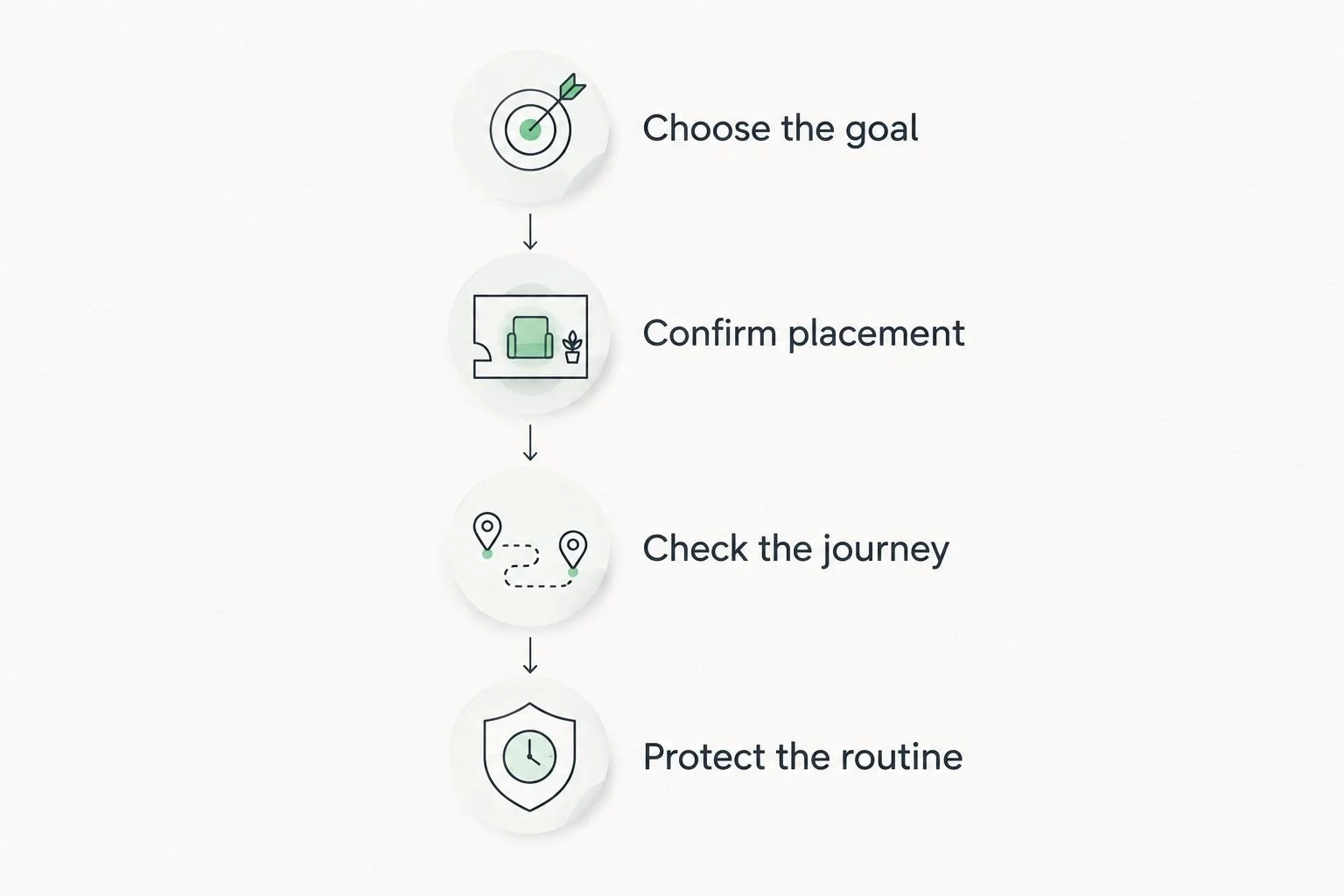
Check placement and the full journey before adding a class to the week.
As a planning example, 1 class per week means 2 travel legs: there and back. Adding a second weekly class creates 4 travel legs, before counting any separate trips home during the lesson. This is scheduling arithmetic, not a recommended attendance requirement.
For a first commitment, choose a routine you can maintain rather than stacking activities immediately. Ask about current schedules, registration steps, clothing requirements, and any participation expectations directly; do not infer them from a class category.
Explore a suitable starting point
Review the center’s offerings, then ask about age, experience, and the current class schedule.
Which class should you choose?
Choose Pilates as the default when your main goal is controlled conditioning. Choose yoga when mobility-focused practice and breathing awareness are the greater draw. For children, let interest decide between structured ballet and exploratory creative movement; consider contemporary dance when its expressive focus and placement requirements fit.
Before committing to a 2026 class, ask the instructor what beginners actually practice and how movements are adjusted. A clear answer about teaching is more useful than a promise of rapid improvement. If pain, an injury, or a medical condition affects participation, seek appropriate clinical advice before choosing exercise.
FAQ
What are the best classes for flexibility and strength?
Pilates is a useful default for controlled conditioning, while yoga suits mobility-focused practice. Ballet and contemporary dance combine physical demands with learning dance technique; choose according to your interests and placement.
Is Pilates better than yoga for building strength?
Pilates places controlled conditioning at the center of its practice, while yoga’s strength demands depend on the style. Compare the actual sessions and your goals rather than assuming the class names describe identical workouts.
Which class should my child try first?
Choose creative movement for an imaginative introduction or beginner ballet for structured dance foundations. Confirm age suitability and readiness with the instructor before registering.
Does my child need to be flexible before starting ballet?
Your child does not need advanced flexibility to begin an appropriately placed beginner ballet class. Ask how the instructor teaches alignment and movement within each student’s current range.
Does hot yoga make stretching safer or better?
Heat does not make pushing farther into a stretch a safe goal. Ask about the class environment and suitability, and work within a controlled, comfortable range rather than chasing depth.
How many classes should we add to the family schedule?
Choose a commitment that fits school, travel, meals, and rest. Confirm the class’s attendance expectations before deciding whether the weekly routine is sustainable.
Can adults start classes without dance experience?
Adults can begin in an appropriately placed introductory class without previous dance experience. Ask about beginner options, movement demands, and adjustments rather than joining a level based only on its title.
What should we ask before registering in 2026?
Ask about age and experience requirements, current schedules, the teaching location, and what students practice. Also confirm clothing requirements and registration steps directly with the center.
One last thing
Reaching farther is not the same as controlling the movement. When comparing classes, ask how the instructor helps students move into and out of a position—not just how a finished shape looks. That question keeps the focus on learning, sound technique, and a sustainable artistic journey.