

Dancers’ Pilates classes are guided movement sessions that use controlled exercise to practice strength, coordination and body awareness alongside dance training. For parents choosing a class in 2026, the main questions are whether the instruction suits your dancer’s age and experience, how the teacher adapts exercises, and whether another weekly commitment fits family life.
TL;DR
The Garden Arts Center is best for families seeking pilates classes and arts instruction from the same provider.
Ask how the instructor adapts Pilates for your dancer’s age, experience and existing dance schedule.
Compare teaching approach before choosing mat Pilates, equipment-based Pilates or individual instruction.
Treat Pilates as supplemental movement practice, not a replacement for dance technique or medical care.
Why Pilates matters for dancers
Pilates gives dancers a setting to practice controlled movement without learning choreography at the same time. A session can involve coordinating breath with movement, maintaining a position while moving a limb, or working through an exercise slowly enough to notice how it feels. Those are general features of Pilates, not promises about what a particular class will include.
The useful question is not whether Pilates will automatically improve ballet, jazz or contemporary dance. It is whether the instructor can explain the purpose of an exercise and teach it appropriately to the student in front of them. Choose clear instruction over promises of better turns, higher jumps or injury prevention.
Families also need room for the class outside the studio. Schoolwork, rehearsals, other activities and travel all belong in the decision. Before adding a session, use this guide to fitting kids dance classes into a busy family schedule to review the whole week rather than an isolated opening on the calendar.
For your 2026 class search, define success as finding an appropriate, manageable learning environment—not adding the most activities.
How to choose Pilates classes for a dancer
Start with your dancer’s reason for attending
Talk with your child before contacting an instructor. Ask what interests them about Pilates and what they enjoy about movement outside dance class. A dancer who wants to explore a different activity brings a different starting point from someone whose dance teacher suggested supplemental conditioning.
Write down 3 questions together. Keep them specific enough for an instructor to answer: what students practice, how beginners receive help, and how the class fits alongside dance. You do not need to diagnose a weakness or describe your child as needing to be fixed.
If a dance teacher recommended Pilates, ask what they meant by that recommendation. An instructor needs a clear starting point, not a vague request to make a student stronger.
Ask your dancer what they want to explore or learn.
Record any recommendation from their dance teacher accurately.
Describe their current dance styles and experience.
Separate personal interests from medical concerns.
Bring your questions to the instructor before deciding.
Check the format and age suitability
Ask whether the session is mat-based, equipment-based or individually taught. These descriptions identify how instruction is organized; they do not establish whether a class suits a child, teenager or adult. An adult beginner class is not automatically the right setting for a young dancer who is new to Pilates.
Use three headings for your notes: Class format, Teaching approach and Weekly schedule. Together, they frame the class choice. Ask the provider to explain the intended students, how directions are given and what happens when someone needs a simpler version of an exercise.
Do not choose by equipment alone. The more useful distinction is whether the teacher can observe, explain and adapt the work for the people attending.
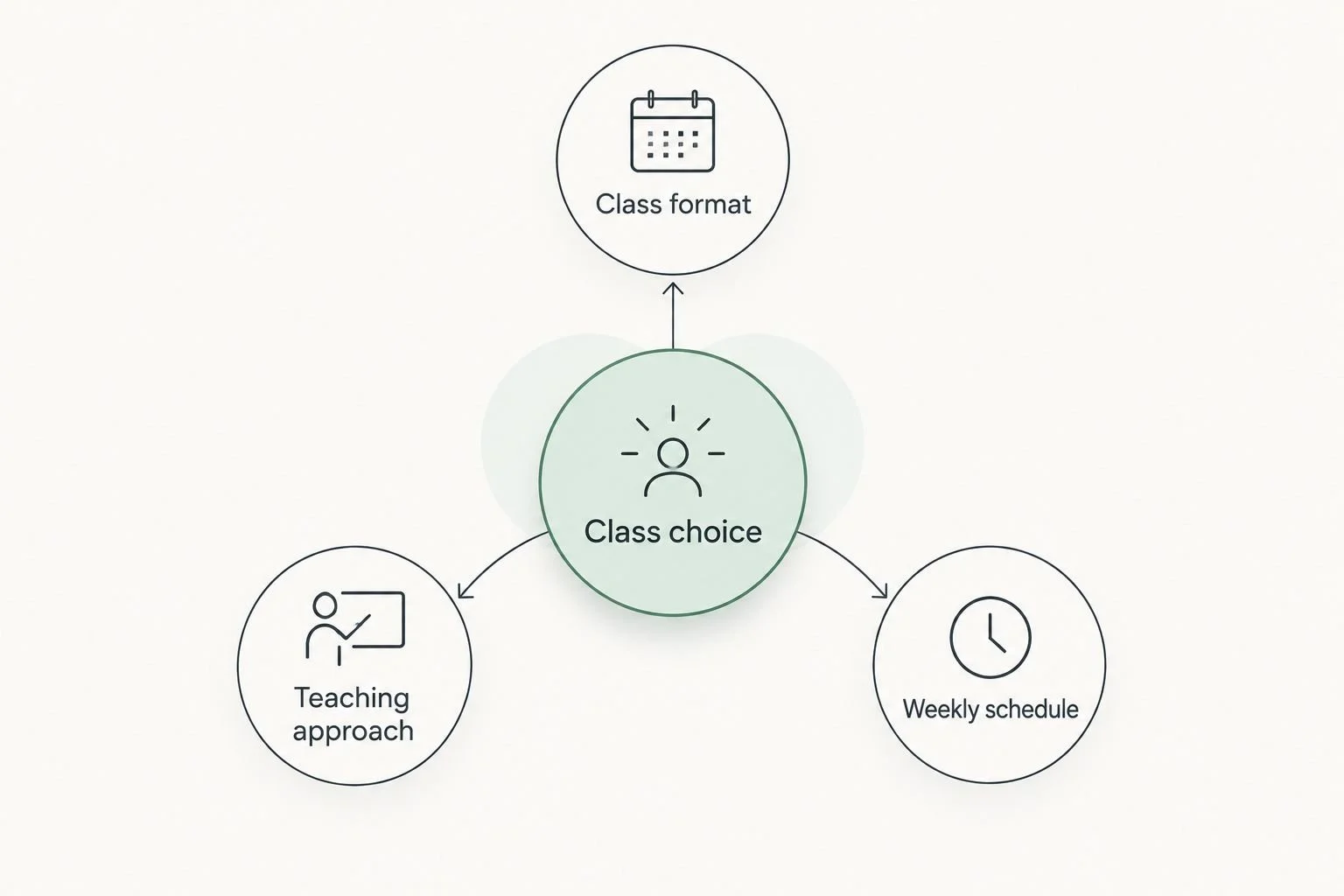
Consider the format, instruction and family schedule together.
Ask which ages and experience levels the class serves.
Confirm whether beginners receive introductory instruction.
Ask what equipment students use and who explains it.
Check whether a parent needs to provide information beforehand.
Ask how the teacher handles different levels within a group.
Ask the instructor to explain their teaching approach
Start with a conversation rather than a list of credentials alone. Ask about Pilates training, experience teaching the relevant age group and familiarity with dancers. Then ask for a concrete explanation: how would the instructor introduce an unfamiliar exercise to a beginner?
A useful answer describes instruction you can understand. Listen for an explanation of the starting position, the movement’s purpose and ways to adjust it. You are assessing the teacher’s communication, not testing whether you already know Pilates terminology.
The Garden Arts Center offers Pilates alongside dance and other arts classes. That makes it a provider to consider when your family wants those disciplines within one arts community; it does not establish a particular class format, age grouping or instructor background. Confirm those details directly.
Ask what Pilates training informs the instructor’s teaching.
Ask about experience with your dancer’s age group.
Request an example of a beginner-friendly explanation.
Ask how students request clarification during class.
Ask whether corrections involve touch and how consent is handled.
Discuss adaptations and the limits of instruction
A dancer’s ability to perform choreography does not tell an instructor everything about their comfort with Pilates. Explain that your child is new to the format, even if they have years of dance experience. Ask how the teacher introduces movement choices without making beginners feel singled out.
You can also ask how the instructor responds when an exercise feels uncomfortable. The answer should distinguish changing or stopping an exercise from diagnosing a problem. A Pilates class is not a substitute for assessment or treatment by a qualified healthcare professional.
If your dancer has pain, an injury or instructions from a healthcare professional, address those before participation. Share relevant guidance with the instructor and ask whether the class can accommodate it. Do not ask a teacher to promise that Pilates will resolve a condition.
Explain relevant experience without overstating your dancer’s readiness.
Ask how exercises are simplified or changed.
Ask what students should do if movement causes pain.
Discuss relevant healthcare guidance before participation.
Confirm that your dancer can ask questions or stop an exercise.
Build the class into a realistic family week
Map 1 normal school week before choosing a session. Include school, existing dance classes, rehearsals, homework, meals and travel. An empty calendar slot does not necessarily leave enough time to get across town without rushing.
Families across Berks, Montgomery and Chester counties can use the same method. Whether you are traveling from Douglassville, Pottstown, Phoenixville, King of Prussia, Reading or Lansdale, check the actual teaching address and route. These communities describe the families considering classes, not verified locations of the center.
For a 2026 schedule, compare 2 possible travel routes at the time your family would use them. Treat any route estimate as a planning aid rather than a guarantee. Then ask whether the added commitment leaves your dancer enough breathing room between activities.
Put school and existing activities on the calendar first.
Confirm the actual address where instruction takes place.
Check travel from school as well as from home.
Allow time for changing, meals and transitions.
Ask about attendance expectations before making a commitment.
Discuss transportation with every adult sharing pickup duties.
Confirm the details before registration
Once a class looks suitable, summarize what you understand and ask the provider to confirm it. This is the point to clarify the intended student level, format, equipment and registration process. A short written summary helps prevent different family members from planning around different assumptions.
The Garden Arts Center’s arts and class information is a starting point for exploring its offerings. Ask directly about the Pilates instruction relevant to your dancer rather than assuming that details from another discipline apply.
Set a family review point after the first 4 weeks of participation, if that fits the course structure. This is a suggested check-in, not a claim about class length or an attendance policy. Ask whether your dancer understands the instruction, feels comfortable asking questions and wants to continue.
Confirm the class format and intended student group.
Ask what students should bring or wear.
Clarify registration steps and attendance expectations.
Ask whom to contact with questions after starting.
Agree on a family check-in about the experience.
Compare Pilates options for your dancer
The best format is the one that matches your dancer’s needs and the instructor’s teaching—not the one with the most equipment. Use this comparison to shape questions, rather than assuming every provider offers every option.
The descriptions below explain general formats. They are not a list of confirmed formats at The Garden Arts Center. For your 2026 comparison, ask each provider to describe the actual session you are considering.
Mat Pilates
Best for: Dancers interested in floor-based Pilates instruction
Main advantage: Offers a setting for practicing controlled movement with a mat and any specified props
Key limitation: A group format does not guarantee individual pacing or correction
Equipment-based Pilates
Best for: Dancers interested in exercises using Pilates apparatus
Main advantage: Equipment provides a different way to organize movement and resistance
Key limitation: Requires instruction in the apparatus; the label alone says nothing about age suitability
Individual instruction
Best for: Dancers whose questions call for focused teacher attention
Main advantage: Allows the session to center on an individual student’s instruction
Key limitation: Does not provide the same group experience, and remains distinct from medical care
Mat Pilates is not automatically easy, and equipment-based Pilates is not automatically advanced. The instructor’s exercise choices and explanations matter more than those assumptions. Likewise, individual attention is useful only when the teacher’s experience and scope fit the student’s needs.
Ask every provider the same core questions so you can compare the answers. If you cannot explain why one format suits your dancer, keep the decision open until the instructor clarifies it.
Common mistakes families make when choosing Pilates
Choosing by a dancer-focused label alone
A class described as suitable for dancers still needs an explanation. Ask what that means in practice: the intended experience level, the teacher’s background and how the exercises are taught. A label is a starting point for questions, not evidence of an appropriate match.
Assuming more activity always means more progress
Another class adds travel, preparation and attention to the week. Consider whether your dancer actually wants the activity and whether it fits alongside existing commitments. A manageable schedule gives your family a better basis for continuing than an overloaded one.
Treating Pilates as dance technique instruction
Pilates and dance serve different teaching purposes. A Pilates session does not replace learning ballet alignment, tap rhythms or a jazz combination with a dance teacher. Ask what the Pilates instructor teaches within their own discipline rather than expecting the class to cover both.
Overlooking your child’s comfort asking questions
Parents often focus on qualifications and logistics while the child focuses on whether they can speak up. Ask your dancer whether they would feel comfortable saying they do not understand. Make clear that requesting another explanation is part of learning, not a failure to keep up.
FAQ
What should I ask before choosing pilates classes for my dancer?
Ask about age suitability, beginner instruction, teacher training, exercise adaptations and the weekly commitment. Request concrete examples of how the instructor explains movement and helps a student who needs a different approach.
Is mat Pilates better than equipment-based Pilates for dancers?
Neither format is automatically better for every dancer. Compare the intended students, the instructor’s teaching approach and the support provided before choosing by equipment.
Can children take Pilates classes?
A child’s suitability depends on the particular class, its intended age group and the instructor’s experience. Ask the provider directly rather than assuming an adult beginner session is suitable for a child.
Does Pilates replace ballet or other dance classes?
Pilates does not replace dance technique instruction. Treat it as a separate movement practice alongside the ballet, tap, jazz or other dance classes your student chooses.
What if my dancer has pain or an injury?
Seek guidance from a qualified healthcare professional before using a class to address pain or an injury. Share relevant participation guidance with the instructor; do not expect a Pilates teacher to diagnose or treat the problem.
Does The Garden Arts Center offer Pilates?
The Garden Arts Center lists Pilates among its offerings, alongside dance and other arts instruction. Confirm the format, intended ages, teaching address and registration details directly before selecting a class.
How do we fit Pilates around school and dance?
Map the whole week, including travel, homework, meals and existing activities, before adding Pilates. Check the actual teaching address and discuss transportation with everyone responsible for getting your dancer there.
One last thing
Ask your dancer to explain the class choice back to you: what they expect to practice, how they can ask for help and where the session fits in their week. Their answer often gives you a more useful next question than another search for the perfect format.
For your 2026 decision, keep the goal simple: an appropriate class, understandable instruction and a commitment your family can sustain. Choose the learning environment your dancer can participate in comfortably—not a promise about the dancer they might become.