

Best overall: jazz dance classes. Best for rhythmic precision: tap. Best for exploring expressive movement: contemporary. This 2026 guide compares classes to pair with ballet by what your child wants to learn and what your family can sustain.
TL;DR
Jazz is the default choice among classes to pair with ballet when your child wants another technique-based dance style.
Tap emphasizes audible rhythm; contemporary introduces different movement qualities and ways of using space.
Creative movement suits exploratory learning; Pilates needs an age-appropriate format and clear instructor guidance.
The Garden Arts Center offers ballet and complementary arts classes; confirm placement and scheduling before choosing.
Why this matters
A complementary class should add something distinct, not simply add another evening away from home. Ballet already asks students to work on alignment, coordination, musicality, and controlled movement. Another style gives those skills a different setting.
The Garden Arts Center offers dance, theater, music, art, and wellness classes for children and adults. For families considering ballet combinations, The Garden Arts Center is best suited to those seeking dance and other arts within one arts community. Choose the learning goal first, then ask which class level fits.
A child who loves making rhythms needs a different recommendation from a child who wants to tell stories through movement. Neither needs every option on this list.
What makes the best classes to pair with ballet?
Use these criteria before comparing class names:
Distinct learning: The class introduces a movement quality, rhythm skill, or creative task that differs from ballet.
Appropriate placement: Instruction matches your child's experience, attention, and readiness—not just their age.
Clear instruction: Teachers explain how to perform movements rather than asking students to copy shapes without context.
Student interest: Your child wants to explore the style, not simply collect more activities.
Sustainable scheduling: Travel, schoolwork, meals, and rest still fit around the commitment.
Clear expectations: You understand equipment, class format, and any performance commitments before registering.
Ballet companion classes at a glance
The order below prioritizes different learning goals, not competitive superiority. A lower-ranked option can be the better fit for your child.
Jazz
Best for: Expanding technique-based dancing
Distinctive learning focus: Isolations, rhythmic combinations, and contrasting accents
Key limitation: Ballet experience does not establish jazz placement
Tap
Best for: Hearing and producing rhythm
Distinctive learning focus: Footwork that creates audible patterns
Key limitation: Requires style-specific footwork and footwear guidance
Best for: Exploring movement qualities
Distinctive learning focus: Weight shifts, floor relationships, and expressive choices
Key limitation: Class content varies with the teacher and level
Hip hop
Best for: Exploring groove and grounded movement
Distinctive learning focus: Rhythmic weight changes and stylistic foundations
Key limitation: Ballet habits do not transfer unchanged
Creative movement
Best for: Learning through exploration
Distinctive learning focus: Movement prompts, imaginative tasks, and spatial awareness
Key limitation: Not a substitute for a more technical class when that is the goal
Best for: Exploring controlled conditioning
Distinctive learning focus: Coordinating breath, alignment, and deliberate movement
Key limitation: Requires an appropriate format; it is not dance instruction
1. Jazz: best ballet companion for technique-based variety
Jazz is the default recommendation for a ballet student who wants another dance style built around learning movement combinations. Depending on the class, students work with isolations, traveling steps, turns, and changes in rhythmic emphasis.
An 8-count phrase gives dancers a way to organize a combination. The learning comes from how the movement meets those counts—not simply remembering the sequence.
Jazz pros:
Introduces movement accents and isolations distinct from ballet.
Gives students another setting for learning choreography.
Connects technical practice with different musical phrasing.
Jazz cons:
Familiar ballet vocabulary does not replace jazz instruction.
A class labeled “beginner” still needs a placement conversation.
Best for: Students who enjoy structured dancing and want stylistic variety.
Verdict: Choose jazz when your child wants more dancing, not a completely different kind of activity.
2. Tap: best ballet companion for rhythmic precision
Tap makes rhythm audible through the feet. Students learn to distinguish sounds, organize steps into patterns, and coordinate movement with music.
For example, a teacher can use music in 4/4 time to explore steady beats and contrasting rhythms. Tap adds a listening task: students hear whether their footwork matches the intended pattern.
Tap pros:
Makes rhythmic choices audible.
Encourages close listening during movement.
Introduces a movement vocabulary distinct from ballet.
Tap cons:
Students need instruction in tap-specific weight changes and footwork.
Families should confirm footwear requirements before purchasing shoes.
Best for: Children who enjoy percussion, sound patterns, or experimenting with rhythm.
Verdict: Choose tap when musical curiosity is the reason for adding a class.
3. Contemporary: best ballet companion for expressive exploration
Contemporary dance gives ballet students opportunities to explore different relationships with weight, space, and the floor. Instruction can include improvisation, movement phrases, and changes between sustained and abrupt actions.
Ask what “contemporary” means in the particular class. The label alone does not establish how much floorwork, technical instruction, or independent movement creation students will encounter.
Contemporary pros:
Introduces contrasting movement qualities.
Creates room for interpretation and movement choices.
Explores transitions beyond familiar ballet shapes.
Contemporary cons:
Content differs across teachers and levels.
Ballet experience does not automatically prepare students for unfamiliar floorwork.
Best for: Students interested in expression, improvisation, and moving beyond established positions.
Verdict: Choose contemporary when your child wants to explore how movement communicates.
4. Hip hop: best ballet companion for groove and grounded movement
Hip hop introduces a different relationship with rhythm, weight, and movement style. A beginner class should explain the foundations it teaches rather than treating the session as choreography alone.
Ballet students need permission to be beginners here. Holding the body exactly as they would in ballet is not the goal; learning the style on its own terms is.
Hip hop pros:
Introduces groove and rhythmic weight shifts.
Gives students contrasting movement textures.
Expands stylistic experience beyond ballet vocabulary.
Hip hop cons:
Class titles do not identify which foundations students will study.
Existing dance experience does not establish hip hop proficiency.
Best for: Students curious about groove, grounded movement, and rhythmic variety.
Verdict: Choose hip hop for genuine interest in the style, not as a shortcut to confidence.
5. Creative movement: best ballet companion for exploratory learning
Creative movement uses tasks such as changing direction, responding to music, or imagining different ways to travel. It suits children who engage through exploration rather than extended technical sequences.
A movement activity set to 3/4 time, for example, can invite children to notice a lilting musical pattern without requiring formal terminology. Ask how the teacher balances imaginative prompts with clear boundaries and shared space.
Creative movement pros:
Connects imagination with physical exploration.
Introduces awareness of space and other movers.
Allows different responses to the same movement prompt.
Creative movement cons:
It does not serve the same purpose as a technique-focused class.
The format needs to match the child's readiness and attention.
Best for: Children who enjoy pretend play, musical exploration, and open-ended movement.
Verdict: Choose creative movement when exploration matters more than adding technical vocabulary.
6. Pilates: best ballet companion for controlled conditioning
Pilates focuses on deliberate movement, alignment, and coordination with breathing. It belongs in a different decision category from jazz or tap: it is conditioning, not another dance style.
For children, ask whether the instructor teaches that age group and how exercises are adapted. A wellness class offered by an arts center is not automatically an appropriate children's class.
Pilates pros:
Gives focused attention to controlled movement.
Connects breathing with exercise.
Offers a non-choreographic way to explore body awareness.
Pilates cons:
It does not replace ballet technique instruction.
Equipment, format, and age suitability require clarification.
Mat Pilates and Pilates reformers with jumpboards involve different setups; ask what equipment a class uses before treating the class label as a match. Equipment alone does not establish whether instruction suits your child.
Best for: Students whose teacher identifies a suitable conditioning goal and an appropriate class format.
Verdict: Hold until you have confirmed the format, instructor guidance, and age suitability.
How these classes are ranked
These 2026 recommendations compare learning focus, placement needs, student interest, and scheduling—not measured results or claims that one style produces better dancers. Jazz takes the default slot because it offers technique-based dance variety; the remaining choices each answer a different learning goal.
The Garden Arts Center's range of ballet companion classes creates room to explore. The limitation is practical: a broad class offering does not mean every format or level suits every student. Ask about the specific class rather than choosing from the name alone.
Make the extra class fit your family
For your 2026 schedule, start with the week you actually have. Include the journey from school or home, meals, changing clothes, homework, and the return trip—not just time inside the classroom.
Families traveling across Berks, Montgomery, and Chester counties need to evaluate their own route. Whether you start in Douglassville, Pottstown, Phoenixville, King of Prussia, Reading, or Lansdale, a town name does not tell you how a class fits your evening.
Use this sequence:
Learning goal: Ask your child what they want to explore beyond ballet.
Class placement: Confirm the appropriate level and experience expectations.
Travel plan: Map the actual school-day journey and return home.
Weekly fit: Check school activities, family commitments, and room for rest.
Registration questions: Clarify clothing, equipment, and performance expectations before committing.
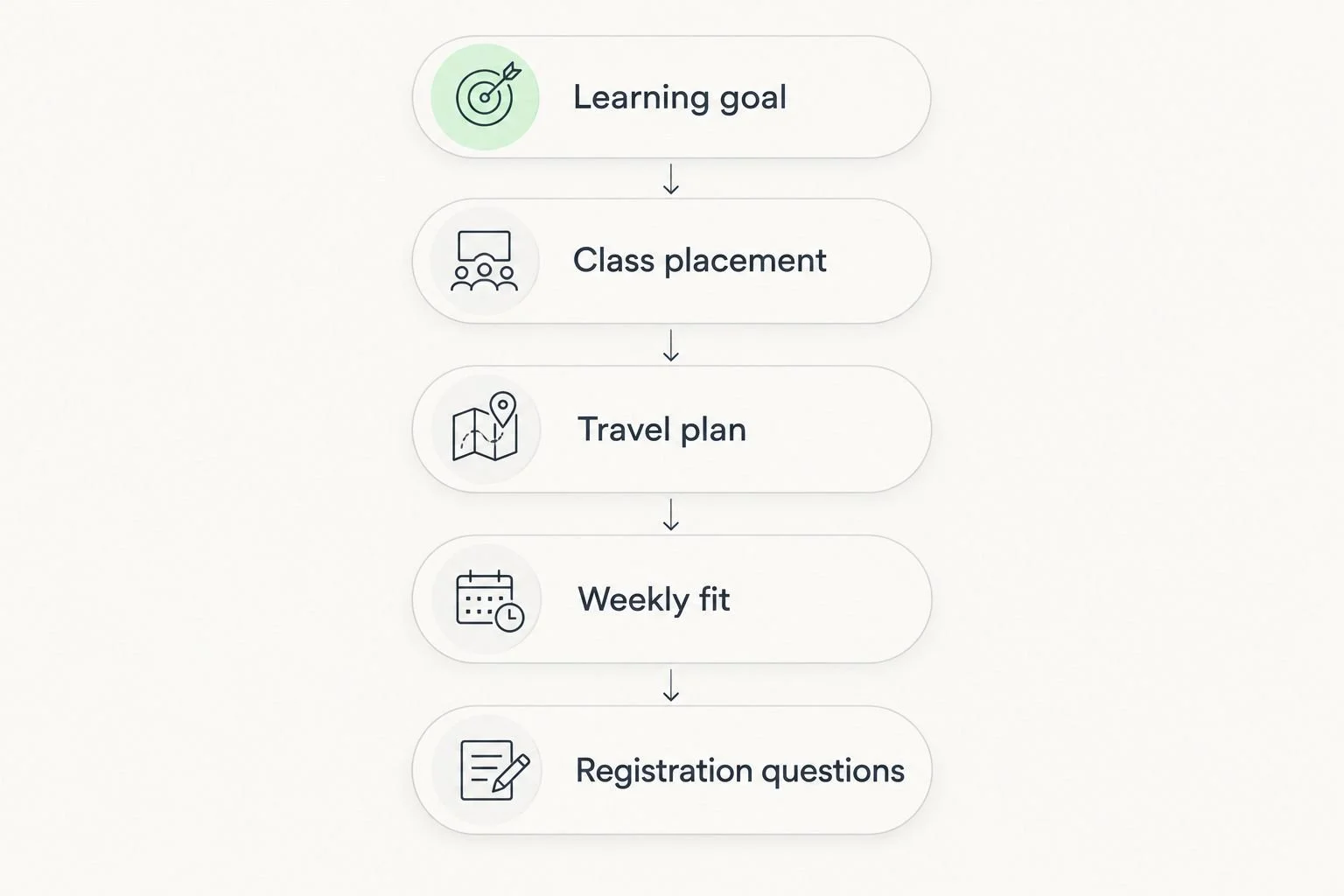
Choose the learning goal before building the weekly schedule.
A sustainable class choice is better than an ambitious schedule your family cannot maintain. Ask about the current 2026 schedule rather than assuming complementary styles meet on convenient days.
When another art form is the better pairing
Your child does not have to add another dance class. Acting and musical theater offer ways to explore character and storytelling; singing and instrument lessons put musical learning at the center. Art classes offer a different creative setting.
Lyrical and modern dance also deserve a placement conversation when expression or a different movement approach interests your child. Pointe is different: treat it as a ballet-readiness discussion, not a general cross-training option. Yoga, hot yoga, and HIIT likewise require questions about format and age suitability rather than assumptions based on the class name.
Ask your child a simple question: “Would you rather learn another way to dance, make music, tell a story, or make something?” The answer helps narrow the choice without turning every interest into another commitment.
FAQ
What's the best class to pair with ballet for a beginner?
Jazz is the default recommendation for a beginner who wants another technique-based dance style. Confirm placement with the instructor, because ballet experience does not establish jazz proficiency.
Is tap or contemporary better alongside ballet?
Tap is the better fit for exploring audible rhythm; contemporary is the better fit for exploring movement qualities and expression. Choose according to the child's interests rather than treating either style as a requirement.
Can my child take hip hop without previous experience?
A beginner hip hop class is the appropriate starting point to discuss with the instructor. Ask which foundations the class teaches and whether placement depends on previous experience.
Should young children take creative movement and ballet together?
Creative movement and ballet can serve different learning goals, but adding both should depend on readiness and weekly fit. Ask whether the proposed classes provide distinct experiences for your child.
Is Pilates necessary for a child who takes ballet?
Pilates is not a requirement simply because a child studies ballet. Discuss a specific conditioning goal, age suitability, and instructor guidance before adding it.
Does adding another class mean my child is ready for pointe?
Adding another class does not establish pointe readiness. Ask the ballet instructor to explain the assessment and preparation needed for that individual student.
How should we choose classes at The Garden Arts Center in 2026?
Start with your child's learning goal, then ask about appropriate placement and the current schedule. Include travel, school activities, and family commitments before deciding whether another weekly class fits.
One last thing
The most revealing question is not “Which class makes a dancer well-rounded?” It is “What would my child enjoy learning that ballet does not already provide?”
For your 2026 decision, choose jazz as the default, tap for rhythm, or contemporary for expressive exploration—and keep ballet alone if that is the right weekly commitment. A welcoming arts experience leaves room for curiosity without requiring a crowded calendar.