

Contemporary dance classes for ballet-trained students are movement lessons that expand classical foundations through varied movement qualities, floorwork, and expression, with the aim of developing a broader dance vocabulary. This guide helps you choose a suitable class in 2026 while accounting for your child’s experience, interests, and family schedule.
TL;DR
Choose contemporary dance classes by placement and teaching approach, not your child’s ballet level alone.
The Garden Arts Center is best for families seeking contemporary dance classes within a broader arts community.
Ballet and creative movement offer useful foundations, but contemporary introduces different movement choices.
Ask about floorwork, beginner expectations, and weekly commitments before choosing a class.
Why contemporary dance matters for ballet-trained students
Ballet gives students experience with alignment, musical phrasing, balance, and remembering movement sequences. Contemporary dance asks them to apply those skills while exploring other ways to move: changing weight, releasing a held shape, or moving between standing and the floor.
Ballet experience is a foundation, not an automatic contemporary placement. A dancer can recognize ballet vocabulary and still need introductory guidance with unfamiliar transitions. If your child is still establishing that foundation, the ballet dance classes for children guide provides a useful starting point.
For parents, the decision also involves a practical constraint: another class must fit around school, travel, and other activities. The goal is not to collect dance styles. It is to choose an experience your child wants and your household can sustain.
How to choose contemporary dance classes in 2026
Identify what your child wants to explore
Start with your child’s interest rather than a class label. Ask what looks appealing about contemporary dance: expressive movement, changing dynamics, choreography, or the chance to move differently from ballet. A clear answer gives you something useful to discuss with an instructor.
Some students want another technical challenge. Others want more room to interpret music or make movement choices. Neither interest automatically determines placement, but each helps you evaluate whether a class description addresses the experience your child wants.
Keep the conversation concrete. Instead of asking whether your child wants to become a contemporary dancer, ask what they would like to try in the next class. You are choosing a learning environment, not deciding their entire dance future.
Ask which movements caught your child’s attention.
Separate their interest from friends’ enrollment plans.
Discuss whether they want to continue ballet alongside contemporary.
Note questions about unfamiliar movements or class expectations.
Describe experience beyond years of ballet
Years of training tell only part of the story. An instructor needs to understand what your child has actually practiced, how recently they attended, and how comfortable they feel learning unfamiliar material. Age and ballet level alone do not describe those differences.
Give a brief, factual summary rather than trying to assign your child a contemporary level yourself. Mention experience following combinations, changing direction, working independently, and moving in a shared space. Include other dance styles without treating them as interchangeable credentials.
Ask how placement accounts for students who know ballet but are new to contemporary. That question leaves room for the instructor to explain the class’s starting point. It also avoids assuming that a familiar ballet term means the surrounding movement will be familiar.
Share current and recent dance experience.
Describe any previous contemporary or modern classes.
Mention long breaks from regular lessons.
Ask which skills students should already understand.
Confirm how age and experience inform placement.
Check the class’s movement and teaching focus
Contemporary is not a single fixed syllabus across all schools. Depending on the teacher and class, lessons can include floorwork, improvisation, changes in dynamics, or movement phrases drawing on ballet and modern dance. Ask about the actual lesson content rather than relying on the category name.
For example, a ballet-trained student might recognize a plié but encounter a different relationship between the movement, the torso, and the next transition. Floorwork introduces another question: how does the teacher explain moving down to the floor and returning to standing?
The Garden Arts Center offers contemporary alongside ballet, modern, creative movement, and other arts classes. That range makes it a relevant option for families interested in an arts community; choosing the right class still requires a discussion about the individual student.
Ask what a typical lesson includes.
Request examples of introductory floorwork or transitions.
Ask whether improvisation is part of the class.
Discuss how teachers explain unfamiliar movement.
Confirm clothing and footwear requirements before purchasing anything.
Build a weekly plan your family can repeat
For your 2026 plan, put the journey on the calendar alongside the lesson. Include departure from school or home, travel, changing, the return trip, and the rest of the evening. A class that fits on paper can still conflict with dinner, homework, or another child’s activities.
Families considering travel from Douglassville, Pottstown, Phoenixville, King of Prussia, Reading, or Lansdale should check the journey from their actual starting point. The same applies across Berks, Montgomery, and Chester counties. A town name alone does not establish a workable commute.
Use a real school week rather than an unusually quiet week as your planning example. If contemporary would be an additional commitment, examine the whole week before deciding. Ask the center directly about current scheduling and attendance expectations; do not infer them from another program.
Map the outbound and return journeys.
Add changing and pickup time to your plan.
Check school activities and existing lessons.
Discuss which adult handles transportation.
Leave room for meals, homework, and rest.
Prepare for a different kind of beginner experience
A student with ballet experience can be capable and new at the same time. Explain that contemporary introduces movement choices they have not practiced yet. Needing a demonstration does not erase their ballet training; it identifies the next thing to learn.
Avoid turning the first lesson into a test of whether your child is naturally good at contemporary. A more useful question is whether they understood the instruction, felt able to ask questions, and wanted to explore the material again. Enjoyment and unfamiliarity can coexist.
Prepare through conversation rather than teaching unfamiliar skills at home. Floor transitions and new movement patterns belong with appropriate instruction. Your role is to help your child arrive with practical questions answered and permission to learn without already knowing everything.
Explain that unfamiliar combinations are expected.
Ask the teacher what students should bring.
Encourage your child to request clarification.
Avoid practicing unfamiliar floorwork from short online clips.
Discuss any relevant physical concerns with the instructor and an appropriate clinician.
Review the fit before adding more commitments
After your child has experienced the class, ask about specific moments rather than requesting a single rating. What movement interested them? What instruction helped? What felt confusing? Those answers make a follow-up conversation with the teacher more useful.
Review the family experience separately. A child can enjoy the lesson while the travel arrangement proves difficult. Equally, a convenient class is not automatically the right learning environment. You need both an appropriate lesson and a weekly commitment that works.
For 2026, choose a repeatable routine over an ambitious collection of classes. Use the instructor’s guidance and your child’s response to decide whether to continue, discuss placement, or reconsider the combination of activities. Do not judge progress by another student’s movement range or confidence.
Ask your child for a specific enjoyable moment.
Identify any instruction they did not understand.
Discuss placement questions directly with the teacher.
Review travel and evening routines.
Revisit the full activity calendar before adding another lesson.
Compare learning options for ballet-trained students
These options serve different goals. The table compares learning approaches, not named class levels or current schedules. Ask about the content of the particular class before choosing.
Introductory contemporary
Best for: Ballet-trained students new to contemporary movement
Main benefit: Introduces unfamiliar movement vocabulary with an introductory focus
Key limitation: Familiar ballet material does not guarantee the whole class will feel easy
Continuing ballet
Best for: Students who want to deepen classical foundations
Main benefit: Keeps attention on ballet technique and vocabulary
Key limitation: Does not replace contemporary-specific instruction
Ballet alongside contemporary
Best for: Students interested in both classical study and broader movement exploration
Main benefit: Gives students opportunities to work in distinct approaches
Key limitation: Adds demands on the family calendar
Creative movement
Best for: Younger beginners whose goals center on movement exploration
Main benefit: Emphasizes discovery through movement
Key limitation: Is not an automatic placement match for an experienced ballet student
Jazz dance
Best for: Students specifically interested in jazz movement and musical phrasing
Main benefit: Offers another distinct dance vocabulary
Key limitation: Is not a substitute for contemporary when contemporary is the student’s goal
The Garden Arts Center’s contemporary dance classes belong within a wider selection of arts instruction. That breadth suits families exploring more than one interest, but a broader selection is not a reason to register for more classes than your week supports.
Choose the learning goal first, then check placement and logistics. A familiar style with a suitable teaching approach can be a better fit than a new style chosen only because it appears to be the next step.
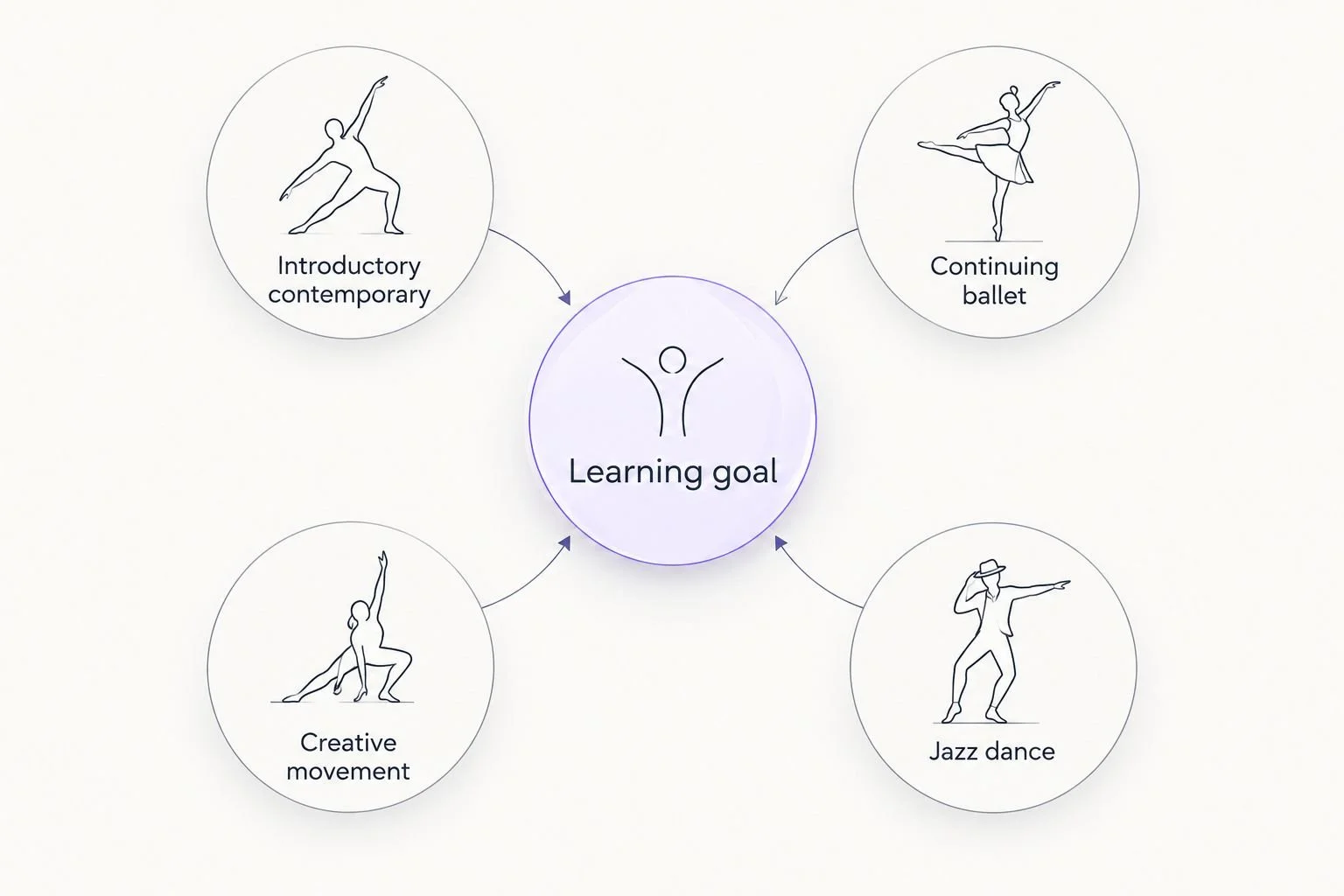
Choose the learning goal before deciding which class label fits.
Common mistakes families make when adding contemporary
Treating contemporary as advanced ballet
Contemporary is a distinct area of dance, not a reward for reaching a particular ballet level. Ballet experience contributes useful skills, but it does not cover every movement approach. Describe your child’s background and let the placement conversation address what is new.
Choosing by a performance clip alone
A polished performance shows choreography, not the full teaching process. It does not explain how beginners learn transitions, receive corrections, or build toward that material. Ask what students practice during lessons and which experience the class expects.
Assuming flexibility determines readiness
A large movement range does not tell you whether a student understands transitions, responds to instruction, or feels comfortable in the group. Avoid choosing a class because your child can copy a striking shape. Ask about the skills needed to participate in the lesson.
Solving the timetable but ignoring the journey
A lesson can avoid a school conflict and still create a difficult evening. Check the complete routine, including siblings’ needs and the trip home. For families planning across county lines, actual travel matters more than whether a class looks close on a map.
Expecting confidence to look the same in every style
A confident ballet student can feel uncertain when asked to improvise or learn unfamiliar floorwork. Do not interpret that first reaction as a final verdict. Ask what support the teacher provides and whether your child wants another opportunity to explore the material.
Questions to ask before registration
Keep your inquiry short enough to get clear answers. Start with your child’s age, recent ballet experience, interest in contemporary, and scheduling constraints. Then ask these 3 questions: Which class fits that background? What should a new student expect? What is the next registration step?
The Garden Arts Center offers dance and other arts lessons for children and adults. For a family considering contemporary, the useful next move is a placement and scheduling conversation—not an assumption about a level, timetable, or required class combination.
For your 2026 inquiry, keep notes beside the family calendar. That makes it easier to compare the teacher’s recommendation with the commitment you can actually make.
Explore your dance class options
Review the center’s offerings, then ask about placement, scheduling, and registration.
FAQ
Are contemporary dance classes suitable for a child who already takes ballet?
Contemporary dance classes can suit a ballet-trained child when the placement matches their contemporary experience and learning needs. Share their background with the instructor rather than assuming their ballet level transfers directly.
Does my child need advanced ballet before starting contemporary?
Advanced ballet is not a universal prerequisite for contemporary dance. Ask the specific class provider which skills and experience students need before joining.
What is different about contemporary dance compared with ballet?
Contemporary dance explores movement approaches beyond classical ballet vocabulary, including varied dynamics, weight shifts, improvisation, or floorwork. The combination depends on the teacher and class, so ask what the particular lesson covers.
Should my child stop ballet to take contemporary?
Taking contemporary does not automatically require stopping ballet. Decide according to your child’s interests, the instructor’s guidance, and the weekly commitment your family can sustain.
How do I choose contemporary dance classes for my child in 2026?
Choose contemporary dance classes by teaching focus, appropriate placement, and a workable family schedule. Ask about lesson content and expectations before taking the next registration step.
What should my child wear to a contemporary dance class?
Follow the specific class’s clothing and footwear requirements. Ask before buying anything, and do not assume ballet shoes or another class’s uniform will be required.
How can families fit contemporary around school and other activities?
Plan the full outing, not just the lesson. Include travel, changing, pickup, meals, homework, and existing activities before deciding whether the weekly commitment fits.
One last thing
Ask your child what they learned, not just whether they were good at it. That small change keeps the conversation focused on discovery rather than comparison.
For your family’s 2026 decision, the strongest next step is simple: match an interested student with suitable instruction and a week that has room for it. A welcoming arts experience should leave space to learn.