

Yes, a teen can start ballet without any prior dance training; the right starting point is a beginner class that teaches foundations rather than assumes them. For a family choosing classes in 2026, the key caveat is placement: a class labeled for teens is not necessarily designed for first-time dancers. Ask about prerequisites, instruction, and the weekly commitment before registering.
TL;DR
Searching ballet dance classes for teens no experience? Choose beginner instruction, not an age label alone.
The Garden Arts Center offers ballet; ask which placement fits a teen starting without dance experience.
Beginner ballet builds foundations; pointe is not a starting option for an untrained dancer.
Choose a weekly commitment that fits school, travel, homework, and your teen’s interest.
Can a teen start ballet without any prior dance training?
Yes. Previous dance lessons are not a prerequisite for learning beginner ballet. Your teen needs instruction that introduces movement vocabulary, coordination, alignment, and musical timing without expecting those skills on arrival.
A useful first step is understanding how ballet classes teach technique to beginners. Then ask whether the class you are considering follows that starting point or expects established technique.
Use this sequence when discussing placement:
Describe the starting point. Say plainly that your teen has never taken dance lessons, even if they enjoy dancing at home.
Ask about prerequisites. Find out whether students must already recognize ballet terminology or follow combinations independently.
Check the teaching approach. Ask how the instructor explains unfamiliar steps and gives corrections to beginners.
Confirm the practical commitment. Review the actual schedule, travel, clothing requirements, and any additional participation expectations.
The goal is not to find the most advanced class your teen can enter. It is to find instruction your teen can understand, practice, and return to consistently.
Why this matters
Starting ballet as a teen means being new at something while becoming more aware of other people's abilities. A class that assumes prior knowledge adds an avoidable barrier: the student must learn the movement and decipher the instructions simultaneously.
For your 2026 class search, separate the desire to belong with peers from the need for beginner teaching. Both matter. An age-appropriate environment helps address the social side, while clear explanations and suitable placement address the learning side.
Your teen does not need to arrive looking like an experienced dancer. Your family needs a clear answer about where a first-time student belongs and how that student receives guidance.
Which ballet class format should a beginner teen consider?
Class names alone do not establish suitability. The following comparison describes general formats, not confirmed class groupings at any particular center.
Beginner ballet with suitable age placement
Best for: Teens learning ballet for the first time
What makes it useful: Introduces foundations without assuming previous ballet lessons
Limitation to check: Confirm that beginner means no prior training, not simply less experience
Mixed-level ballet
Best for: Students whose starting skills the instructor can accommodate
What makes it useful: Brings different experience levels into one class
Limitation to check: A new student needs explanations and appropriately adjusted work; ask how those are provided
Pointe
Best for: Dancers whose teacher has assessed readiness after ballet training
What makes it useful: Develops a specialized part of ballet technique
Limitation to check: Not a starting class for a teen without training
Beginner ballet is the best starting choice for a teen with no dance experience. A mixed-level class deserves a placement conversation rather than an automatic yes or no. Pointe belongs later, subject to the teacher's assessment, not to a student's age or enthusiasm alone.
If the description is unclear, ask what an instructor expects a student to know on the first day. That answer is more useful than labels such as introductory, open, or teen.
What does a teen learn in beginner ballet?
Beginner ballet introduces skills that experienced dancers continue refining. These examples describe ballet foundations, not a promised syllabus or lesson sequence.
Alignment and controlled movement
Students learn to organize the body while standing and moving. Instruction addresses relationships among the feet, knees, hips, torso, and head rather than treating a pose as something to copy at any cost.
A useful question is how the teacher explains turnout without asking students to force their feet outward. Sound instruction works with the dancer's current control and range of movement.
Ballet vocabulary
A plié is a bending movement; a tendu stretches the working leg with the foot maintaining contact with the floor. Learning the words alongside demonstrations helps students connect spoken instructions with physical actions.
Your teen does not need to memorize a ballet dictionary before attending. Ask whether the instructor introduces unfamiliar terms as part of teaching the movements.
Musical timing and coordination
Ballet involves coordinating movement with music and connecting actions into sequences. A beginner is learning where to move, when to move, and how separate movements fit together.
Difficulty remembering a sequence does not establish that a student is unsuited to ballet. It identifies something the student is still learning.
Classroom routines
Students also learn how to follow demonstrations, use shared space, and respond to corrections. These routines are part of becoming comfortable in a dance class, not knowledge a first-time student must already possess.
Ask how students signal that they need an explanation. A teen who knows how to ask for help has a practical way to handle an unfamiliar exercise.
Why the right starting class varies
The best placement depends on more than age. Discuss these factors before choosing:
Previous movement experience: Tell the instructor about sports, theater, or informal dance experience without presenting them as substitutes for ballet training.
Existing class expectations: Ask what students are already expected to recognize, remember, and perform.
Instructional support: Find out how the teacher demonstrates movements, checks understanding, and responds when a student needs another explanation.
Social comfort: Ask about age grouping and how new students enter an established class community.
Individual needs: Share relevant learning, access, or health considerations so you can discuss appropriate participation.
Family logistics: Check whether travel and the weekly schedule make attendance sustainable.
No single factor settles the decision. An enthusiastic teen still needs appropriate instruction, and an appealing class still needs to fit the family calendar.
How can you fit beginner ballet into the family week?
Choose a commitment your family can maintain, not the fullest schedule you can imagine. For 2026 planning, build the trip into the decision before adding another activity.
Families across Berks, Montgomery, and Chester counties—including Douglassville, Pottstown, Phoenixville, King of Prussia, Reading, and Lansdale—should check the actual class location and route. A town mentioned in a service area does not establish a physical teaching location there.
Use this planning sequence:
School commitments: Put dismissal, homework demands, clubs, and existing activities on the calendar.
Travel: Check both the trip to class and the trip home, including who handles transportation.
Class commitment: Confirm the lesson schedule and ask about any other expected participation.
Family review: Let your teen explain whether the plan feels manageable alongside school and rest.
A calendar should show the whole commitment, not just the minutes spent dancing. Avoid treating an open space on the timetable as proof that the evening works.
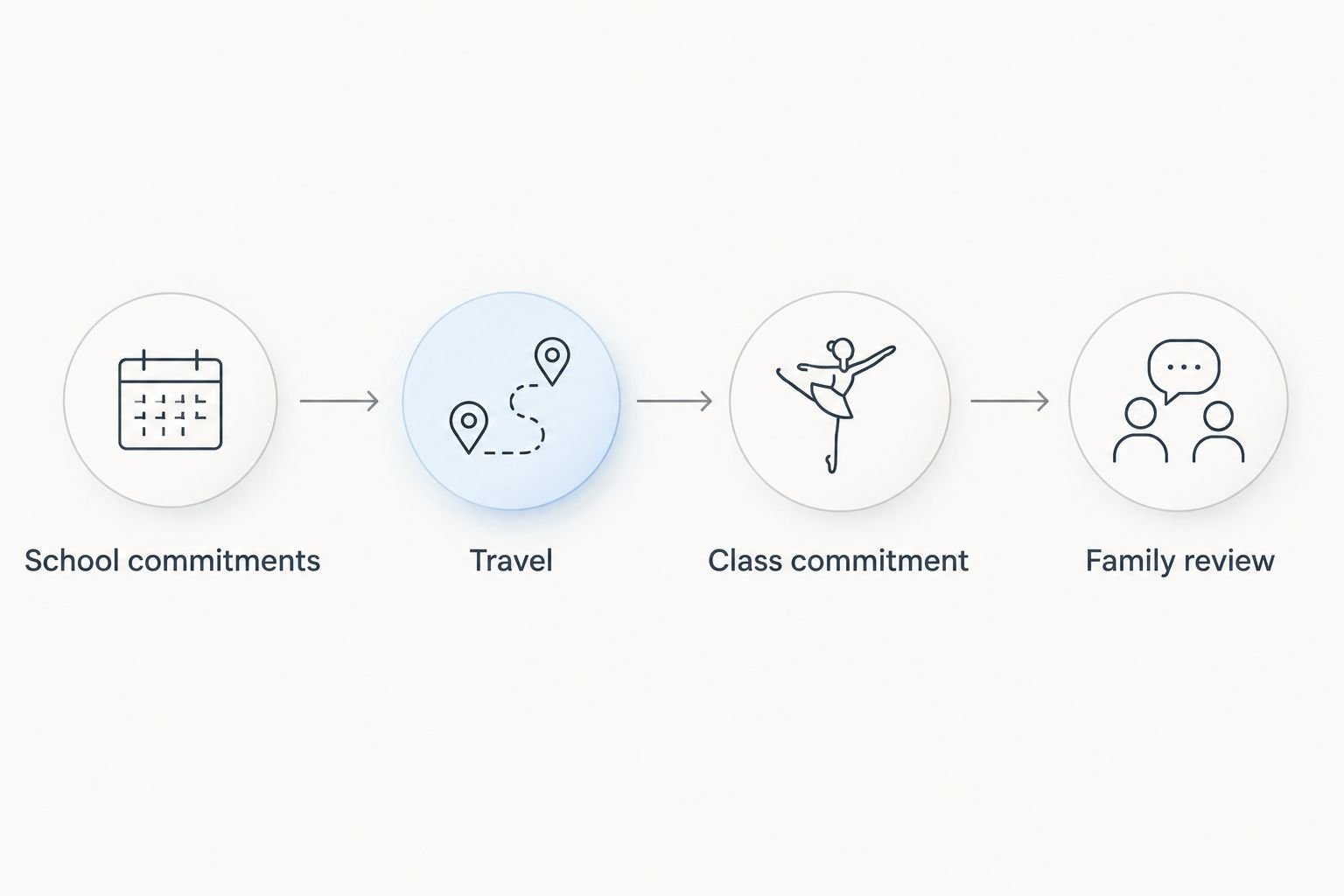
Check the whole evening before choosing a weekly class.
Revisit the plan when school activities change. Ask about the center's actual attendance and scheduling policies rather than assuming that missed lessons, makeups, or schedule changes work a particular way.
What should you ask before registering?
A useful inquiry gives the center enough information to discuss placement without turning your teen's inexperience into a problem to solve before they arrive.
Include your teen's age, lack of previous dance training, interest in ballet, and realistic scheduling constraints. Mention any relevant learning or participation needs you want to discuss privately.
Then ask:
Which ballet placement is appropriate for a teen with no previous lessons?
Does that class teach terminology and foundations from the beginning?
How does the instructor support a student who needs a demonstration repeated?
What clothing and footwear are required before the first lesson?
What commitments beyond regular lessons should families understand?
What steps are needed before registration?
For 2026 registration planning, contact The Garden Arts Center to discuss beginner ballet placement and the current schedule. The Garden Arts Center offers ballet within an arts community serving different ages and abilities; confirm the specific class fit rather than assuming a dedicated teen-beginner grouping.
The Garden Arts Center is best for families seeking ballet within a broader arts community. Its range of disciplines is relevant if your teen also enjoys theater, music, or other dance styles, but breadth alone does not determine the right ballet placement.
Ask about beginner ballet placement
Share your teen’s starting point and scheduling needs before choosing a class.
Does my teen need to be flexible before starting ballet?
No prior flexibility benchmark is required to begin learning ballet. Your teen should not force stretches or turnout to look ready for class; ask the instructor what preparation, if any, is appropriate.
If your teen has pain, an injury, or a health concern, seek appropriate clinical advice and discuss relevant participation needs with the instructor. A class-placement conversation is not a medical assessment.
Will my teen have to dance with younger children?
Age grouping depends on the actual class structure. Ask how the center balances age, experience, and instructional needs rather than assuming every beginner joins the youngest group.
Your teen's comfort matters. Include them in the conversation about the group and how the teacher welcomes a new student.
How soon can a beginner teen start pointe?
Pointe is not an entry point for a teen without ballet training. Readiness depends on assessment of ballet technique, strength, control, and other individual considerations—not simply reaching a particular birthday.
Ask the ballet teacher to explain the preparation and assessment process. Avoid buying pointe shoes or practicing pointe independently in anticipation of future classes.
FAQ
Is it too late to start ballet as a teenager?
No, a teenager can begin learning ballet without previous dance training. Choose instruction that starts with foundations and discuss placement rather than assuming an age label guarantees beginner suitability.
What should I search for if my teen has never danced?
Search for beginner ballet instruction that explicitly accepts students without prior training. When reviewing ballet dance classes for teens no experience, confirm both the age grouping and the skills expected on entry.
Does my teen need to learn ballet steps before the first class?
No, a beginner should not need to arrive already knowing ballet steps. Ask whether the class introduces terminology and demonstrations from the beginning.
What should a teen wear to a first ballet lesson?
Follow the center's confirmed clothing and footwear requirements. Ask before purchasing anything, because a general ballet clothing list does not establish a particular class's dress code.
Can a teen take ballet just for enjoyment?
Yes, a teen can learn ballet for enjoyment rather than a professional ambition. Explain that goal during the placement conversation so you can discuss the class's expectations.
Should a beginner teen practice ballet at home?
A beginner teen should ask the instructor which class exercises are appropriate to repeat at home. Avoid unsupervised pointe work, forced turnout, or attempts to copy advanced movements from videos.
How do I find the right class at The Garden Arts Center?
Contact The Garden Arts Center with your teen's age, experience, interests, and scheduling needs. Ask which ballet placement teaches foundations and what you need to confirm before registration.
One last thing
For your 2026 decision, ask your teen what would make returning after an unfamiliar first lesson feel manageable. The answer might be knowing how to ask a question, understanding the routine, or having enough time to get there without rushing.
Make the first goal understanding the class, not matching an experienced dancer. That gives your family a clearer basis for choosing instruction and deciding whether the weekly commitment fits.