

Children should begin jazz dance when they can participate in a teacher-led group, follow simple movement directions, and enjoy learning steps to music—not simply when they reach a particular birthday. For your 2026 enrollment decision, confirm the program’s age requirements and beginner placement, then consider whether the weekly commitment fits your child and your family.
TL;DR
For jazz dance classes for kids, age requirements and individual readiness both matter; ask about beginner placement.
Choose creative movement when playful exploration fits better than learning set steps.
The Garden Arts Center offers kids dance alongside other arts classes for children and adults.
Confirm prerequisites, travel, school commitments, and class expectations before registering.
What age should children begin jazz dance classes?
The right starting point is an age-appropriate beginner class that matches your child’s readiness. A birthday alone does not tell you whether your child will enjoy following a teacher, sharing movement space, or repeating a short sequence.
Start with the program’s stated age requirements. Then ask how instructors place children who are new to dance, especially when a child’s age and previous experience point toward different groups. A class labeled “kids jazz” still needs clarification about prerequisites and teaching expectations.
For a closer look at the subject, read about beginner jazz dance rhythm and technique. Use the explanation to prepare questions rather than treating a class name as a complete description.
Creative movement
Best for: Children who prefer playful movement exploration
What to clarify: How the class introduces listening, rhythm, and shared space
Limitation to consider: It is not the same as learning a dedicated jazz vocabulary
Beginner jazz
Best for: Children interested in learning set steps to music
What to clarify: Age requirements, prerequisites, and how steps are introduced
Limitation to consider: Repetition and teacher-led sequences might not suit every child yet
Beginner ballet
Best for: Children interested in ballet movement and technique
What to clarify: Whether the class accepts children without previous training
Limitation to consider: It is a different starting style, not a universal prerequisite for jazz
These are different entry points, not a ranking of children’s ability. Choose the teaching format your child can participate in now rather than the class that sounds most advanced.
Why this matters
A child can love dancing at home without knowing what a group dance lesson involves. At home, your child controls the music, pace, and stopping point; in class, the teacher guides the activity and students share the space.
Your 2026 class choice should account for both experiences. Interest matters, but so does your child’s willingness to listen, try an unfamiliar movement, and return to it after a correction. None of that requires polished dancing before the first lesson.
Look for a manageable beginning, not proof of talent. You are choosing somewhere to learn, not asking your child to demonstrate the finished result.
How can you tell whether your child is ready?
Use everyday observations to prepare for a conversation with the instructor. These are practical questions, not a developmental test or a substitute for the program’s placement guidance.
Interest in learning
Ask whether your child wants to learn dance steps with a teacher, rather than only whether they like music. Explain that a lesson includes watching, trying, and practicing—not just choosing favorite songs.
A child does not need to know the word “jazz” to express an interest. You can describe the activity plainly: learning movements, putting them together, and dancing with a group.
Following directions
Notice how your child responds to simple movement instructions during everyday play. Can your child listen, try the action, and pause for the next direction?
Do not turn this into an audition at home. If instructions are difficult, tell the instructor what helps your child understand them and ask how the class presents new material.
Sharing space
Group dance involves awareness of other people. Ask how the class introduces personal space, waiting, and moving without crowding classmates.
Your child does not need perfect group habits before starting. The useful question is whether the teaching environment can support the habits your child is still learning.
Trying again
Learning a movement involves revisiting it. Consider whether your child is willing to try something unfamiliar after watching an adult demonstrate it.
Frustration is information, not a reason to label your child unready for every dance class. Ask whether a different class format or starting level would be a better match.
Creative movement or beginner jazz: which fits now?
Creative movement is a sensible option when your child wants to explore movement more than practice set steps. Beginner jazz is the option to investigate when your child shows interest in learning and repeating a teacher-led sequence.
Neither choice needs to become a permanent track. Ask how the program handles later placement changes and what the instructor looks for before recommending another class. Do not assume that moving into jazz happens automatically after a particular birthday.
For families planning activities in 2026, this distinction can simplify the decision: choose the format your child can enjoy participating in now. There is no need to select a more structured class simply because another child has started it.
Ballet is another possible beginning, but it serves a different interest. If your child specifically wants jazz, ask whether the beginner jazz class requires ballet experience instead of adding an extra commitment by assumption.
Why the right starting age varies
There is no single age answer that replaces the details of the actual class. These factors help explain why children of the same age can need different placements:
Program requirements: Confirm the class’s stated age criteria rather than borrowing an age range from another school.
Previous experience: Tell the instructor about earlier dance or group-class participation without assuming it guarantees a particular level.
Teaching format: Ask whether the class emphasizes exploratory activities, set exercises, or learning movement sequences.
Support needs: Explain useful communication approaches, transition concerns, or accommodations you want to discuss.
Weekly demands: Consider school, travel, meals, and other activities when deciding whether participation is sustainable.
Age and readiness belong in the same conversation. Neither should be used to ignore the other: interest does not override an enrollment requirement, and meeting an age requirement does not explain every part of class fit.
How to choose a class without overloading your week
Before registering for 2026, work through the class decision in this order. A suitable dance style still needs a workable place in your family’s routine.
Child interest: Ask what your child hopes to do in dance class. Listen for interest in learning with others, not just enthusiasm for an outfit or performance.
Class placement: Confirm age requirements, experience expectations, and who answers placement questions. Describe your child’s starting point accurately.
Weekly schedule: Compare the actual lesson information with school dismissal, existing activities, meals, and bedtime routines.
Travel plan: Check the route from wherever your family will actually begin the trip, including the return journey and sibling arrangements.
Once those pieces fit, ask about registration requirements and any additional commitments. Keep the decision tied to the information you receive rather than an imagined version of the week.
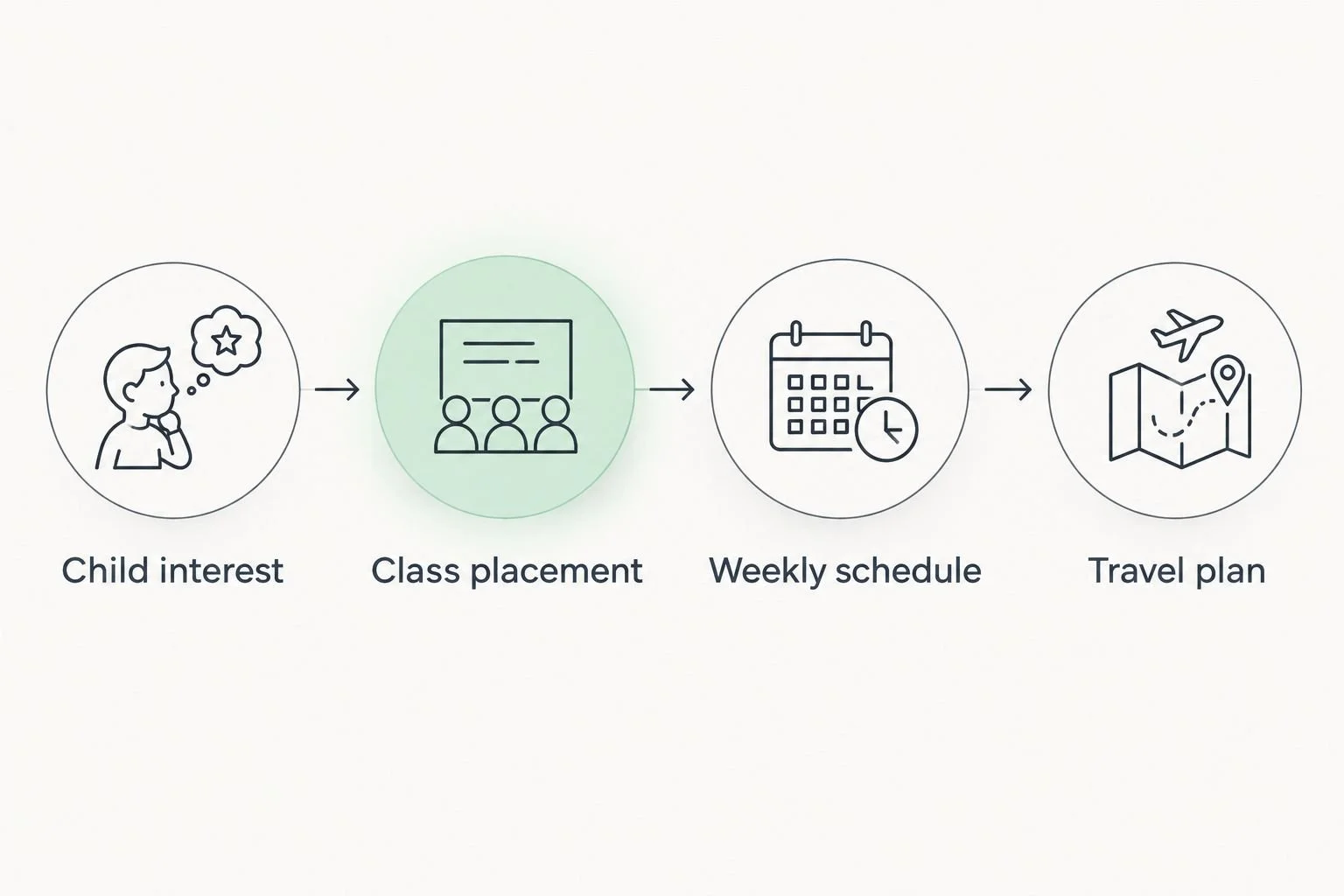
Confirm class fit and the family routine before registering.
Families across Berks, Montgomery, and Chester counties need to make this calculation from their own starting point. Whether you are traveling from Douglassville, Pottstown, Phoenixville, King of Prussia, Reading, or Lansdale, check the class location and route rather than assuming a nearby town name means a nearby classroom.
A practical question is: can your family repeat this trip on an ordinary school week? Include the time needed to leave, arrive, and get home—not just the lesson itself.
What should you ask about beginner jazz instruction?
Ask what beginners actually learn and how the instructor introduces it. “Beginner” should lead to a useful explanation of the class, not end the conversation.
Jazz dance includes work with rhythm, coordination, body isolations, and movement combinations. For example, an isolation separates the movement of a body part from surrounding movement; a combination joins steps into a sequence. Ask which foundations the particular class introduces and how instruction changes for its age group.
Useful questions include:
How do you demonstrate a new movement before asking children to try it?
How do you help a student who needs another explanation?
What does an appropriate beginner level look like in this class?
How do you approach alignment and controlled movement?
What should a parent communicate before the first lesson?
Choose clear teaching expectations over impressive-sounding labels. You do not need to assess advanced technique yourself; you need an understandable account of how your child will begin learning.
Where does The Garden Arts Center fit?
The Garden Arts Center is a fit for families seeking kids dance classes within a broader arts community. Its offerings include jazz, ballet, tap, creative movement, other dance styles, music, theater, art, and wellness classes for children and adults.
That breadth gives families with different interests a place to explore. It does not establish that particular classes share a timetable or that siblings can attend together; those details need confirmation.
For jazz dance classes at The Garden Arts Center, use the contact page to ask about age requirements, beginner placement, and the information needed before registration. Include your child’s previous experience and your scheduling constraints so the conversation addresses both learning fit and family logistics.
Ask about a suitable starting class
Discuss your child’s experience, placement questions, and family scheduling needs.
Does my child need ballet before starting jazz?
Ballet is not something you should add by assumption before beginner jazz. Ask whether the specific jazz class has a ballet prerequisite and whether any recommended supporting training is required or optional.
If another class is suggested, ask what it contributes and how it fits your child’s current workload. A recommendation is most useful when you understand its purpose.
Is my child too late to begin if classmates have danced before?
Previous experience is a placement question, not a reason to rule out starting. Ask for a class that teaches foundations rather than choosing a group solely because its students are the same age.
Your child should not have to pretend to know unfamiliar steps. Describe the starting point honestly and ask how new students learn the class vocabulary.
FAQ
What age should my child start jazz dance classes?
Choose a starting class by its age requirements and your child’s readiness for teacher-led group learning. Confirm beginner placement rather than treating a birthday as the only deciding factor.
How do I know whether my child is ready for jazz dance?
Look for interest in learning movements, trying simple directions, sharing space, and practicing with a teacher. Discuss any concerns or support needs with the instructor before choosing a class.
Should my child try creative movement before jazz?
Creative movement is an option when playful exploration fits your child better than learning set steps. Ask which format matches your child’s interests and the program’s placement criteria.
Can my child start jazz without previous dance lessons?
Ask for a beginner jazz class that accepts students without previous lessons. Confirm its prerequisites, because an age-group label does not explain the expected experience level.
What should I ask before registering for jazz in 2026?
Confirm age requirements, beginner placement, prerequisites, lesson details, and registration expectations. Then compare the commitment with travel, school activities, and your family’s weekly routine.
Does The Garden Arts Center offer jazz dance for children?
The Garden Arts Center lists jazz among its dance offerings for children and adults. Contact the center to confirm the appropriate class for your child’s age, experience, and scheduling needs.
What should I do if my child feels nervous about starting?
Explain what learning in a group involves and ask your child what feels unfamiliar. Share those concerns with the instructor and ask how the class supports students who need help settling in.
One last thing
Before committing to a 2026 class, rehearse the proposed family routine on paper. Write down where your child will be beforehand, who handles transportation, and what happens after the lesson.
A suitable class and a sustainable week belong together. If the learning fit is right but the logistics are not, ask about other class options rather than expecting your family to absorb a routine that already looks difficult.