

Yes, kids with little rhythm can enjoy hip hop dance classes for kids; keeping a beat is something they can practice, not a skill they must perfect before starting. Choose a class that welcomes beginners and teaches movements in manageable parts, rather than expecting your child to follow a finished routine immediately.
TL;DR
Hip hop dance classes for kids can suit beginners who enjoy music but struggle to stay on beat.
Choose beginner instruction that separates the beat, footwork, and arm movements before combining them.
The Garden Arts Center offers families dance within a broader arts community.
Consider your child's interest, instructional support, and family schedule—not rhythm alone.
Why this matters
A child who misses a beat has not failed a readiness test. Listening to music, remembering movements, and coordinating different body parts are separate tasks; putting them together takes practice.
For your family's 2026 class search, start with interest rather than a judgment about talent. A child who wants to move to music has a reason to explore dance, even when the movements do not yet match the song.
The Garden Arts Center is a fit for families seeking dance instruction within a broader arts community. Alongside dance, The Garden Arts Center offers theater, music, art, and wellness classes for children and adults.
Can kids with little rhythm still enjoy hip hop dance classes?
Yes—beginner hip hop can give children a place to practice rhythm while enjoying movement. The important distinction is between a class that teaches foundations and a class that expects students to arrive with those foundations already in place.
When you evaluate hip hop dance classes for kids in 2026, ask how the instructor introduces unfamiliar movement. These teaching approaches address different parts of the challenge:
Clapping or stepping to a steady beat
Best for: Children finding the pulse
What it helps children practice: Matching a simple action to music
Limitation to discuss: It does not teach a whole dance combination
Practicing feet before adding arms
Best for: Children overwhelmed by simultaneous movements
What it helps children practice: Learning footwork with fewer competing tasks
Limitation to discuss: The combined movement still needs practice
Repeating a short movement phrase
Best for: Children learning movement order
What it helps children practice: Remembering what comes next
Limitation to discuss: Repetition needs explanation, not just another attempt
Using spoken counts alongside music
Best for: Children who benefit from clear timing cues
What it helps children practice: Connecting movements with timing
Limitation to discuss: Children also need opportunities to listen to the music
These are teaching approaches to ask about, not a description of a particular class's lesson plan. The strongest answer from an instructor explains how a beginner receives help when the group moves ahead.
Enjoyment does not require perfect timing
Your child can enjoy a song, participate in a movement activity, and feel proud of learning a step without staying on beat throughout. Enjoyment and technical accuracy are different questions.
Ask your child what felt interesting and what felt confusing. Their answers tell you more about class fit than whether they copied every movement correctly.
Being new is different from being in the wrong level
A beginner class should not require prior dance experience unless its stated entry requirements say otherwise. Still, the word beginner does not tell you everything about pace, age grouping, or expectations.
Ask whether the group includes children learning dance for the first time. Also ask what happens when a student needs a movement demonstrated again; that answer makes the teaching approach more concrete.
How can you help your child try rhythm without pressure?
Keep home exploration playful and optional. You are helping your child notice music, not conducting an audition or replacing a dance teacher.
Listen together. Choose music your child enjoys and listen for a steady pulse. Tap along yourself without asking your child to perform.
Find the beat. Invite your child to clap or gently tap a hand to that pulse. A simple 4-beat pattern gives you something short to repeat.
Add movement. Try stepping in place while keeping the same pulse. Leave complicated arm movements out for now.
Combine gradually. If your child wants another challenge, add a comfortable arm movement. Return to stepping alone if combining actions becomes frustrating.
Ask about enjoyment. Finish by asking what felt fun or which song they would choose next. Do not score the attempt.
The purpose is exploration. There is no need to master an 8-count phrase before asking about a beginner class, and no reason to turn a missed beat into a family concern.
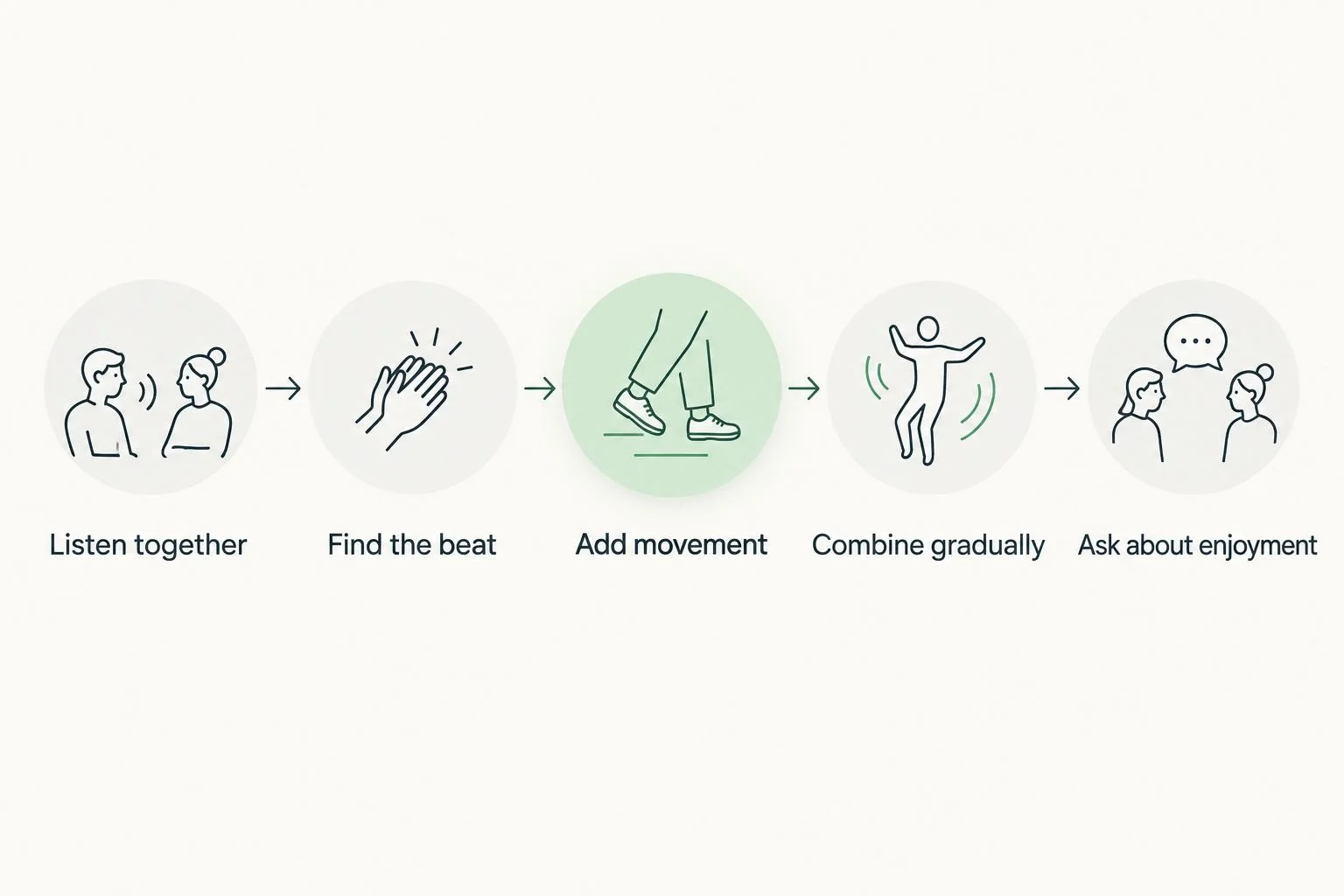
Keep rhythm exploration simple, optional, and focused on enjoyment.
Why the beginner experience varies
Difficulty with rhythm does not tell you which part of a class feels difficult. Look at these factors before deciding that hip hop is unsuitable:
Starting experience. A child learning to follow movement instructions needs different support from a child who already knows classroom routines.
Instructional pace. Demonstration, explanation, and time to repeat a movement make the learning task different from immediately following a full combination.
Movement complexity. Stepping to a beat and coordinating feet, arms, and direction changes are not equivalent tasks.
Comfort asking for help. Ask how the instructor responds when a child loses their place or does not understand a correction.
The weekly commitment. Travel, school activities, meals, and other commitments affect whether the class is practical for your family.
Avoid treating every difficulty as a rhythm problem. If your child understands the beat but forgets the sequence, ask about help remembering movement order rather than requesting more counting alone.
What should you ask before choosing a class?
For a 2026 enrollment decision, ask questions that reveal what beginner support looks like. General reassurance is less useful than an explanation of the teaching process.
Does this class welcome children with no dance experience?
How do you introduce the beat before teaching combinations?
Do you separate footwork from arm movements when students need that?
How do you help a child who loses their place?
What age and experience guidelines apply to this group?
What clothing and footwear does the instructor require?
What weekly attendance and performance commitments should families understand?
Listen for respectful, specific answers. An explanation of how a teacher breaks down a step is more useful than a promise that every child will quickly catch up.
The Garden Arts Center offers dance and related arts instruction, but your child's fit still depends on the particular class. Use the contact page to ask about beginner expectations, current scheduling, and the next steps toward registration.
Ask about beginner dance
Discuss your child's experience, class expectations, and your family's scheduling needs.
Should you choose hip hop or creative movement?
Choose according to your child's interests and the class's entry expectations, not a ranking of dance styles. Creative movement and beginner hip hop can both introduce movement with music, but their teaching emphasis differs.
Beginner hip hop
Best for: Children interested in hip hop music and movement
What to ask about: How foundational steps and timing are introduced
Trade-off: Following combinations can add a memory challenge alongside rhythm
Creative movement
Best for: Children drawn to movement exploration
What to ask about: How music, space, and movement prompts shape lessons
Trade-off: It does not necessarily focus on hip hop-specific movement
Creative movement is not a required preliminary step for every hip hop beginner. Likewise, a child who enjoys open-ended movement does not need to rush into more structured combinations.
Ask what students actually do during class. The description of an activity is a better guide than assuming that one style is automatically easier or more suitable for every child.
How can families make dance fit the week?
A suitable class also needs a sustainable journey and weekly commitment. When planning your 2026 schedule, consider the whole evening rather than the lesson in isolation.
For families across Berks, Montgomery, and Chester counties—including Douglassville, Pottstown, Phoenixville, King of Prussia, Reading, and Lansdale—check the teaching location before estimating travel. A community served by a center is not necessarily a town where it has a physical location.
Build your decision around these practical checks:
School finish: Allow for pickup, a snack, and changing clothes.
Travel: Check the route at the time you would actually make the trip.
Other activities: Look for conflicts with school events and existing commitments.
Home routine: Consider dinner, homework, and bedtime after the return journey.
Additional expectations: Ask about any rehearsals or performances before committing.
Do not assume that adding more classes will solve a rhythm concern. Start with a commitment your family can sustain, and discuss additional training only when it serves your child's interests and needs.
What if my child feels embarrassed about missing the beat?
Missing the beat is a learning moment, not a reason to label your child as unmusical. Ask the instructor how mistakes and corrections are handled, especially when a child feels uncomfortable receiving attention.
At home, describe something you noticed rather than making a comparison with classmates. Mention willingness to try, attention to a demonstration, or enjoyment of a particular movement—only when you actually observed it.
How will I know whether the class is a good fit?
A good fit gives your child an understandable task, respectful guidance, and room to ask for help. Perfect timing is not the deciding measure.
Ask what your child remembers learning and whether they want to return. If confusion or distress continues, speak with the instructor about the specific difficulty before deciding whether to adjust the level or explore another class.
FAQ
Can my child start hip hop if they cannot keep a beat?
Yes, difficulty keeping a beat does not automatically rule out beginner hip hop. Ask whether the class teaches timing from the beginning and welcomes children with no previous dance experience.
Does my child need ballet before taking hip hop?
Ballet is not a universal prerequisite for beginner hip hop. Check the specific class's entry requirements rather than assuming your child needs another style first.
What should I tell the instructor if my child struggles with rhythm?
Describe what you have observed, such as difficulty clapping along or combining arm and foot movements. Ask how the instructor supports that task instead of labeling your child as having no rhythm.
Should we practice hip hop every day before enrolling?
Daily home practice is not a universal requirement for starting beginner hip hop. Keep optional movement play enjoyable and ask the instructor about any preparation the particular class expects.
Is creative movement better than hip hop for a beginner?
Creative movement is not automatically better than hip hop for every beginner. Choose according to your child's interests, the lesson activities, and the support provided for new students.
How long does it take a child to develop rhythm?
There is no single timeline that applies to every child. Ask the instructor for feedback on specific skills, such as finding the pulse or matching a step to it, rather than expecting progress by a fixed deadline.
What should we ask about before registering for kids hip hop?
Ask about experience requirements, teaching methods, clothing, scheduling, and attendance or performance commitments. Include travel and school activities when deciding whether the weekly routine works for your family.
One last thing
Before choosing a class in 2026, separate finding the beat from remembering the dance. A child who can clap along but loses their place in a combination needs a different conversation from a child still learning to hear the pulse.
Describe the task that is difficult, not a talent you think is missing. That gives your family and the instructor a clearer starting point—and leaves room for your child to enjoy learning.