

Yes—busy professionals can fit adult dance classes into their week by choosing a suitable level and protecting a recurring time slot that includes travel, changing, and the trip home. The workable choice is the class you can attend during an ordinary workweek, not just a quiet one; before registering in 2026, confirm the schedule, attendance expectations, and any commitments outside class.
TL;DR
Adult dance classes for busy schedules work best when travel and family responsibilities fit around a recurring class.
The Garden Arts Center offers adult dance classes within a broader arts community; ask about current levels and scheduling.
Choose beginner dance instruction by experience and interests, not by which class leaves the smallest calendar gap.
Confirm attendance expectations before registering, especially if work travel or changing shifts affect your week.
Why this matters
A dance class needs more space in your calendar than its teaching time alone. Leaving work, collecting a child, changing clothes, and getting home all affect whether the commitment feels sustainable.
For parents, the decision also belongs in the family calendar. A class that conflicts with school pickup or a partner’s work schedule needs a practical arrangement, not a promise to somehow make it work. Start with this guide to weekly time commitments for busy families, then assess your own routine.
The aim is not to fill every open evening. It is to make room for something you want to keep doing.
Can busy professionals fit adult dance classes into their week?
Yes, when the class fits both your experience and your door-to-door schedule. Use this sequence to assess a possible class before making a registration decision.
Map fixed commitments. Put work hours, school responsibilities, caregiving, and existing activities on your calendar first. Include obligations that happen irregularly but are already predictable, such as recurring business travel.
Check travel. Consider the route you would actually take: from work, from home, or after a pickup. Confirm the teaching address rather than assuming a class is near the town named in a search result.
Confirm class fit. Ask which adult class matches your experience, what foundations it covers, and whether prior training is expected. A convenient time does not make an unsuitable level appropriate.
Ask about attendance. Find out how absences, late arrivals, and any additional commitments are handled. Do not assume that a class permits occasional attendance or offers replacement sessions.
Choose a repeatable routine. Decide how you will get there, what needs preparing beforehand, and how you will get home. Register when the arrangement works without relying on rushed handoffs or unfinished responsibilities.
These steps also help you separate a genuine scheduling conflict from a question that simply needs an answer. Uncertainty about changing arrangements is something to ask about; a recurring overlap with work is a calendar problem to resolve first.
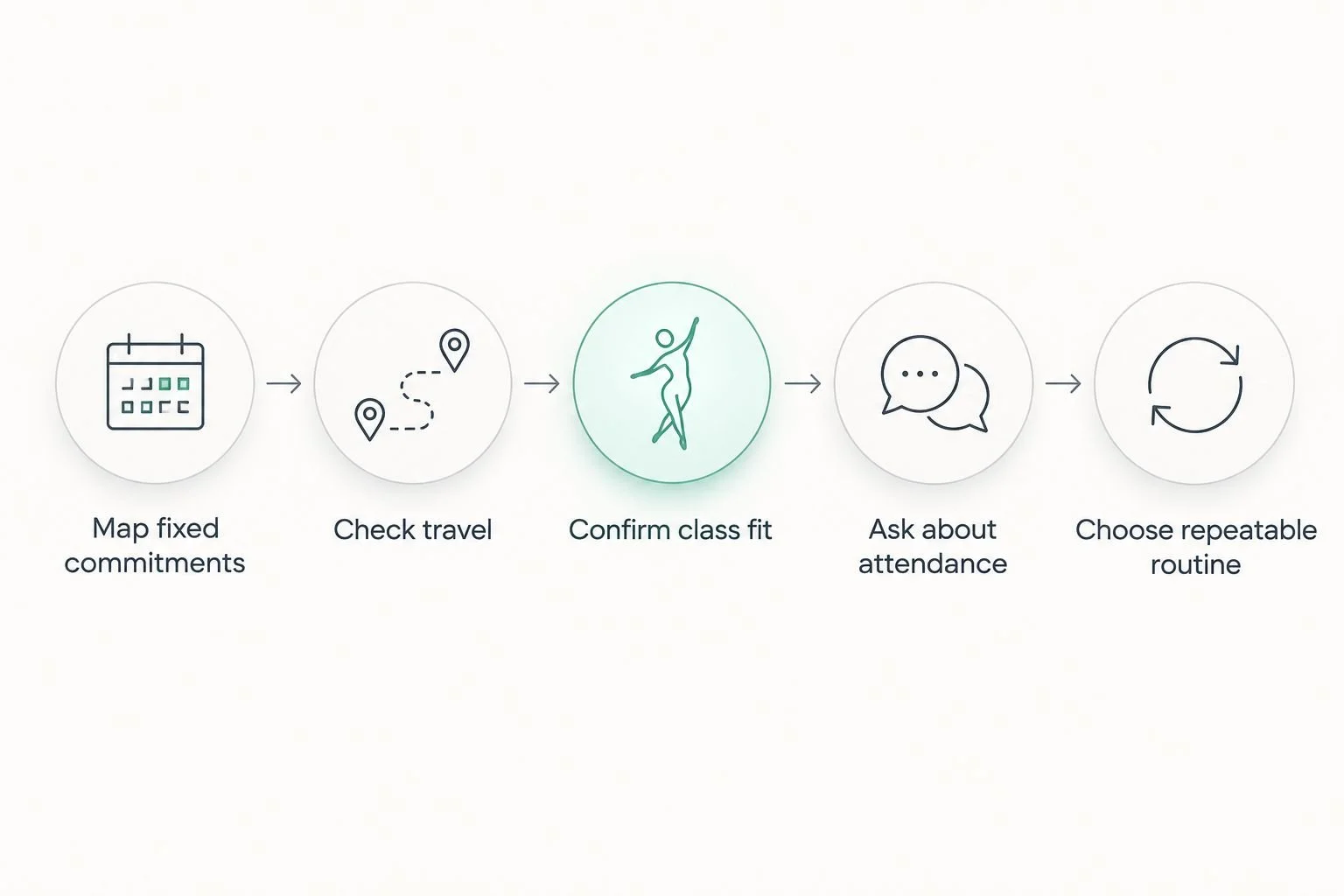
Check the whole routine before choosing a class by its start time.
Choose a dance style you want to return to
Interest matters alongside logistics. If you enjoy the movement and understand what you are learning, you have a clearer reason to protect that time in your week.
The comparison below describes general dance foundations, not a confirmed adult timetable or syllabus at The Garden Arts Center. Ask which styles and levels are currently taught to adults before choosing.
Ballet
Best for: Adults interested in structured technique
Typical learning focus: Alignment, placement, controlled movement, and coordination
Limitation to consider: Detailed foundational work requires patience; ask about beginner placement
Tap
Best for: Adults drawn to making rhythm through movement
Typical learning focus: Footwork, timing, weight shifts, and sound clarity
Limitation to consider: Footwork builds progressively; confirm footwear requirements before buying
Jazz
Best for: Adults who enjoy rhythmic movement and combinations
Typical learning focus: Coordination, isolations, musicality, and technique
Limitation to consider: Class labels alone do not establish the expected experience level
Hip hop
Best for: Adults interested in groove and rhythmic movement
Typical learning focus: Weight shifts, isolations, rhythm, and movement sequences
Limitation to consider: Teaching approaches differ; ask what the class actually covers
Contemporary
Best for: Adults interested in expressive movement
Typical learning focus: Movement quality, transitions, and use of space
Limitation to consider: Some classes expect existing technique; verify prerequisites
Choose the style you want to learn, then check the level and schedule. Do not assume that a dance style is easier, less demanding, or more suitable for beginners because of how it looks in a short video.
You do not need to decide your entire dance future before beginning. You do need a clear explanation of what the particular class expects from a new student.
Why the weekly commitment varies
The time you need depends on more than the dance style. These factors determine whether a class fits your actual life:
Work patterns. A predictable finish time creates different planning needs from rotating shifts or frequent travel. Explain the pattern when asking about attendance expectations.
Travel route. A journey from the office is different from a journey after school pickup. Assess the relevant route rather than distance alone.
Family handoffs. Childcare, meals, and another household member’s commitments affect when you can leave and return.
Class level. Ask whether the course assumes previous knowledge or includes expectations beyond the taught session. Do not infer either from a style name.
Participation requirements. Confirm whether performances, rehearsals, or other activities are part of the particular class. Never assume they are required—or absent.
Preparation needs. Clothing, footwear, changing arrangements, and belongings all belong in your practical plan. Get the actual requirements before buying anything.
For your 2026 calendar, write down the full commitment rather than entering only the class start time. That makes conflicts visible while you can still choose a different arrangement.
Make the journey part of the decision
If you are considering classes from Berks, Montgomery, or Chester County, use your own starting point and destination. Families and professionals in Douglassville, Pottstown, Phoenixville, King of Prussia, Reading, and Lansdale need to assess their individual routes; those town names do not establish where a center teaches.
Check the journey at the time you would normally travel. Include parking, the walk to the entrance, and any changing arrangements you need to confirm. A route that works on a free afternoon does not answer whether it works after your usual workday.
For parents, avoid building a plan around unconfirmed overlapping activities. Ask about each person’s actual class schedule and supervision arrangements before assuming that an adult lesson can happen while a child attends another activity.
A shared arts outing works only when the handoffs work. If coordinating everyone creates more strain than attending separately, choose the simpler arrangement.
What to ask before registering in 2026
A useful inquiry explains both your experience and your practical constraints. That gives the person advising you something specific to respond to, rather than leaving them to guess what “busy schedule” means.
Ask these questions about the particular adult class:
Is this class appropriate for someone with my dance background?
What foundational skills does the instructor teach?
What are the current meeting times and session dates?
What attendance expectations apply if my work schedule changes?
How are late arrivals and missed classes handled?
Are there commitments outside the regular class?
What clothing and footwear are required?
What should I know about arrival, changing, and departure?
The Garden Arts Center offers dance and other arts instruction for children and adults. The Garden Arts Center is best for adults seeking dance instruction within a broader arts community. That breadth is relevant for families with different interests, but it does not establish that everyone’s classes run together or that a particular work schedule will fit.
Use the contact page to describe your experience, preferred dance style, and scheduling constraints. Ask for guidance on a suitable class before treating an open calendar slot as a registration decision.
Ask about an adult dance class
Share your experience and scheduling constraints to ask about an appropriate next step.
Can I start adult dance without previous experience?
Yes—adults can begin learning dance without childhood training. The important distinction is between being new to dance and joining a class that expects prior technique.
Tell the instructor whether you are completely new, returning after a break, or experienced in a different style. Those are different starting points. Ask how the class introduces foundational movement rather than assuming all adult classes begin at the same level.
For a busy beginner, understandable instruction matters more than trying to keep pace with an unsuitable group. You should know what you are practicing and whom to ask when a movement needs clarification.
Can I attend dance if work sometimes runs late?
You need the class’s actual late-arrival and attendance expectations before deciding. Do not assume that arriving after the start is acceptable or that missed sessions can be replaced.
Explain whether the conflict is occasional or part of your normal work pattern. If the same meeting regularly overlaps with class, choose a different arrangement rather than making lateness the foundation of your plan.
A scheduling conversation should also cover travel-related absences. Ask what happens when you miss material and what the instructor expects when you return.
Should I wait until my schedule is less busy?
Wait if you cannot identify a workable recurring commitment; do not wait simply because your calendar is not perfect. The useful test is whether you can attend during a normal week without sacrificing essential responsibilities.
Before adding adult dance to your 2026 plans, decide what will make room for it. That might mean declining another optional activity, arranging a household handoff, or choosing a less congested part of the week.
If none of those changes is realistic, asking about a future session is a sensible next step. There is no need to turn an arts activity into another source of pressure.
FAQ
What should I look for in adult dance classes for busy schedules?
Look for an appropriate level, a workable door-to-door routine, and clearly explained attendance expectations. Confirm the actual schedule and any additional commitments before registering.
Can I take adult dance classes if I have never danced before?
Yes, adults can start dance without previous training when the class teaches beginners. Ask about placement and foundational instruction rather than assuming every adult class is introductory.
Does The Garden Arts Center teach adults as well as children?
The Garden Arts Center offers dance and other arts instruction for children and adults. Ask which adult styles and levels match your experience and current schedule.
Which dance style should a busy beginner choose?
Choose a style that interests you and a class that matches your experience. Ballet, tap, jazz, hip hop, and contemporary have different movement focuses, but no style name guarantees a convenient timetable or beginner placement.
Can I miss dance classes when I travel for work?
Ask about the particular class’s attendance expectations before registering. Do not assume that absences, replacement sessions, or flexible attendance are permitted.
Can my child and I take classes during the same trip?
Ask about the actual schedules and supervision arrangements before planning a shared trip. Offering classes for different ages does not establish that suitable sessions overlap.
What should I confirm before registering for adult dance in 2026?
Confirm the class level, meeting times, attendance expectations, clothing requirements, and any commitments outside class. Then check the full journey against work and family responsibilities.
One last thing
Plan the trip home before you commit to the trip there. It is easy to focus on reaching class after work and overlook dinner, caregiving, or preparation for the next day.
A sustainable dance routine leaves room for the rest of your evening. Give yourself permission to choose the class that fits your life—not the most ambitious calendar you can imagine.