

Choose vocal lessons by matching the teacher’s experience with young singers, the child’s musical interests, and a weekly commitment your family can sustain. Ask how instruction adapts to a developing voice, what practice involves, and how the teacher responds when singing feels uncomfortable or a child loses confidence.
TL;DR
Choose vocal lessons around your child’s interests, age-appropriate instruction, and a sustainable family schedule.
Ask singing teachers how they select songs, explain technique, and adapt lessons to a developing voice.
The Garden Arts Center offers vocal lessons within a broader arts community that includes dance, theater, and music.
Compare lesson formats by teaching attention and musical goals, not by which sounds most advanced.
Why this matters
A young singer’s enthusiasm deserves attention, but enthusiasm alone does not tell you which instruction fits. A child who loves acting out songs has different immediate interests from one who wants help singing melodies accurately. Start with what your child enjoys, then look for a teacher who can turn that interest into understandable musical work.
The Garden Arts Center is a fit for families seeking vocal lessons within a broader arts community. You can explore The Garden Arts Center as part of your search, while checking the specific teacher, lesson format, and scheduling details before registering.
For your family’s 2026 planning, the goal is not to find the busiest music calendar. It is to choose instruction your child wants to return to and a routine your household can support.
How do you choose vocal lessons for a young singer?
Use the following sequence to move from a general interest in singing to a clear enrollment decision. Ask prospective teachers the same questions so you can compare their answers rather than relying on impressions alone.
1. Start with your child’s reason for singing
Ask what your child wants to sing and where singing already happens: at home, in a school choir, during theater activities, or while listening to favorite music. A specific answer gives a teacher something useful to work with. Your child does not need a polished career goal.
Separate the child’s interest from an adult’s expectations. Wanting to enjoy songs is a valid starting point; preparing for an audition is a different brief. Tell the teacher which matters now rather than asking a beginner to work toward every possible goal.
2. Ask about experience teaching developing voices
Ask how the teacher adapts instruction for children and adolescents. Useful answers explain how songs are selected, how unfamiliar ideas are introduced, and how teaching changes when a student struggles. A performance background alone does not answer those questions.
Listen for an approach that avoids asking a child to imitate the weight, volume, or vocal qualities of an adult recording. Young singers need work suited to their own voices. Ask what the teacher does if an exercise feels strained or a song sits uncomfortably.
3. Make the teaching concrete
Ask for examples of what a student would work on. Pitch matching, rhythm, clear words, musical phrasing, and understanding a song’s meaning are useful discussion points. These are examples to ask about, not a promise that every provider follows the same curriculum.
A teacher should be able to explain an activity in language your child understands. For example, ask how the teacher would help a student find a starting note or keep a phrase connected without pushing for volume. Choose explanations your child can act on, not impressive terminology.
4. Clarify the work between lessons
Ask what practice would involve, how instructions are shared, and what role a parent should play. Find out whether the teacher expects independent work or help remembering the assignment. Do not assume a younger child can interpret written musical directions alone.
Discuss your actual home routine. Tell the teacher about homework, shared living space, and other activities so practice expectations are clear before you commit. An assignment that nobody understands is not useful simply because it appears on a lesson sheet.
5. Check the entire weekly commitment
For a 2026 lesson plan, look beyond the lesson itself. Include travel, school dismissal, meals, homework, and your child’s other activities. Ask the provider directly about current scheduling and attendance arrangements rather than assuming they resemble another activity’s rules.
Families comparing travel from Douglassville, Pottstown, Phoenixville, King of Prussia, Reading, or Lansdale should assess the route they would actually take. Consider the practical journey across Berks, Montgomery, and Chester counties without treating any town as a verified center location.
6. Agree on a meaningful first goal
Choose a goal the child and teacher can explain together. That might be following a melody more confidently, understanding a song’s rhythm, or preparing an appropriate selection for a school activity. Keep the goal tied to learning rather than a promised outcome.
Ask how the teacher will discuss progress with you and your child. Useful feedback identifies what the student is working on and what comes next. A performance opportunity, if one exists, is not a substitute for clear instruction.
Which vocal lesson format fits your child?
Individual instruction, group singing, and theater-focused work serve different purposes. These are general formats to compare, not a statement that every format is offered by a particular provider. For a 2026 enrollment decision, confirm the actual lesson structure before comparing it with another option.
Individual vocal lessons
Best for: A child seeking focused work on personal singing goals
Main advantage: The teacher can direct attention to the individual student
Limitation to consider: The child works without peer participation during that instruction
Group singing instruction
Best for: A child motivated by making music with others
Main advantage: Students can practice listening and singing together
Limitation to consider: Individual teaching attention is shared
Theater-focused singing work
Best for: A child interested in telling a story through song
Main advantage: Singing connects with character, text, and dramatic intention
Limitation to consider: The format alone does not establish how much vocal technique is taught
Choose individual vocal lessons for individualized instruction, group singing for shared music-making, and theater-focused work for song interpretation. None of these labels proves that a teacher is the right match. Ask what students actually do during the session.
Avoid choosing a format solely because it sounds like the next level. A child who enjoys a group does not automatically need to leave it, and a child who wants personal help does not need to demonstrate advanced skill before you ask about individual instruction.
Why the right vocal lessons vary between children
When comparing vocal lessons in 2026, use your child’s circumstances rather than another family’s timetable. The strongest choice balances these factors:
Musical interests: Favorite songs and activities give the teacher a starting point, but song selection still needs to suit the student’s voice.
Learning readiness: Consider whether your child enjoys trying an activity again, listening to instructions, and receiving help.
Current experience: School singing, theater participation, and previous lessons give useful context without determining a child’s potential.
Teaching fit: Notice whether explanations are clear and corrections preserve the child’s willingness to participate.
Weekly commitment: Account for travel, school activities, and the support available for practice at home.
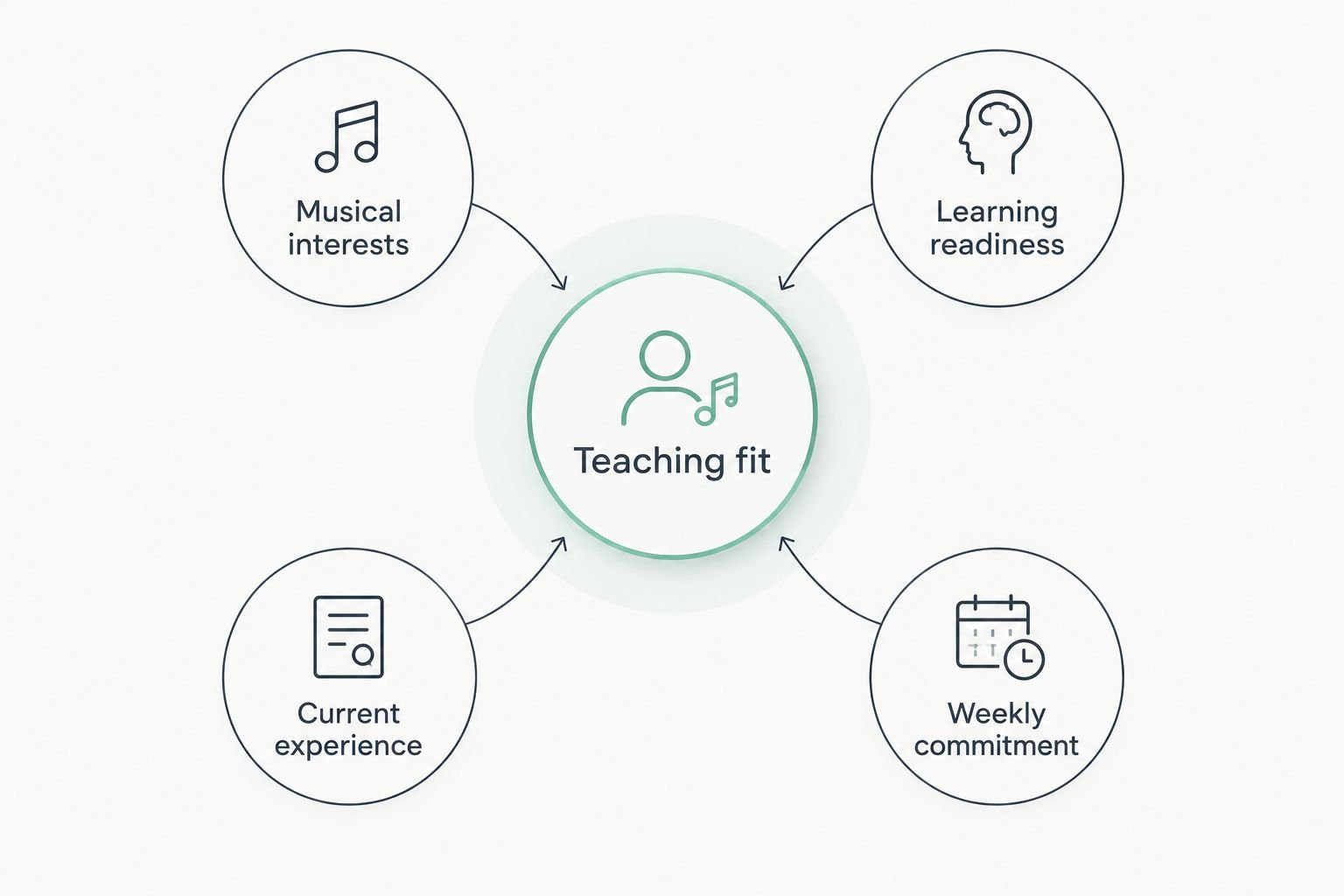
A suitable lesson choice accounts for the child and the family routine, not just the musical goal.
A strong answer in one area does not cancel a problem elsewhere. An engaging teacher still needs to fit your family’s practical routine. A convenient appointment still needs to provide instruction your child understands.
What should you ask before registering?
Bring a short list of questions to your conversation with a provider. You do not need to judge a teacher’s singing demonstration; you need to understand how your child would be taught.
What experience do you have teaching children at this stage?
How do you choose songs for a student’s current voice?
What would you work on with a beginner?
How do you respond when an exercise feels uncomfortable?
What practice would you ask for between lessons?
How do parents receive guidance or feedback?
What scheduling, attendance, and registration arrangements should we understand?
Listen for direct answers rather than guarantees. No teacher can responsibly promise a particular role, range, or audition result. An explanation of the teaching process gives you a more useful basis for choosing than a prediction of future success.
The Garden Arts Center offers vocal lessons alongside other arts subjects. That breadth is relevant when your child also enjoys dance or theater, but it does not settle the individual lesson decision. Confirm the singing instruction and practical arrangements that matter to your family.
Explore your family’s arts options
Review the center, then confirm vocal instruction and scheduling details before registering.
How do I know whether my child is ready for vocal lessons?
Interest in singing, willingness to try an activity, and the ability to engage with a teacher are useful starting points. Readiness is not the same as already singing accurately. Ask the prospective teacher how they assess whether their instruction fits your child’s stage.
You can also ask your child what sounds enjoyable about lessons and what feels worrying. A child who wants to sing but fears mistakes needs a different conversation from one who does not want lessons at all. Keep participation collaborative rather than presenting registration as a test of talent.
Should my child choose singing instead of another arts class?
Choose around the child’s current interest and the family’s capacity, rather than treating singing and another art form as rivals. Singing, acting, instrumental music, and dance involve different activities; enjoying one does not create an obligation to add the others.
The Garden Arts Center’s offerings include music, theater, dance, art, and wellness. That gives families several subjects to consider, not a reason to fill every afternoon. If the week is already crowded, make one sustainable choice before considering another commitment.
FAQ
What should I look for in vocal lessons for a beginner?
Look for clear instruction, songs suited to the student’s developing voice, and a teacher who explains how beginners learn. Ask what the child would work on and how practice instructions are shared.
Does my child need to sing in tune before starting vocal lessons?
Your child does not need to demonstrate polished singing before you discuss beginner vocal lessons. Ask the teacher how they assess pitch matching and whether their instruction fits the child’s current stage.
Are private vocal lessons better than group singing for children?
Private vocal lessons suit focused individual instruction, while group singing suits shared music-making. Compare your child’s goals and comfort with each format instead of assuming one is always better.
What should I do if singing makes my child’s throat hurt?
Stop the singing activity rather than encouraging your child to push through pain. Tell the teacher, and seek guidance from a qualified healthcare professional if discomfort persists or recurs.
Can a young singer learn songs they already love?
Favorite songs can help a teacher understand a young singer’s interests, but the selection still needs to fit the student’s voice. Ask how the teacher adapts material or chooses an appropriate alternative.
How do I fit vocal lessons around school and other activities?
Plan for the full commitment, including travel and any practice the teacher requests. Confirm current scheduling and attendance arrangements before registration, then compare them with your family’s actual week.
Does The Garden Arts Center offer subjects besides vocal lessons?
The Garden Arts Center offers dance, theater, instrumental music, art, and wellness subjects alongside vocal lessons. Confirm the specific instruction and arrangements relevant to your child before choosing a class.
One last thing
Before making your 2026 decision, ask your child to explain one thing they would like help learning. Bring that answer to the teacher. It creates a practical starting point without requiring your child to perform on demand or name a distant ambition.
Choose the teacher who can turn that interest into an understandable next step. Then check that the weekly commitment leaves room for the rest of family life. A thoughtful registration decision accounts for both the singer and the household supporting them.