

Beginner photography education is instruction in using a first camera with the aim of making deliberate choices about light, focus, and composition. Photography classes should connect each setting to a visible result, giving new photographers manageable practice rather than a long list of controls to memorize.
TL;DR
Choose photography classes that teach exposure, focus, composition, and practical feedback using your own camera.
The Garden Arts Center serves children and adults through arts education; confirm photography instruction directly.
Start with your camera manual and simple exercises before buying additional equipment.
For families, a suitable skill level and sustainable travel routine matter more than an impressive course description.
For your 2026 class search, separate an arts center's general offerings from a confirmed photography course. The Garden Arts Center offers arts education for children and adults, but you should confirm photography instruction, beginner suitability, and camera requirements directly before planning around a course.
Why photography classes matter for first-camera beginners
Your first camera asks you to make several decisions at once: where to focus, how much movement to show, and how bright the photograph should look. A beginner course should make those decisions easier to understand, not simply introduce more terminology.
Choose instruction that explains why a photograph changed, not just which button to press. A sharp background with a blurry subject, for example, calls for a different correction than a frame blurred by camera movement.
For parents, there is another decision: whether the learning format fits the child and the household. A young photographer might need help reading menus or handling equipment, while an adult beginner might prefer independent assignments between lessons. Ask how instruction accommodates those differences.
Families across Berks, Montgomery, and Chester counties should also consider the full trip. Whether you travel from Douglassville, Pottstown, Phoenixville, King of Prussia, Reading, or Lansdale, assess the journey alongside school activities and other commitments. A class belongs in your routine only when the whole evening works.
How to choose photography classes and prepare your first camera
Learn your camera's basic controls
Start with the manual for your exact camera model. Find the instructions for charging the battery, inserting a memory card, reviewing pictures, changing focus settings, and selecting an exposure mode. Practicing these tasks at home leaves lesson time for photography rather than menu hunting.
Make a small reference note in your own words. Include the controls you repeatedly forget, not every feature the camera contains. For a child, work through the note together and let the child operate the camera whenever practical.
Automatic mode is a reasonable starting point. You do not need to master manual exposure before attending a beginner class, and a course that assumes that knowledge is not an introductory fit.
Locate the battery, memory card, playback, and delete controls.
Find the camera's focus-area and exposure-mode settings.
Take and review a photograph without consulting the manual.
Write down unfamiliar terms to ask about during instruction.
Practice changing one setting at a time
Use a stationary household object near a window for your first exercise. Keep the subject and viewpoint consistent while changing a single setting. Comparing similar photographs makes the effect easier to recognize than comparing unrelated pictures.
Shutter speed controls how long the exposure lasts. For example, 1/500 second is a shorter exposure than 1/60 second and is better suited to freezing movement when other conditions allow. Neither setting guarantees a sharp photograph; focus, subject movement, and how steadily you hold the camera still matter.
Aperture affects light and depth of field. With other factors unchanged, f/4 produces shallower depth of field than f/8. These are practice examples, not universal settings to use for every subject.
Photograph the same subject with different shutter speeds.
Compare aperture settings while keeping your viewpoint fixed.
Place the focus point on your intended subject.
Keep unsuccessful photographs so you can ask what happened.
Match the course to the actual beginner
Before enrolling in 2026 photography classes, describe the learner rather than relying on the word beginner. Mention whether the student is a child, teenager, or adult; whether they have used the camera; and what they want to photograph. Those details help clarify whether the teaching level fits.
The Garden Arts Center suits families exploring arts education; confirm photography instruction before treating it as a photography-class option. Its stated offerings include visual arts alongside dance, theater, music, and wellness, but those categories do not establish a specific photography curriculum.
For any provider, request concrete examples of introductory work. An answer about selecting a focus point or comparing shutter speeds tells you more than a promise to inspire creativity. Professional guidance should connect creative choices with understandable technique.
Describe the student's experience with the camera.
Ask which skills the introductory lessons cover.
Confirm whether the course welcomes the student's age group.
Ask how instructors provide feedback on photographs.
Verify photography instruction rather than assuming it from an arts listing.
Check camera compatibility before committing
Bring your camera model and lens information into the conversation before registration. Different cameras offer different controls, and a lesson built around interchangeable lenses might not suit a learner using a basic compact camera.
A phone can help you practice framing and noticing light, but it does not necessarily provide the controls a camera-based course expects. Conversely, owning an interchangeable-lens camera does not mean you need more lenses before you begin.
Start with the equipment you already own. Ask the instructor to explain any additional requirement and which lesson needs it. Avoid purchasing accessories simply because they appear in a general photography checklist.
Provide the exact camera model when asking about suitability.
Confirm whether students need adjustable exposure controls.
Ask whether your existing lens supports the planned exercises.
Check whether lessons require a computer or editing application.
Wait for confirmed requirements before buying additional equipment.
Plan a weekly routine your household can maintain
Choose a workable routine before choosing a course in 2026. Put school dismissal, work, meals, travel, and existing activities on the same calendar. Include time to prepare the camera and return home, not only the lesson itself.
For a child, consider who carries the equipment and who helps with practice. A photography lesson and a family commitment can fit together, but only if the travel and preparation are realistic. Ask about the actual schedule and attendance expectations directly; do not assume flexibility.
For your 2026 calendar, leave room to review photographs between sessions. Even a short practice period has a clearer purpose when the learner knows which skill to revisit. The goal is a repeatable routine, not a crowded calendar.
Map the complete trip from departure to return.
Check for conflicts with school and other activities.
Identify who handles transportation and equipment preparation.
Ask about lesson length and between-class assignments.
Confirm attendance expectations before registration.
Build a feedback routine around your photographs
Choose a small group of photographs to discuss rather than presenting every image on the memory card. Include a picture you like, one that disappointed you, and one that raised a question. Explain what you wanted each photograph to show.
Useful feedback separates observation from correction. If the subject is dark against a bright window, ask how exposure and lighting affected the result. If the wrong object is sharp, ask about focus placement before changing unrelated settings.
For your 2026 learning plan, organize review around three questions: what worked, what did not, and what to try next. You can use that routine independently or bring it into a class discussion.
State what you wanted the viewer to notice.
Identify the specific part of the image that needs attention.
Record the setting or technique you will change next.
Repeat the exercise before moving to a different challenge.
Compare beginner photography learning options
The right option depends on whether you need flexibility, shared practice, or individual attention. These are learning formats to investigate, not a list of confirmed local courses. Each has a useful role and a limitation.
For a first camera, compare options by the kind of feedback you need. If your main obstacle is finding controls, independent practice can be a useful start. If you cannot explain why pictures fail, prioritize opportunities to discuss your actual images.
Camera manual and self-guided practice
Best for: Learning your own camera controls
Main benefit: Lets you repeat an exercise on your schedule
Key limitation: Does not provide an instructor's diagnosis of mistakes
Recorded beginner course
Best for: Working around changing family commitments
Main benefit: Lets you pause and revisit demonstrations
Key limitation: Personalized feedback depends on the course
Live group photography class
Best for: Learning with other beginners
Main benefit: Provides shared demonstrations and discussion
Key limitation: Instructor attention is divided among students
Individual photography instruction
Best for: Addressing specific camera or technique questions
Main benefit: Focuses the conversation on your needs
Key limitation: Offers less peer interaction than a group
The comparison comes down to four distinct priorities: camera controls, flexible practice, shared learning, and focused feedback. Decide which obstacle is preventing progress before selecting a format.
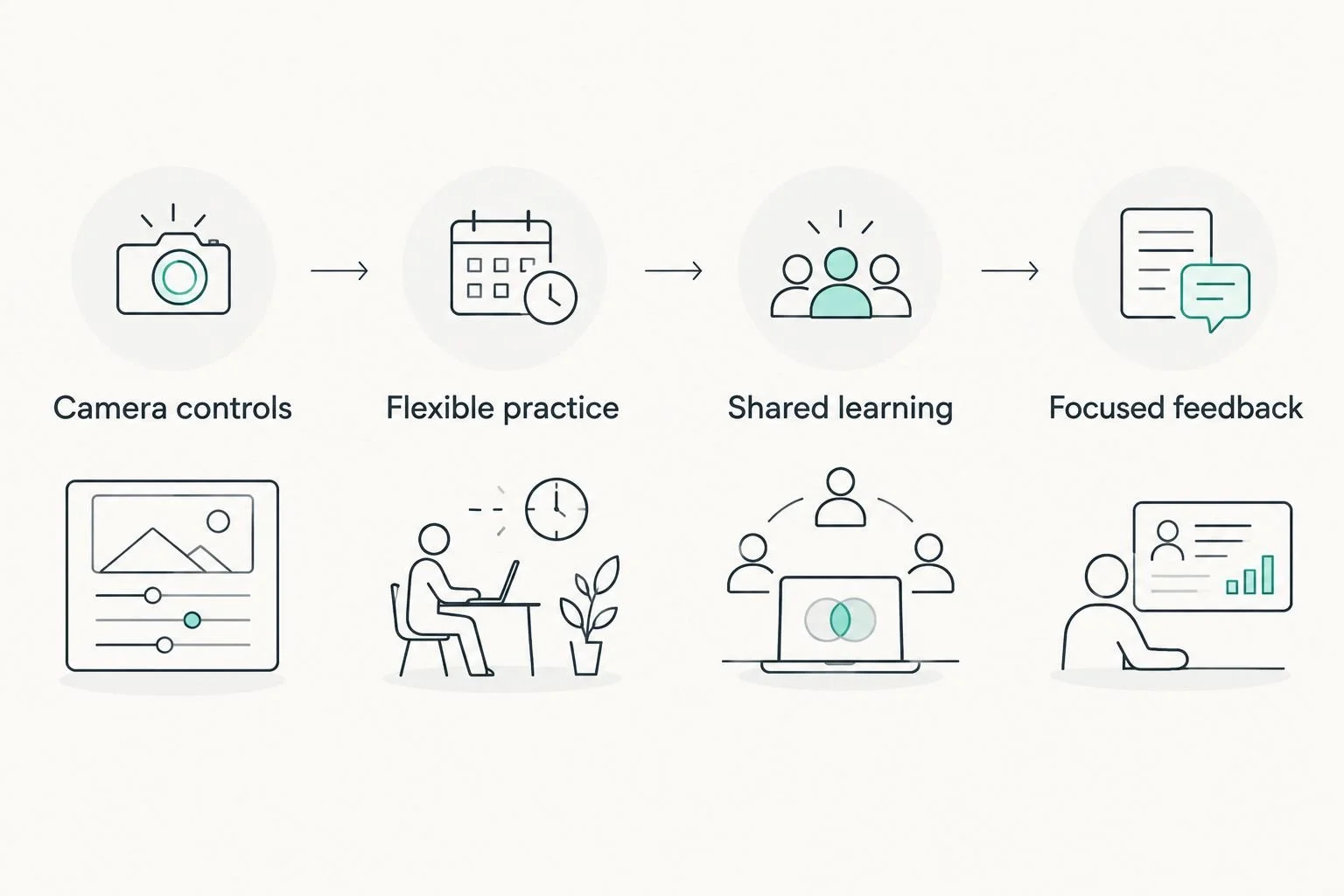
Choose a learning format around the help you need most.
Do not interpret a format as a quality guarantee. A live class still needs a clear beginner curriculum, and an individual lesson still needs understandable explanations. Ask what students practice and how they receive feedback before deciding.
Common mistakes first-camera beginners make
Choosing by the class title alone
A course called beginner photography might introduce camera controls, emphasize composition, or assume familiarity with exposure. Those are different starting points. Ask for the opening topics and prerequisites so your first lesson begins at the right level.
Buying equipment before identifying the problem
A new lens does not explain a misplaced focus point or an unsuitable shutter speed. First identify whether the difficulty comes from settings, light, movement, or a genuine equipment limitation. Purchase decisions are easier to assess once you can name the problem.
Expecting manual mode to solve every photograph
Manual exposure gives you control over settings; it does not choose the subject, improve framing, or place focus for you. Learn what each control changes rather than treating a mode label as proof of progress. Semi-automatic modes also provide opportunities to practice deliberate decisions.
Overlooking the child's interest and the family's routine
A child who enjoys photographing pets might respond differently to an assignment focused on buildings. Ask about subjects and exercises without expecting a course to follow every preference. Then check whether travel and practice fit the household's week.
FAQ
What should photography classes teach someone with a first camera?
Beginner photography classes should teach camera operation, exposure, focus, composition, and reviewing photographs. Ask for examples of practical exercises and how instructors explain mistakes.
Do I need an expensive camera to start photography classes?
Choose equipment according to the course requirements, not its price or appearance. Share your camera model with the provider and confirm that its controls support the planned lessons before purchasing anything else.
Can my child take photography classes with no experience?
Look for instruction explicitly designed for your child's age and experience level. Ask whether students need to read camera menus independently, handle equipment without help, or complete practice between lessons.
Is a group photography class better than individual instruction?
A group class suits learners who want shared demonstrations and discussion, while individual instruction suits specific questions and focused feedback. Compare the actual curriculum and feedback arrangements rather than choosing by format alone.
Should I learn manual mode before taking a photography class?
You do not need to master manual mode before a genuinely introductory photography class. Learn how to operate and review images on your camera, then confirm the course's prerequisites.
Does The Garden Arts Center offer beginner photography classes?
Confirm photography instruction directly with The Garden Arts Center before making registration plans. Its stated arts offerings do not establish a specific beginner photography course or its requirements.
How do I fit photography classes around school and family activities?
Assess the complete commitment, including travel, preparation, the lesson, and practice. Compare that routine with school and existing activities, then confirm the provider's schedule and attendance expectations.
One last thing
Before choosing a course in 2026, photograph the same familiar subject again and write down one thing you cannot yet explain. That question gives you a practical way to assess instruction: can the provider describe how a beginner would learn to investigate it?
Your first camera is a starting point, not a shopping assignment. Choose a class that helps you understand the photographs you already make, and build the next step around that understanding.