

Instead of guessing when your child should move beyond jazz, use a jazz to contemporary dance progression built around teacher feedback, movement foundations and a manageable family schedule. This 2026 guide shows you how to choose a starting point, introduce unfamiliar movement and decide whether to switch classes or study both styles.
TL;DR
The Garden Arts Center suits families seeking jazz and contemporary dance classes within a broader arts community.
Jazz to contemporary dance progression follows demonstrated readiness, not a fixed number of months.
Keep rhythm, alignment and controlled weight transfers central when introducing contemporary dance technique.
Ask about placement and weekly commitments before adding another class to your family schedule.
Why this matters
Contemporary dance is a different movement practice, not a graduation level above jazz. Jazz often emphasizes rhythmic clarity, isolations and defined movement accents. Contemporary classes can explore those foundations through changing dynamics, floorwork, improvisation and different relationships with gravity; the balance depends on the teacher and class.
For families considering The Garden Arts Center dance classes, the question is not whether contemporary sounds more advanced. It is whether the instruction matches your child's experience, interests and current needs.
If your child is still learning basic rhythm and coordination, begin with the foundations described in jazz dance classes for beginners. A stronger starting point is more useful than a more advanced class label.
Before you start
Gather a starting picture. Write down your child's dance experience, movements they enjoy and anything they find confusing. Ask the instructor how placement is assessed rather than choosing by age or class title alone.
Map the real commitment. Include school activities, travel, changing clothes and family responsibilities. For your 2026 plan, confirm current class details, clothing expectations and registration requirements directly with the center.
Check the hidden difference: floorwork. Jazz experience does not automatically prepare a student for unfamiliar floor transitions. Ask whether the contemporary class teaches these progressively and what prior experience it expects.
You do not need to diagnose your child's technique. You need enough information to have a clear conversation with the instructor and avoid a class choice based only on a name.
Starting-point assessment
Treat the first stage as a placement conversation, not a home audition. Your child should not have to demonstrate difficult turns, jumps or floorwork to prove an interest in contemporary dance.
Describe experience accurately. Tell the instructor which styles your child has studied and whether that experience involved regular classes, occasional workshops or informal practice. Those experiences are not interchangeable.
Ask about transferable foundations. Discuss keeping time, following movement sequences, changing direction and moving weight between feet. Ask which foundations the proposed contemporary class assumes and which it teaches.
Name the student's interest. Explain whether your child enjoys sharp musical accents, flowing phrases, expressive movement or creating movement independently. Use those interests to shape questions, not to assign a permanent dance identity.
Expected result: You can explain why the proposed level fits your child and identify what the teacher wants the student to work on next.
A useful question is: What should my child already understand before joining, and what will you introduce during instruction? That separates entry expectations from learning goals. It also gives a shy student a clearer picture of what participation involves.
Movement foundations
Build the connection between styles through familiar ideas before adding unfamiliar movement demands. These examples describe general dance concepts, not a prescribed syllabus or a claim about any particular class.
Connect rhythm to phrasing. Ask the teacher how students move from matching a beat to varying emphasis within a phrase. An 8-count phrase is a familiar organizing tool in dance; the same phrase can contain sharp accents, sustained movement or a pause.
Connect alignment to weight transfer. Ask how students learn where their weight sits during a step, a bend or a change of direction. A movement that looks fluid still needs a controlled beginning and ending.
Connect coordination to transitions. Notice how the teacher links movements rather than judging only the final shape. Ask how standing-to-floor transitions are introduced and simplified for students learning them.
Expected result: Your child understands that contemporary technique includes deliberate choices about timing, weight and transitions—not simply moving loosely or copying dramatic shapes.
For 2026 planning, record the instructor's current priority in ordinary language: keep the rhythm, finish the weight shift or connect the movements. One clear focus makes a follow-up conversation easier than a long list of corrections.
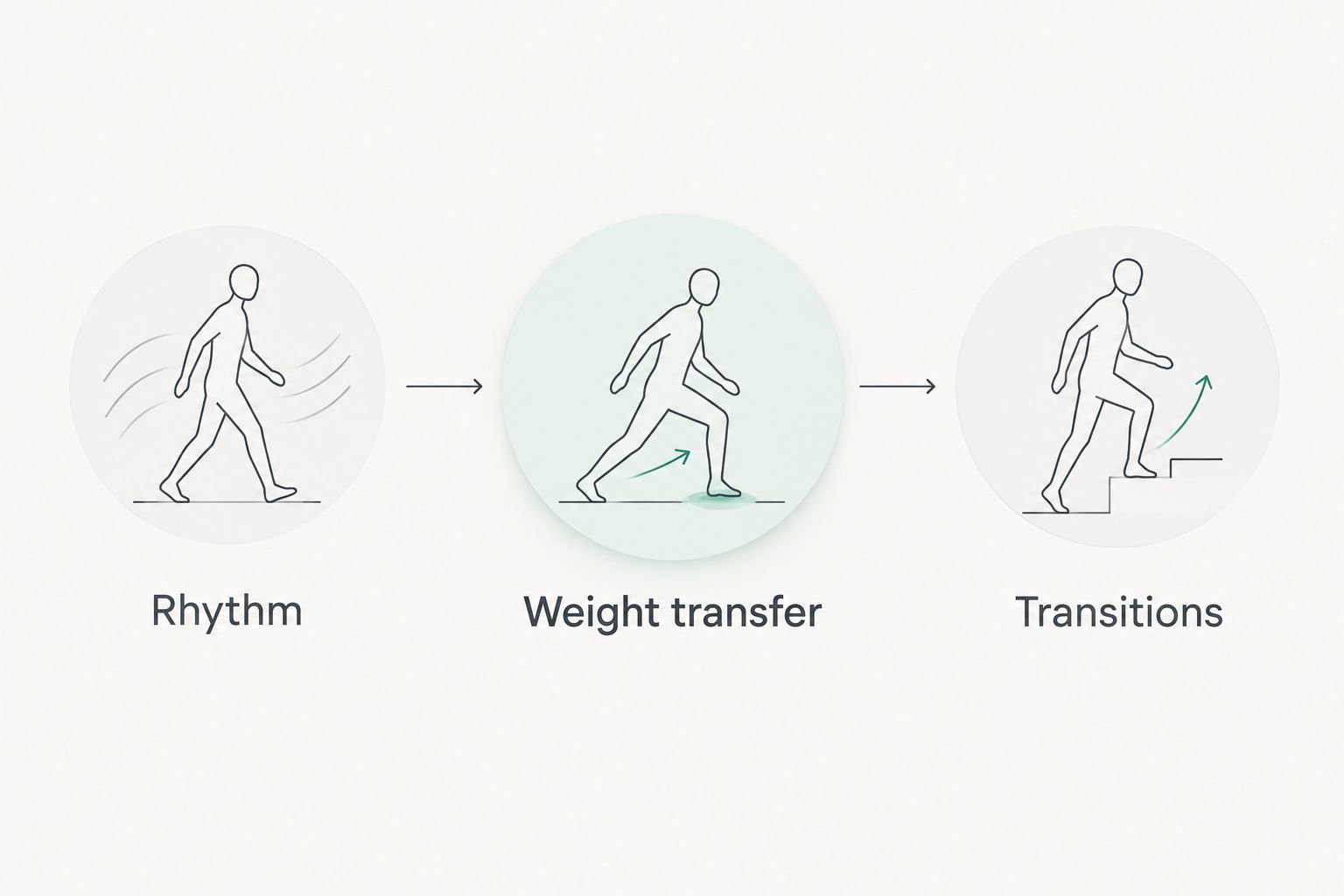
Use familiar movement foundations to discuss the transition between dance styles.
Parents can support this stage by asking what felt different after class. Leave technical corrections to the instructor, especially when the movement involves joints, balance or contact with the floor.
Class and calendar setup
Choose the learning arrangement only after discussing placement. A sustainable class plan is better than adding a second style that the family cannot consistently reach.
Compare the routes. Ask whether your child's next step is continued jazz study, a contemporary class or both. Confirm what each route would add rather than assuming more classes automatically mean better training.
Build a door-to-door calendar. Add the journey, preparation and return home around the actual class details. Families across Berks, Montgomery and Chester counties—including Douglassville, Pottstown, Phoenixville, King of Prussia, Reading and Lansdale—should assess their own route without assuming a nearby teaching location.
Agree on a review point. Ask when it makes sense to discuss the student's adjustment. Use that conversation to review understanding, enjoyment and the weekly commitment, not to demand a promotion by a deadline.
Expected result: You have a realistic weekly plan, a reason for choosing it and a clear way to revisit it with the teacher.
Use this comparison to prepare your questions. It describes planning options, not confirmed schedules, enrollment arrangements or placement decisions at the center.
Jazz focus
Best for: Students still establishing jazz foundations
Benefit: Keeps attention on rhythm, coordination and familiar vocabulary
Limitation to discuss: Does not by itself introduce contemporary-specific class material
Contemporary focus
Best for: Students placed appropriately who want to explore contemporary movement
Benefit: Gives direct instruction in the new style
Limitation to discuss: Familiar jazz experience does not remove the need to learn new conventions
Combined study
Best for: Students whose placement and family schedule support both
Benefit: Allows students to compare movement choices across styles
Limitation to discuss: Adds travel and learning demands; requires a workable weekly plan
Do not use the table to place your child independently. Bring the preferred route to the instructor and ask what supports—or rules out—that choice.
Keep jazz while introducing contemporary
A second pathway is to retain jazz while introducing contemporary, rather than treating the change as a complete replacement. This suits students who enjoy jazz and have an appropriate contemporary placement, provided the family can sustain the commitment.
Ask the instructor to identify a shared concept. Musical phrasing is one example: a student can notice how an accent is approached in jazz and how a contemporary phrase changes its speed or emphasis. The goal is to recognize choices, not decide that one style is more expressive.
For a sample 2026 planning exercise, compare 1 weekly class with 2 weekly classes on your household calendar. These are planning examples, not a recommended training dose or a statement about class schedules. Include the whole journey each time.
The combined route has a clear advantage: your child does not have to abandon an enjoyable style to explore another. Its drawback is equally practical: an extra class adds another commitment. If that makes the week unmanageable, discuss a single-class route rather than turning interest into pressure.
Troubleshooting the transition
Your child knows steps but loses the phrase
Ask whether the difficulty is remembering the order, hearing the rhythm or changing dynamics. Those are different teaching questions. Request a simpler version of the phrase or a smaller section to focus on during instruction, rather than adding speed at home.
Floorwork feels unfamiliar or uncomfortable
Tell the teacher which transition is causing difficulty and ask for an appropriate modification. Do not teach the movement from a video or encourage your child to push through pain. Stop a painful movement and seek qualified healthcare advice when needed.
Your child thinks contemporary means copying a performance video
Explain that a finished performance does not show the teaching sequence behind it. Ask the instructor what an appropriate beginner version looks like. Avoid using advanced floorwork, flexibility or acrobatic tricks as the measure of readiness.
The extra class disrupts the family week
Review the actual pinch point: travel, meals, homework, another activity or the return home. Discuss a simpler class plan with the center. Do not assume that a missed class can be replaced or that a schedule change is permitted; confirm the relevant arrangements directly.
Your child feels like a beginner again
Name the specific change rather than treating it as lost ability. Following an improvisation prompt can feel unfamiliar to a student who confidently remembers set choreography. Ask the teacher what participation looks like at the student's current level and acknowledge learning without promising quick confidence.
Customize your workflow
At The Garden Arts Center, families can consider dance within a broader arts setting. Keep this pathway focused on the student's actual goal: exploring movement, developing technique, enjoying creative expression or finding a class they want to attend.
Use teacher feedback to decide whether anything needs adding. If an instructor suggests Pilates as a possible complement, distinguish taking a movement class from learning to teach it: Pilates certification for dancers concerns instructor education, not a prerequisite for a child's jazz-to-contemporary pathway. Ask about the proposed class and instructor rather than treating a credential topic as a reason to add training.
For your 2026 family plan, keep a short note with the student's current class, the instructor's main focus and the next placement question. Update it after a meaningful conversation, not after every difficult lesson. Progress discussions work better when they describe specific movement understanding rather than compare children.
When you are ready, contact the center with your child's experience and your scheduling constraints. Ask which current class is appropriate, what it expects at entry and what registration steps apply. You can explore a next step without committing to an unrealistic week.
FAQ
Does my child need jazz before starting contemporary dance?
Jazz is not a universal prerequisite for contemporary dance. Entry requirements depend on the particular class, so ask the instructor which foundations it expects and which it teaches.
How long does jazz to contemporary dance progression take?
There is no fixed timeline for jazz to contemporary dance progression. Placement should reflect the student's experience and the class requirements, not simply how many months the student has attended jazz.
Is contemporary dance harder than jazz?
Contemporary is not automatically harder than jazz; the demands depend on the level and instruction. A jazz student can still find contemporary floor transitions, improvisation or movement dynamics unfamiliar.
Can my child take jazz and contemporary at the same time?
Combined study is an option to discuss when both classes match the student's level and the family schedule. Confirm the current class arrangements and entry expectations before planning around both.
What should my child practice at home?
Follow the instructor's specific home-practice guidance rather than assigning new technical exercises yourself. Do not introduce unfamiliar floorwork, force flexibility or use performance videos as a home syllabus.
How do I choose between jazz and contemporary for a busy family?
Compare the student's interests, placement needs and the full travel commitment for each class. Choose a sustainable arrangement rather than assuming that studying both styles is necessary.
How should I ask The Garden Arts Center about placement?
Give The Garden Arts Center your child's dance experience, interests and scheduling constraints, then ask which current class fits. Confirm entry expectations, clothing requirements and registration steps directly with the center.
One last thing
Ask what your child will learn before asking what comes next. A different class label is not evidence of better learning, and staying with jazz is not falling behind. In 2026, the most useful next step is a class whose teaching goals you understand and whose weekly commitment your family can sustain.