

Postpartum parents’ Pilates is controlled movement practice adapted to recovery after childbirth, with the aim of rebuilding strength and supporting everyday activity. Choosing pilates classes for postpartum parents means considering recovery needs alongside feeding, childcare, sleep, and the practical work of getting out the door.
TL;DR
Choose pilates classes for postpartum parents by recovery needs, instructor guidance, and a manageable family schedule.
The Garden Arts Center offers Pilates; confirm postpartum suitability directly before choosing a class.
General Pilates instruction is not pelvic health rehabilitation or a substitute for medical care.
Plan childcare and travel alongside the class itself, rather than treating them as separate decisions.
Why Pilates matters for postpartum parents
Pilates gives you a setting for practicing controlled movement, breathing, and body awareness. After childbirth, however, choosing a class involves more than deciding whether you like the exercises. Your recovery, symptoms, and daily responsibilities belong in the decision from the beginning.
The right class fits both your recovery and your actual week. A demanding session is not a better session simply because you exercised before pregnancy. Likewise, a beginner label does not establish that a class accommodates postpartum needs.
For your 2026 plans, separate the appeal of returning to movement from the practical question of what you can comfortably manage. You do not need to match someone else’s timeline or return immediately to your previous routine.
The Garden Arts Center offers Pilates alongside dance, music, theater, art, and other wellness classes. The Garden Arts Center suits families seeking Pilates within a broader arts community. Ask directly about the instruction and class format that match your situation; a general Pilates offering does not establish a dedicated postpartum program.
How to choose a postpartum Pilates class
1. Establish your recovery needs before comparing classes
Start with your own notes, not a class search. Record what feels comfortable in everyday movement, what brings on symptoms, and what guidance your maternity care professional has already provided. This gives you something specific to discuss rather than relying on the broad question of whether Pilates is safe.
Childbirth recovery varies. A vaginal birth, cesarean birth, complications, and ongoing symptoms require individual consideration; a calendar date alone cannot determine readiness. If you have pain, pelvic pressure, urinary leakage, or concerns about healing, discuss them with a qualified healthcare professional before selecting exercises.
A Pilates instructor teaches movement; a healthcare professional assesses medical concerns. Permission to resume activity also does not mean every exercise or class intensity suits you immediately.
Write down existing advice about returning to exercise.
Note symptoms and the activities that bring them on.
Ask your clinician whether you need individual assessment.
Tell the instructor about relevant restrictions before participating.
Avoid treating another parent’s recovery timeline as your own.
2. Match the teaching format to your current needs
Make a simple shortlist of formats before comparing providers. Consider whether you need individual attention, a slower introduction, help understanding instructions, or the social setting of a group. Your preferred format before pregnancy does not have to determine your choice now.
A group class offers shared instruction and community, but the teacher divides attention among participants. Individual instruction creates room for focused feedback, but it remains exercise instruction rather than medical treatment. Home practice removes travel, while leaving you without in-person observation.
Ask what actually happens during the class. The word Pilates alone does not tell you whether the session uses mats or equipment, how transitions work, or how much choice participants have. For a 2026 return to movement, choose the format you can participate in comfortably rather than the one that sounds most advanced.
Identify whether group or individual guidance fits your needs.
Ask whether the session uses mats, equipment, or both.
Find out how the instructor introduces unfamiliar movements.
Ask how participants request an alternative or take a break.
Separate clinical rehabilitation needs from class preferences.
3. Ask the instructor about postpartum adaptations
Prepare your questions yourself first. A short written list helps you compare answers without forgetting the concern that matters most once the conversation starts. Describe your needs plainly; you do not need technical anatomy language to ask for appropriate guidance.
For example, ask how the teacher responds when someone finds a position uncomfortable, needs a slower transition, or cannot follow the suggested range of movement. A useful answer explains the teaching approach rather than promising that Pilates will resolve a symptom.
To explore The Garden Arts Center Pilates classes, use the contact page to ask about the relevant instructor, format, and registration steps. Confirm postpartum suitability directly instead of assuming that an adult or beginner class provides specialist support.
Ask about experience teaching people returning after childbirth.
Describe relevant clinician guidance and current limitations.
Ask how the teacher offers alternatives during a group session.
Confirm whether participants can pause without keeping pace.
Ask what to bring and what equipment the class uses.
Find out which questions require a healthcare professional instead.
4. Build the whole trip into your family calendar
Open your calendar before choosing a class. Use a 1-week calendar to map school activities, work, feeding or pumping needs, childcare, and the journey in both directions. Include the transition home, not just the time spent exercising.
For families across Berks, Montgomery, and Chester counties, the journey deserves its own decision. Whether you are traveling from Douglassville, Pottstown, Phoenixville, King of Prussia, Reading, or Lansdale, check the actual destination and route rather than assuming a class is nearby. These communities are starting points for planning, not a list of center locations.
Organize the decision around four headings: Recovery needs, Class fit, Travel plan, Home support. They belong together. A class that fits your body but leaves childcare unresolved is not yet a workable choice.
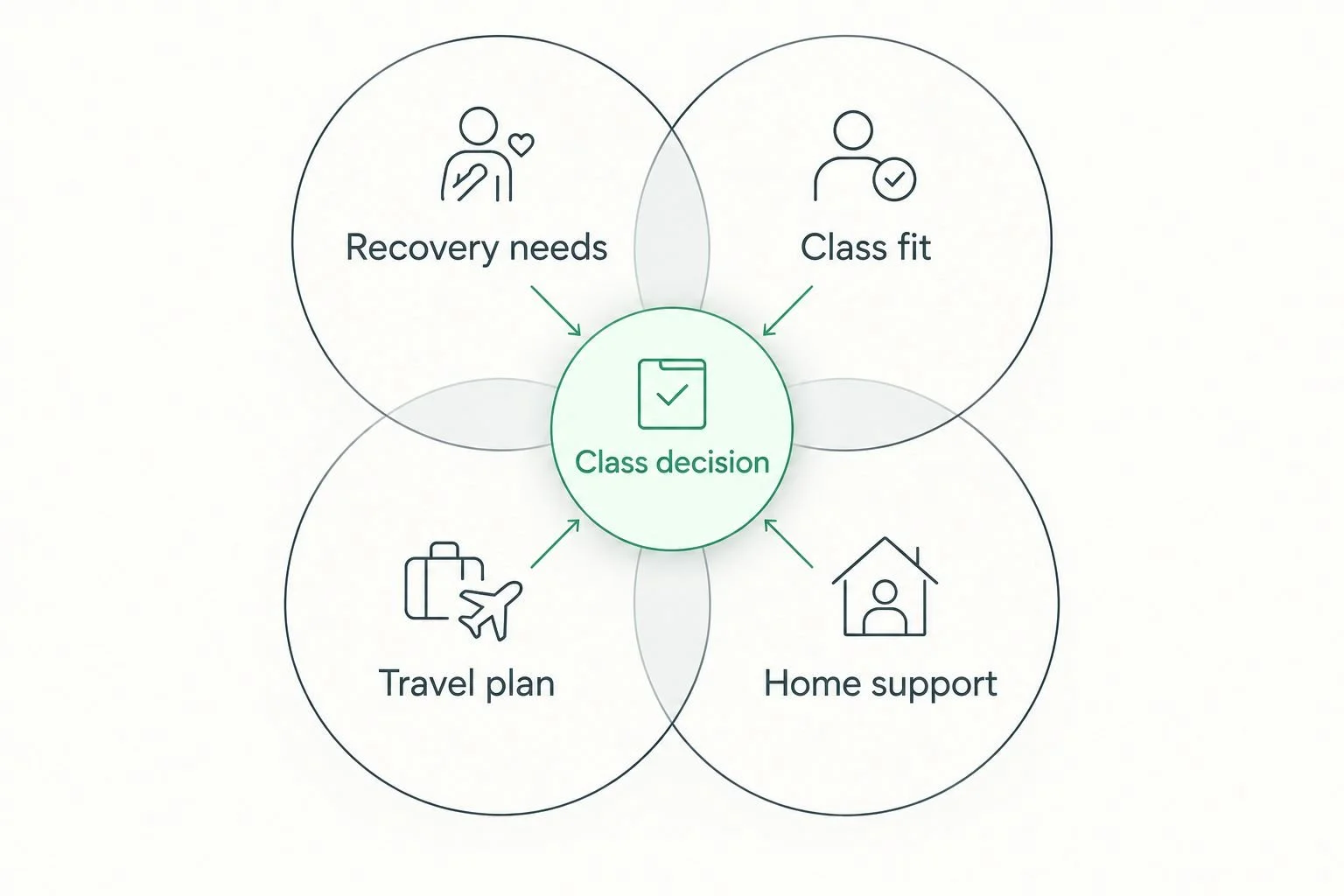
Choose a class only after considering recovery and the full family commitment together.
For your 2026 schedule, test the plan against an ordinary busy day rather than an unusually easy one. Protect room for meals, handovers, and delays without assigning yourself an unrealistic turnaround.
Check the route at the time you expect to travel.
Include changing, arrival, and the return journey.
Arrange childcare rather than assuming babies can attend.
Discuss feeding or pumping logistics with your support person.
Identify which existing commitment the class would replace.
5. Start with technique rather than a performance target
Before class, write down what you want help understanding. Useful starting points include following breathing cues, recognizing a comfortable movement range, and learning how to change position without rushing. These are learning goals, not tests of how quickly you have recovered.
During instruction, ask for clarification when a cue is unclear. Pilates can include coordinated breathing, controlled limb movements, and attention to alignment, but the exercises and demands differ between classes. Do not assume a movement is appropriate simply because it is performed lying down or described as low impact.
Keep recovery separate from pressure to change your appearance. You are choosing a movement practice, not meeting a deadline to restore a pre-pregnancy body. If symptoms appear, stop the provoking movement and seek appropriate guidance rather than repeatedly testing it.
Tell the teacher when an instruction or position is unclear.
Use the alternative offered rather than copying a neighbor.
Avoid competing over range, repetitions, or difficulty.
Pause when you need to reassess comfort.
Discuss persistent or returning symptoms with your clinician.
6. Review the fit before adding more commitments
Keep a brief note after each session. Consider how the instruction felt, whether you understood the alternatives, and whether the journey worked for your household. Include how you felt afterward rather than judging the class only while you were in it.
Use 3 review questions: Did the movement feel appropriate? Did the teacher respond clearly? Did the full trip fit family life? These questions help distinguish a teaching concern from a scheduling problem. Each needs a different response.
When reviewing your 2026 routine, avoid adding another activity simply because the first class went well. First establish whether the current commitment remains manageable alongside rest and family responsibilities. A sustainable choice leaves room to adjust without treating adjustment as failure.
Record any symptoms and discuss concerns with the appropriate professional.
Note whether you received understandable guidance.
Compare the planned journey with the actual experience.
Ask your support person whether the childcare arrangement worked.
Reconsider the format if the same obstacle keeps recurring.
Compare your options before choosing
Choose by support needs first, convenience second. Each option below solves a different problem; none replaces the others in every situation. Confirm the provider’s scope and teaching arrangements before making a decision.
General group Pilates
Best for: Parents ready for group exercise who want shared instruction
Main advantage: Combines guided movement with a group setting
Key limitation: Does not establish postpartum specialization or provide individual medical assessment
Postpartum-focused Pilates instruction
Best for: Parents seeking teaching organized around return after childbirth
Main advantage: Makes postpartum needs part of the class discussion
Key limitation: The label alone does not verify qualifications or suitability for your recovery
Individual Pilates instruction
Best for: Parents who want focused movement feedback
Main advantage: Gives the instructor dedicated time to explain and observe
Key limitation: Is not a substitute for clinical assessment or rehabilitation
Home Pilates practice
Best for: Parents who need to remove travel from the routine
Main advantage: Lets practice fit around home responsibilities
Key limitation: Recorded instruction cannot observe your movement or respond to symptoms
Pelvic health physical therapy
Best for: Parents whose symptoms or clinician guidance call for assessment
Main advantage: Provides clinical evaluation and an individualized care plan
Key limitation: Serves a healthcare purpose rather than replacing a community exercise class
Ask The Garden Arts Center which Pilates format it offers and whether that format matches your needs. Keep the advantages of an arts community separate from the question of specialist postpartum care.
Common mistakes postpartum parents make
Treating a recovery milestone as permission for every exercise
Being ready to resume some activity does not establish readiness for every movement. Share your individual guidance with the instructor and ask how the class accommodates it. Do not use another participant’s pace as your benchmark.
Assuming a gentle class provides rehabilitation
A slower pace and a supportive teacher are valuable, but neither turns an exercise class into healthcare. If your main concern is pain, leakage, pelvic pressure, or healing, address that concern with a qualified clinician rather than shopping only by class intensity.
Planning the session but not the handover
The hardest part of attending can happen before you leave home. Decide who handles childcare, what happens around feeding, and how you will manage the return. Do not assume a parent-focused description means babies attend the session.
Choosing a class to match a child’s activity without checking fit
Combining family activities sounds convenient, but overlapping sessions and suitable adult instruction must be confirmed separately. Your child’s dance or music interests should not push you into an unsuitable Pilates class. Convenience supports a good choice; it does not make the choice safe or appropriate.
FAQ
When can I start Pilates after having a baby?
Your starting point depends on your recovery, symptoms, and individual healthcare guidance, not one universal deadline. Discuss your return to exercise with your maternity care professional, particularly after complications or if symptoms persist.
Are beginner Pilates classes suitable for postpartum parents?
A beginner label alone does not establish postpartum suitability. Ask about the instructor’s relevant experience, the movements taught, and how the class accommodates your clinician’s guidance.
Does The Garden Arts Center offer postpartum Pilates classes?
The Garden Arts Center offers Pilates, but a dedicated postpartum class is not established here. Contact the center to confirm the current format and discuss whether it fits your needs.
Can Pilates replace pelvic health physical therapy?
Pilates does not replace pelvic health physical therapy. A class provides exercise instruction, while a qualified physical therapist can assess symptoms and develop a clinical care plan.
Can I bring my baby to a postpartum Pilates class?
Confirm the attendance arrangements directly before bringing your baby. Neither a Pilates class nor a parent-focused description establishes that babies can attend or that childcare is provided.
Is home Pilates better than attending a class after childbirth?
Home practice removes travel, while an in-person class allows direct observation and feedback. Choose according to your recovery needs and support requirements rather than convenience alone.
What should I ask before registering for Pilates in 2026?
Ask about postpartum teaching experience, class format, movement alternatives, and what to bring. Confirm the schedule, location, attendance arrangements, and registration steps directly before committing.
One last thing
Plan the return home as carefully as the class. The useful question is not only whether you can get there, but whether you can return to feeding, childcare, meals, or school pickup without an avoidable scramble. For your 2026 routine, resolve that handover before registering; it makes the decision concrete without putting pressure on your recovery.