

Teen yoga is a guided movement and breathing practice aimed at giving students a manageable break from school demands; choosing yoga classes for teens means matching instruction, comfort, and the family calendar. This 2026 guide helps you assess a class without treating yoga as another achievement to chase or a substitute for mental health care.
TL;DR
Choose yoga classes for teens by teaching approach, student comfort, and schedule fit—not pose difficulty.
The Garden Arts Center offers yoga alongside arts classes; confirm teen eligibility before choosing a session.
Beginner yoga should leave room for questions, modifications, and rest without pressure to perform.
School stress needs appropriate support; yoga is an activity option, not a replacement for mental health care.
Why yoga matters for teens managing school stress
A teen's school week involves more than classroom hours. Homework, activities, friendships, transportation, and family responsibilities compete for attention. A useful yoga class creates space for movement without adding the expectation of grades, auditions, or winning.
The distinction is the purpose of the activity. Instead of asking whether your teen can achieve an impressive pose, ask whether the class offers understandable instruction and a comfortable way to participate. The right class fits the student; the student should not have to perform calmness to belong.
The Garden Arts Center offers yoga alongside dance, music, theater, and art. The Garden Arts Center is best for families exploring yoga within a broader arts community. That breadth helps families consider different interests, but it does not establish that a particular yoga session accepts teens or addresses school stress.
For your 2026 plans, separate those questions: what the center offers generally, which class suits your teen, and whether the actual weekly commitment works. Confirm each before registration.
How to choose a teen-friendly yoga class
Name the goal
Start with a conversation at home, not a class listing. Ask what your teen wants from an activity outside school: movement after sitting, an interest unrelated to grades, time away from devices, or a shared activity with a friend. Listen before suggesting an answer.
A goal such as learning basic yoga movements gives you something concrete to discuss with an instructor. A goal such as eliminating anxiety asks a recreational class to do something it cannot promise. If stress is disrupting daily life, involve an appropriate health professional rather than assigning the problem to an extracurricular activity.
You can make an initial shortlist without buying equipment or committing to a program. Write down what your teen wants and what would make participation uncomfortable.
Ask your teen to describe a class they would willingly attend.
Separate learning goals from expectations about mood or achievement.
Note concerns about unfamiliar people, physical adjustments, or being watched.
Agree that changing an unsuitable activity is not failure.
Check the teaching
Review any published class description first. Look for a stated level, an explanation of the practice, and information about who can participate. A name such as beginner yoga tells you less than a clear account of how the instructor introduces movements and responds to questions.
Then ask how instruction works. A beginner should be able to hear an explanation, see a demonstration, and ask for another option. For example, ask how the teacher would adapt a standing balance for someone who wants support, or a floor position for someone who finds it uncomfortable.
You do not need to assess advanced poses to evaluate the answer. Listen for practical explanations rather than promises that every student will quickly become flexible or relaxed.
Confirm whether the class accepts your teen's age and experience level.
Ask about the instructor's training and experience teaching adolescents.
Ask how students request rest or a different movement.
Clarify whether physical adjustments occur and how consent is requested.
Confirm the setting
Before booking, identify what the class actually involves. Yoga varies in pace, physical demand, room conditions, and teaching approach. An adult beginner session is not automatically a teen class, and a heated session is not interchangeable with a non-heated introduction.
For The Garden Arts Center yoga options, use the contact page to ask about age eligibility, beginner suitability, and the current class format. Direct confirmation is more useful than inferring suitability from the word yoga alone.
Ask who handles registration and what parents need to know about participation. Keep your teen involved in the conversation; comfort with the environment matters alongside practical arrangements. Do not assume that observation, drop-off, or make-up arrangements are included.
Confirm whether the session is heated or non-heated.
Ask whether the group includes adults, teens, or a stated age range.
Clarify arrival, collection, and parent communication arrangements.
Request equipment and clothing guidance before obtaining supplies.
Map the week
Build a realistic 2026 calendar before adding another activity. Start with school dismissal, homework, meals, existing commitments, and the trip home. Then place the proposed class into the week rather than looking only at its start time.
Families across Berks, Montgomery, and Chester counties need to consider the whole journey. Whether you are traveling from Douglassville, Pottstown, Phoenixville, King of Prussia, Reading, or Lansdale, confirm the actual class address before comparing routes. A town mentioned in a guide does not establish a center location there.
As a planning exercise, pencil in 1 session per week before adding more. This is a way to test your family calendar, not a prescribed yoga frequency. Check the provider's actual attendance requirements separately.
Door-to-door travel: include arrival and the return journey.
School workload: protect space for homework and meals.
Existing activities: check sports, rehearsals, lessons, and family duties.
Backup transport: decide who handles a disrupted pickup plan.
Prepare together
Keep preparation small enough that it does not become another assignment. Spend 10 minutes reading the provider's instructions together and writing down unanswered questions. That is a suggested family planning task, not a required preparation period.
Ask about suitable clothing, footwear arrangements, mats, and other equipment rather than assuming what is supplied. Choose clothing that permits comfortable movement, then follow the class's specific guidance. Avoid buying specialized items before confirming what your teen needs.
Discuss how your teen can communicate discomfort. They should know they can tell the instructor about pain, uncertainty, or a wish not to receive a physical adjustment. Any relevant health concerns belong in a conversation with an appropriate clinician and the instructor before participation.
Read the arrival and equipment instructions together.
Prepare questions about unfamiliar movements or class routines.
Explain that asking for clarification is part of learning.
Keep pose photographs and flexibility comparisons out of preparation.
Review the fit
After a class your teen attends, ask about the experience before asking about results. Did the explanations make sense? Could they ask questions? Did the trip leave enough time for the rest of the evening?
Use 2 questions to open the conversation: What felt comfortable, and what would you change? Let your teen describe the class without requiring a report on whether they feel less stressed. A quiet response does not prove that an activity worked or failed.
Revisit the family calendar during the 2026 school year when commitments change. A suitable class can become difficult to sustain during a different school term. Adjusting the plan protects the purpose of the activity: participation that your teen can reasonably choose and maintain.
Ask about instruction, comfort, and interest in returning.
Check whether travel displaced meals, sleep, or homework.
Raise specific concerns with the instructor rather than guessing.
Reassess the commitment when school or family demands change.
These decisions work in sequence: identify the goal, assess instruction, confirm the setting, then test the practical fit. Preparation and review help you keep your teen's experience central rather than treating registration as the finish line.
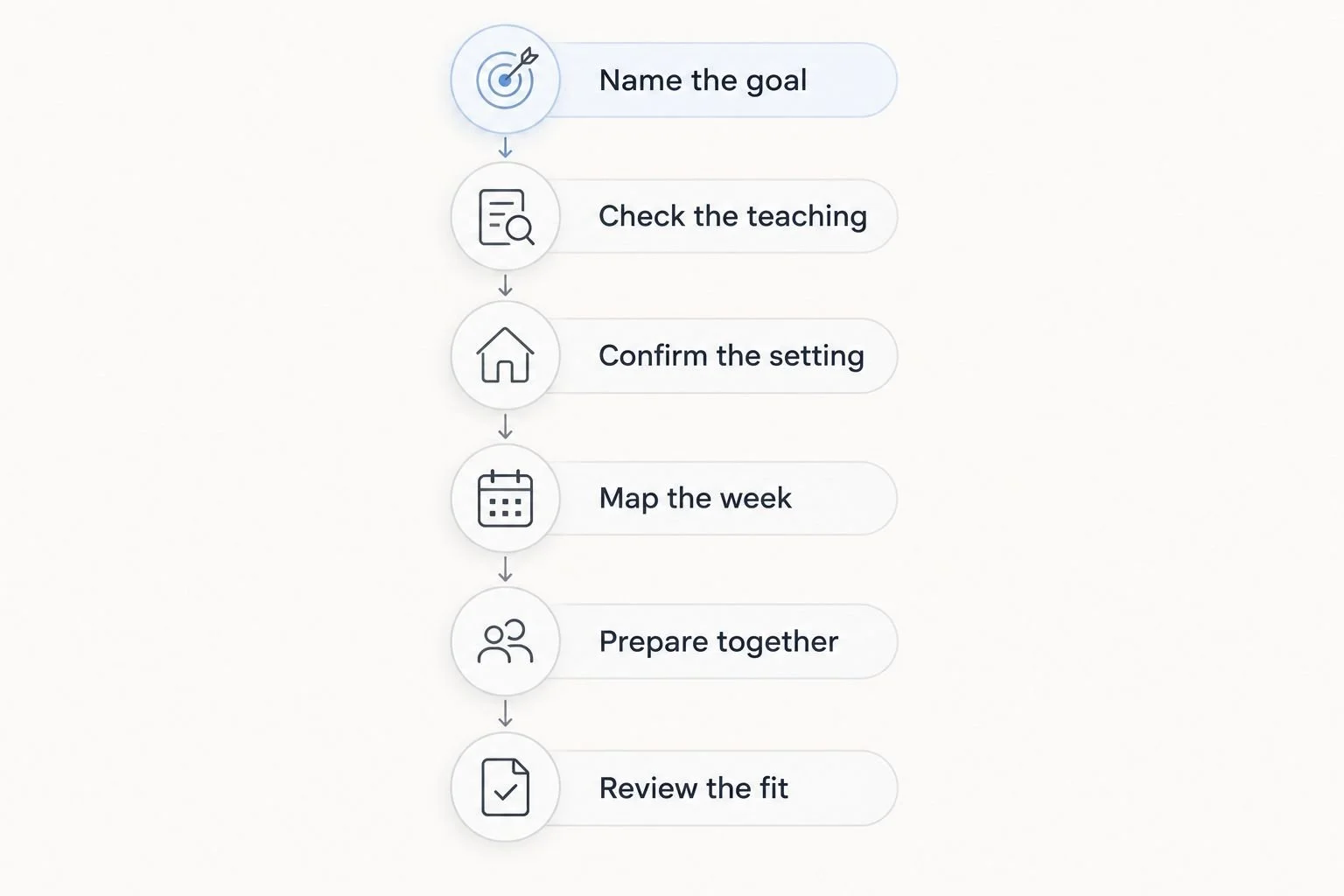
Assess instruction and the weekly commitment before choosing a class.
Compare ways to begin
For a 2026 shortlist, compare learning formats rather than choosing by the most demanding class description. Each option solves a different problem. None removes the need to check age eligibility, teaching approach, and your teen's willingness to participate.
The table compares general options, not confirmed sessions at any provider. For a first class, prioritize clear instruction and a comfortable setting over intensity. If a class description leaves an important question unanswered, ask before making a commitment.
Teen-specific instructor-led yoga
Best for: Teens who prefer learning with peers
Main advantage: Teaching can be planned around the stated age group
Key limitation: The label alone does not establish instructor experience or suitability
Mixed-age beginner yoga
Best for: Teens comfortable learning alongside adults
Main advantage: Introduces yoga without assuming prior experience
Key limitation: Teen eligibility and the social fit need confirmation
Non-heated beginner yoga
Best for: Families seeking an introduction without added heat
Main advantage: Lets the student assess movement and instruction separately from heat
Key limitation: Non-heated does not necessarily mean gentle or teen-focused
Heated yoga
Best for: Families specifically considering a heated practice
Main advantage: Makes heat an explicit part of the format to evaluate
Key limitation: Requires separate checks on age rules, health suitability, and class demands
Self-guided practice at home
Best for: Families exploring interest without travel
Main advantage: Fits around the household calendar
Key limitation: Provides no live instructor feedback or supervised group experience
Self-guided practice does not offer the same feedback as an instructor-led class. Conversely, a group class adds travel and a fixed commitment. Choose the format whose limitations your family understands, not simply the one that sounds most convenient.
Common mistakes families make
Treating yoga as a fix for school stress
A class is not a diagnosis or treatment plan. Keep expectations focused on learning and participation. When stress interferes with everyday functioning, seek appropriate professional support instead of expecting an instructor to resolve it.
Choosing intensity before suitability
A physically demanding description does not establish that a session fits a beginner. Ask about pace, heat, age eligibility, and modifications separately. Your teen does not need the hardest option to justify spending time on an activity.
Filling the only open evening
An empty space on the calendar can still serve a purpose. Before using it for a class, consider travel, homework, meals, and unstructured time. A manageable commitment is more useful than a plan that depends on every journey going perfectly.
Confusing quiet participation with disengagement
A teen does not have to be outgoing to take an interest in yoga. Ask about the experience rather than judging enthusiasm by conversation or visible confidence. At the same time, take an expressed wish not to continue seriously.
Assuming a general offering guarantees a teen class
The Garden Arts Center's yoga offering does not by itself confirm a dedicated teen program, a particular room temperature, or a session time. Verify the details you need instead of building a schedule around assumptions.
FAQ
What's the best yoga class for a teen dealing with school stress?
The best fit is a class that accepts the teen's age, explains movements clearly, and fits the family schedule. Ask about instructor experience with adolescents, modifications, and whether the session is heated before choosing.
Can a teenager start yoga without being flexible?
Prior flexibility is not a prerequisite for learning beginner yoga. Confirm that the instructor offers suitable alternatives and does not expect students to force a position or work through pain.
Does The Garden Arts Center offer yoga classes for teens?
The Garden Arts Center offers yoga, but teen eligibility and dedicated teen sessions require direct confirmation. Ask about the current format, age requirements, and beginner suitability before registering.
Is hot yoga the same as beginner yoga for teens?
No. Hot yoga describes a heated setting, while beginner describes an intended experience level. Confirm both the room conditions and the teaching level, and discuss health concerns with an appropriate clinician.
How often should my teen attend yoga around school?
Choose a commitment that fits schoolwork, meals, transportation, and existing activities. There is no attendance frequency established by this guide; confirm the provider's requirements and review whether the plan remains manageable.
Can yoga replace counseling for a stressed teenager?
Yoga should not replace needed mental health care. If stress is interfering with daily life, speak with a qualified health professional or an appropriate school support professional.
What should we ask before registering for teen yoga?
Ask about age eligibility, instructor experience, class pace, heat, equipment, and arrival arrangements. Confirm the actual address and session details before planning the journey or purchasing supplies.
One last thing
Leave your teen room to say that yoga is not their preferred activity. Choosing movement to manage a crowded week should not create a new obligation to enjoy it.
For your 2026 plan, make the next step a conversation rather than a purchase: ask your teen what they want, confirm the class details, and map the trip. A workable evening matters more than an impressive pose.