

Competitive-team tap dance training is instruction in rhythm, footwork, and ensemble timing with the aim of preparing dancers to perform choreography together. When choosing tap dance classes for competitive teams, look for instruction that develops clear sounds and shared timing—not just faster routines—and fits your child’s school and rehearsal commitments.
TL;DR
Choose tap dance classes for competitive teams by placement, sound clarity, ensemble timing, and a sustainable family schedule.
The Garden Arts Center offers tap dance within a broader arts community; ask directly about competitive-team requirements.
Technique instruction and choreography rehearsal serve different purposes; confirm that your dancer receives both.
Agree on practice priorities with the instructor rather than adding speed or repetitions independently.
Why tap training matters for competitive teams
Tap dancers make music as they move. In a team routine, the group must coordinate not only positions and gestures but also the sounds each dancer produces. A formation can look aligned while the taps arrive at different moments.
That distinction matters when your child already studies another style. Ballet, jazz, hip hop, lyrical, contemporary, and modern dance involve musicality, but experience in those classes does not establish tap placement. Tap requires its own vocabulary, sound production, and weight transfers.
The Garden Arts Center is best for families seeking tap dance within a broader arts education. Its offerings include dance, theater, music, art, and wellness for children and adults. Explore The Garden Arts Center as an arts community, then ask directly whether its current tap instruction matches your dancer’s team commitments; do not assume that offering tap means operating a competitive team.
For your 2026 class decision, separate three questions: what your dancer needs to learn, what the team expects, and what your family can sustain. A suitable class needs to answer all three.
How to choose tap dance classes for competitive teams
Identify your dancer’s next learning goal
Start with a conversation, not a class label. Ask your child which parts of tap feel enjoyable and which feel difficult, then compare that answer with feedback from the current instructor or team director.
Make the goal observable. Instead of asking for advanced training, ask whether your dancer needs clearer shuffles, more reliable weight changes, steadier timing, or greater confidence remembering a phrase. These are different teaching priorities, even when they appear in the same routine.
Use an 8-count phrase as a discussion tool if the instructor agrees. Your goal is to identify where the dancer loses clarity—not to conduct a home audition or assign placement yourself.
Write down one technique goal and one ensemble goal.
Ask the instructor which prerequisite skills need attention.
Separate your child’s interests from competition-placement ambitions.
Describe previous tap experience separately from other dance training.
Evaluate how the instructor teaches sound and timing
Begin with direct questions about instruction. Ask how the teacher introduces a step, checks understanding, and helps a dancer correct an unclear sound. A useful answer describes teaching actions rather than relying on words such as advanced or intensive.
For example, a shuffle combines a forward brush and a backward brush without transferring weight onto the working foot. An instructor can isolate those sounds, check balance, and then place the step into a phrase. The movement’s name alone does not tell you whether a student understands it.
Families considering The Garden Arts Center’s tap dance classes should ask how placement and feedback work for their particular dancer. The center’s wider arts offering supports exploration; the class’s actual teaching approach still needs to match the student’s needs. These questions for evaluating professional dance instruction keep that conversation focused on teaching.
Ask how teachers distinguish rhythm errors from unclear footwork.
Request an explanation of how new steps build on existing skills.
Ask how students receive individual corrections within a group.
Confirm how the instructor determines an appropriate starting level.
Separate technique development from routine rehearsal
Write down what happens in your child’s existing training before adding another commitment. Learning choreography, cleaning formations, and developing tap technique overlap, but they are not interchangeable.
A technique lesson can examine why a sound disappears during a weight change. A rehearsal applies the dancer’s skills to a specific sequence, entrance, or group pattern. Choose instruction that addresses the underlying difficulty, not just the section where it becomes visible.
Ask whether your dancer needs a regular technique class, focused individual feedback, or better coordination between the class teacher and team director. Do not assume that adding another routine will solve a foundational problem.
List existing classes and rehearsals separately.
Ask which setting addresses the dancer’s current learning goal.
Confirm who communicates corrections that affect team choreography.
Keep a short record of recurring feedback rather than collecting unrelated drills.
Compare the full weekly commitment
Build your family’s 2026 calendar before selecting a class. Include school dismissal, homework, meals, transport, existing rehearsals, and sibling activities—not just the lesson itself. A class that fits on paper can still create a difficult evening.
For families across Berks, Montgomery, and Chester counties, the starting point matters. Plan from your actual school or home in Douglassville, Pottstown, Phoenixville, King of Prussia, Reading, or Lansdale. Those communities describe the families considering classes, not verified center locations.
Use a 7-day calendar to see the complete pattern. Compare travel at the relevant time of day, and confirm the teaching location directly before estimating the journey. Ask about schedule and participation expectations rather than assuming flexibility or make-up arrangements.
Add door-to-door travel and changing time to the calendar.
Mark school performances, sports, and existing dance commitments.
Identify who handles transport when the usual driver cannot.
Ask which commitments are required and which are optional.
Choose a weekly pattern your child can repeat without constant rushing.
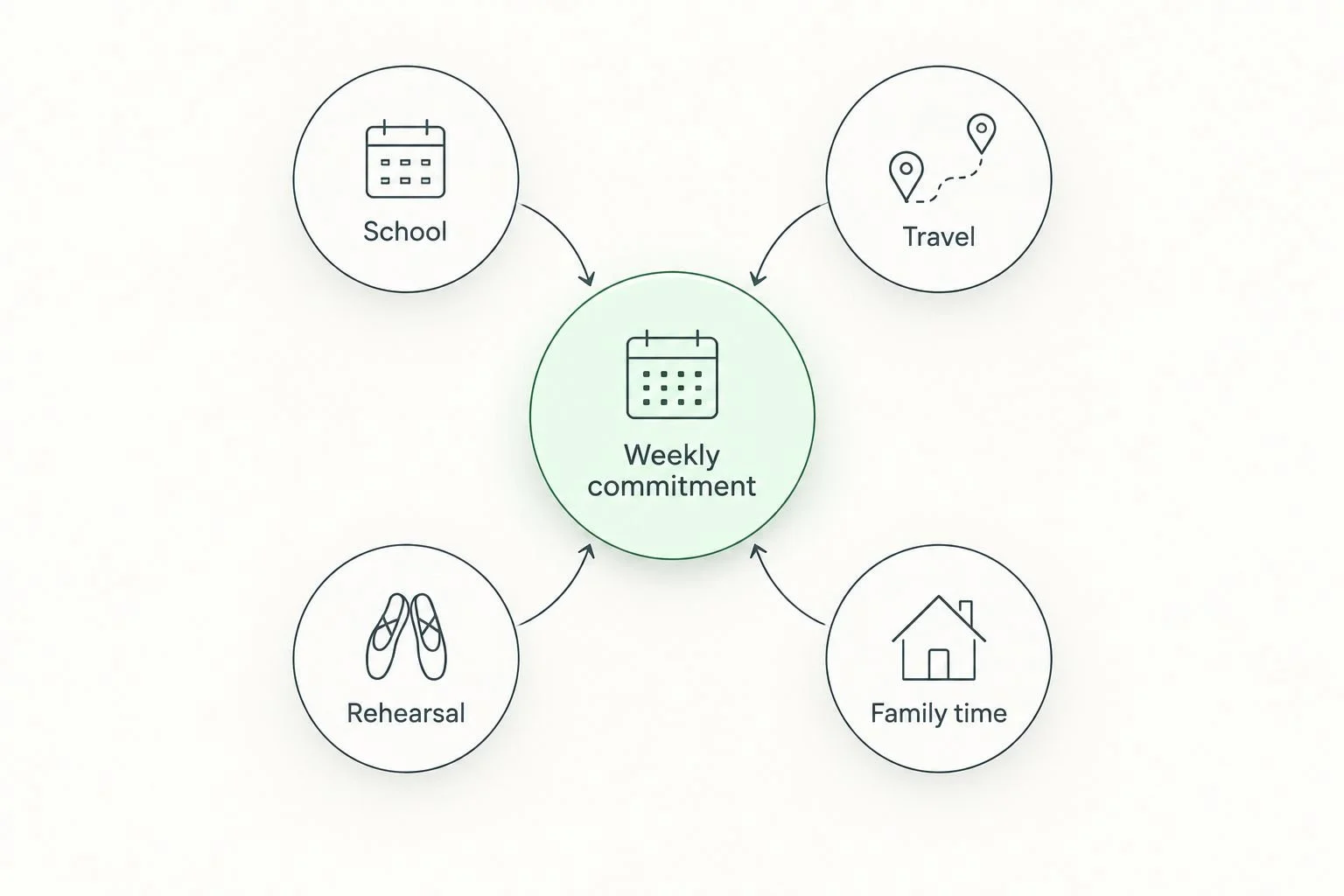
Judge the class by the whole evening, not only the lesson time.
Agree on a focused practice plan
Start with the instructor’s assignment and the space you already have. Ask which movement to practice, how to recognize a correct attempt, and when to stop. Home practice should reinforce the lesson rather than introduce a competing explanation.
For your 2026 practice plan, distinguish listening from physical repetition. Your dancer can identify musical accents, speak a rhythm, or review permitted rehearsal notes without tapping on an unsuitable surface. Confirm both footwear and flooring expectations before doing footwork at home.
A simple listening comparison can use 2 passes through the same instructor-approved phrase: listen first for even timing, then for clear sounds. This is a way to focus attention, not a required practice duration or a promise of progress.
Ask for one current priority rather than a long drill list.
Confirm suitable footwear and practice surfaces with the instructor.
Use recording only with the appropriate teacher and participant permission.
Let your child explain the correction in their own words.
Stop adding speed when the assigned sounds become unclear.
Coordinate team expectations and return after injury
Before committing to competitive-team tap training in 2026, ask how the class and team handle conflicting instructions, missed choreography, and return after an injury. Keep those conversations separate: artistic decisions belong with the dance teachers, while injury assessment and clearance belong with an appropriate healthcare professional.
For example, a dancer returning after an ankle sprain needs guidance about actual dance demands, not just a date on the calendar. Questions about ankle sprain recovery timelines belong alongside a clinician’s assessment of the injury and the movements involved; a general timeline is not individual clearance for tap rehearsal.
Ask who needs to receive any restrictions and how the family should communicate changes. Do not assume that a class offers modified participation, observation, or substitute activities. Confirm the arrangements directly, without asking an instructor to make a medical decision.
Identify the contact for class questions and the contact for team questions.
Share relevant clinician guidance through the appropriate family communication channel.
Ask how changes to choreography are communicated.
Confirm participation expectations before returning after an injury.
Compare training options for your dancer
The best option fills a specific gap in your child’s current training. These are training formats to discuss, not a list of confirmed services or competitive programs at The Garden Arts Center. Ask each provider what the format actually includes.
Group tap technique class
Best for: Dancers developing tap foundations alongside peers
Main benefit: A setting for learning vocabulary, rhythm, and shared exercises
Key limitation: Individual feedback shares time with group instruction
Team choreography rehearsal
Best for: Dancers preparing a particular group routine
Main benefit: Direct work on formations, transitions, and ensemble timing
Key limitation: Routine preparation does not replace foundational instruction
Individual tap lesson
Best for: Dancers needing attention on a defined technical issue
Main benefit: Feedback focused on the student’s specific difficulty
Key limitation: Does not recreate full-team spacing and timing
Independent home practice
Best for: Dancers reinforcing an instructor-approved assignment
Main benefit: Repetition and listening between lessons
Key limitation: Cannot replace teacher feedback or establish class placement
For a 2026 decision, compare the proposed teaching plan against your written goal. If the main difficulty is hearing and matching the group’s rhythm, individual instruction alone leaves an ensemble gap. If the difficulty is an unclear step, repeating the full routine leaves the underlying technique unexamined.
Before registration, gather the class name, placement advice, teaching location, weekly schedule, equipment expectations, and participation requirements. Resolve any conflict with the team calendar before treating the decision as settled.
Common mistakes families make with competitive tap training
Choosing a level by age or competition experience alone
A dancer can have extensive stage experience and still need introductory tap work. Ask how placement considers tap-specific skills, not simply years spent dancing. The appropriate starting point gives your child material they can understand and build on.
Treating louder taps as clearer technique
Volume does not establish whether the rhythm is accurate or the intended sounds are distinct. Ask what the instructor wants the dancer to hear. Avoid encouraging harder stamping as a universal correction for unclear footwork.
Adding classes without naming the purpose
Ballet, jazz, and other styles have their own learning goals; none automatically replaces tap instruction. Before adding another class, finish this sentence: this class addresses my child’s need to learn ____. If the answer remains vague, ask for placement advice first.
Turning every practice into a family audition
Your child needs room to learn without constant comparison to teammates. Agree on the teacher’s current priority, acknowledge effort, and let the instructor assess technical progress. Keep family feedback specific and supportive rather than replaying every mistake.
Assuming the team calendar tells the whole story
A rehearsal listing does not explain transport, clothing changes, meals, or homework. Revisit the full weekly calendar when commitments change. A sustainable routine protects your child’s ability to participate with attention and enthusiasm.
FAQ
What should I look for in tap dance classes for competitive teams?
Look for appropriate placement, instruction in clear sounds and rhythm, and opportunities to work on ensemble timing. Ask how technique teaching connects with choreography rehearsal and whether the full commitment fits your family schedule.
Does my child need tap experience before joining a competitive team?
Entry requirements depend on the team and class, so confirm them directly with the instructor or director. Experience in ballet, jazz, or another style does not establish tap readiness.
Are individual tap lessons better than group classes for team dancers?
Individual lessons suit a defined technical issue, while group classes provide shared rhythm exercises and peer learning. Choose the format that addresses your dancer’s current goal rather than treating either format as automatically better.
Does The Garden Arts Center offer competitive tap teams?
The Garden Arts Center offers tap and other arts classes, but competitive-team provision is not established here. Ask directly about current class placement and whether the instruction suits your child’s team commitments.
How much should a competitive tap dancer practice at home?
The instructor should set the practice assignment for the dancer’s level and current goal. Ask what to practice, how to recognize a correct attempt, and which footwear and surface are suitable rather than choosing an arbitrary duration.
How do I fit tap classes around school and other rehearsals?
Compare the complete weekly commitment, including travel, meals, homework, changing time, and sibling activities. Confirm the actual teaching location and participation expectations before committing to a schedule.
Can my child return to tap class after an ankle sprain?
Return after an ankle sprain needs individual guidance from an appropriate healthcare professional. Share relevant restrictions with the instructor and confirm participation arrangements rather than relying on a general recovery timeline.
One last thing
Ask your dancer what they want to hear improve—not just what they want to perform. Clearer sounds, steadier timing, and confidence sharing a rhythm give a teacher something concrete to discuss. That conversation is a better starting point than choosing the most demanding class title.