

Show choir vocal training is singing instruction aimed at helping ensemble performers coordinate vocal technique, musical accuracy, and stage movement. For families choosing vocal lessons for show choir singers in 2026, the right fit supports the school director’s work without overwhelming the student’s weekly schedule.
TL;DR
Choose vocal lessons for show choir singers around ensemble goals, comfortable singing, and a sustainable family schedule.
The Garden Arts Center suits families seeking singing lessons alongside other arts disciplines.
Keep vocal technique and choir blend central; solo audition preparation serves a different purpose.
Ask instructors how they coordinate individual practice with school repertoire and choreography.
Why vocal lessons matter for show choir singers
Show choir asks students to sing, listen, remember staging, and move together. Individual instruction creates space to examine a phrase that gets lost in a full ensemble rehearsal: an uncertain entrance, unclear words, or a passage that feels uncomfortable while moving.
The Garden Arts Center is best for families seeking singing lessons within a broader arts community. The Garden Arts Center offers vocal instruction alongside dance, theater, music, and other arts classes; ask directly about an instructor’s experience with competitive show choir before choosing a lesson.
The distinction matters. A school choir director prepares the ensemble, while a voice instructor can focus on the individual singer. Neither role replaces the other, and an effective lesson plan respects both.
For your family’s 2026 plan, start with the actual challenge rather than adding training simply because competition feels demanding. A student who struggles with harmony needs a different emphasis from a confident singer who loses clarity during choreography.
How to choose and use vocal lessons
1. Identify the singing challenge
Start with a conversation among your child, the choir director, and you. Ask what feels difficult and what the director wants the student to improve. Use the assigned music rather than a demanding solo chosen only to impress an instructor.
Listen to a permitted rehearsal recording together. Describe what happens without judging the singer: the entrance arrives late, the words become unclear, or the melody changes when another part enters. Let your child explain how the passage feels, too.
Bring 1 musical phrase to the first discussion, with the difficult spot marked. That gives the instructor a concrete starting point without turning the lesson into a list of everything your child thinks is wrong.
Mark the passage in an authorized score.
Write down the director’s instruction accurately.
Separate pitch, rhythm, diction, and movement concerns.
Ask your child which goal feels most useful.
2. Build a workable weekly plan
Before contacting an instructor, put school, choir rehearsals, homework, transportation, and rest on the same calendar. A lesson slot is not workable if getting there requires a rushed departure from school or repeatedly conflicts with ensemble commitments.
Families across Berks, Montgomery, and Chester counties should evaluate the actual journey. Whether you travel from Douglassville, Pottstown, Phoenixville, King of Prussia, Reading, or Lansdale, check the teaching location and your route rather than assuming a nearby town name means a nearby classroom.
For 2026, build your weekly plan around commitments you can sustain during both ordinary school weeks and performance weeks. Leave the lesson duration and frequency for discussion with the instructor; no single schedule fits every singer.
School: Include dismissal, homework, and other activities.
Choir: Mark rehearsals, performances, and travel.
Travel: Check the full door-to-door journey.
Lessons: Include arrival and the return trip.
Rest: Protect time that is not another activity.
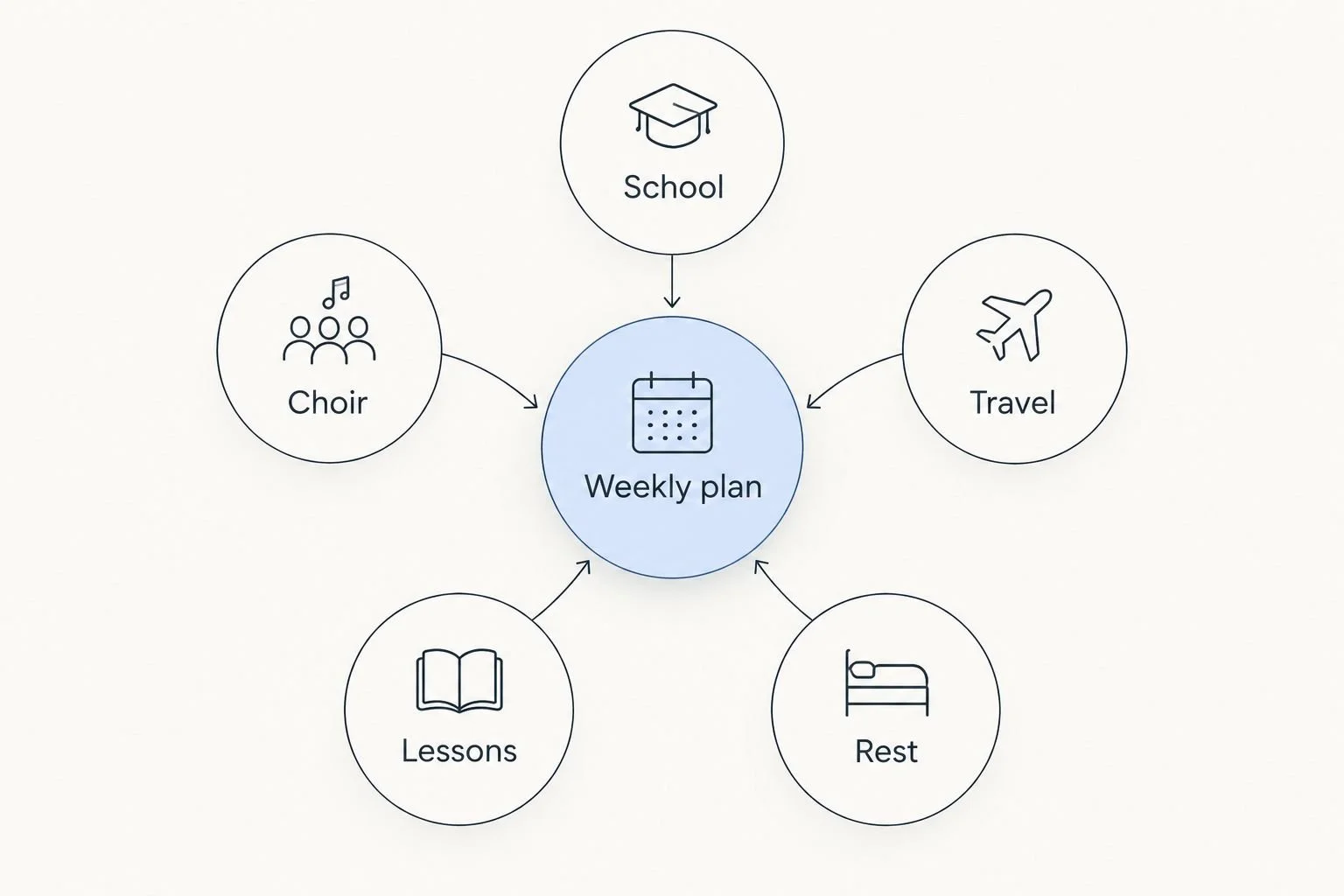
Choose a lesson commitment that fits the whole week, not just an open calendar slot.
3. Ask about instruction before registering
Use your school director’s feedback as a starting point, then ask prospective instructors how they would approach it. Look for an explanation of the teaching process, not a promise about solos, placements, or competition results.
The Garden Arts Center offers singing lessons and a wider arts setting. That makes it a relevant option for families exploring vocal instruction alongside theater or dance, but those offerings alone do not establish a specialized show choir program. Ask about the specific instructor and lesson format.
Bring 3 questions to your initial conversation: how instruction fits the singer’s experience, how school repertoire enters lessons, and how practice expectations fit existing rehearsals. You can contact the center with those questions before deciding whether to proceed toward registration.
Ask about experience teaching school-age ensemble singers.
Explain the student’s current choir responsibilities.
Ask how the instructor handles changing voices.
Confirm scheduling and registration details directly.
4. Develop technique without chasing volume
Begin with the music and guidance your child already has. Ask the choir director to clarify breathing marks, pronunciation, and musical phrasing. An individual instructor can then assess how the student approaches those tasks and choose exercises suited to the singer.
A useful explanation connects technique to something audible or observable. For example, an instructor might help a student coordinate a phrase entrance, keep words understandable, or approach a passage without pushing for a louder sound. These are teaching examples, not a prescribed exercise routine.
Pain and persistent hoarseness are not training goals. Stop an activity that hurts, tell the instructor and director, and seek medical advice for persistent or recurring voice symptoms. A singing lesson is not a medical assessment.
Follow exercises chosen for the individual student.
Ask what each exercise is intended to address.
Avoid copying demanding online vocal challenges.
Report discomfort instead of singing through it.
5. Practice ensemble listening and accuracy
Use director-approved learning materials first. Your child needs to know the assigned part, not merely the melody heard most clearly in a recording. A voice instructor can help identify where the singer loses the part and build a focused practice task around that passage.
Pitch accuracy and ensemble blend are connected but different. A student can sing the correct notes while using vowels, timing, or volume that do not match the group. Discuss the director’s expectations so individual lessons do not encourage a conflicting performance style.
Make 2 recordings of the same short passage when recording is permitted: one before focused work and one afterward. Compare the intended skill, not the student’s worth as a performer. Do not post classmates’ voices or rehearsal material without permission.
Check starting notes against approved materials.
Mark entrances and releases in the score.
Match the director’s chosen word pronunciation.
Review one specific goal when listening back.
6. Coordinate singing with stage movement
Start by separating an uncertain vocal passage from difficult choreography. Ask the director or choreographer how to break down the transition, then rebuild the combination under their guidance. Repeating the whole routine without identifying the problem makes it harder to know what needs attention.
Dance instruction can address movement technique; vocal instruction addresses singing. Neither automatically covers the other. If your child already takes ballet, jazz, tap, hip hop, or another dance class, explain the show choir demands before adding a separate commitment.
For the 2026 performance season, ask your child to identify the exact transition where singing changes. Is the entrance missed after a turn, or do words become unclear during traveling steps? That description helps the relevant instructor respond.
Learn the musical phrase accurately before combining tasks.
Identify the movement attached to the difficult entrance.
Ask the choreographer about unclear movement instructions.
Recombine singing and movement with teacher guidance.
7. Review progress with your child
Use the original goal as the review point. Ask whether your child understands the phrase better, can explain the instructor’s guidance, and feels comfortable asking questions. Competition rankings do not isolate the effect of individual lessons.
Include the family schedule in that review. A useful lesson still needs to fit homework, travel, school attendance, and the student’s willingness to participate. Ask about adjustments rather than assuming that more lessons or another class is the answer.
At your next 2026 planning conversation, let your child speak first. Belonging matters: the student should have room to learn, make mistakes, and ask for help without feeling that every lesson is an audition.
Revisit the original musical goal.
Ask what your child understands more clearly.
Share relevant director feedback with permission.
Recheck travel and homework demands.
Agree on the next focused learning task.
Compare support options for show choir singers
Choose support by the problem it addresses, not by how impressive the class sounds. These options serve different purposes, and adding all of them is not a requirement. Confirm the instructor’s approach and your family’s schedule before making a commitment.
School choir rehearsal
Best for: Ensemble coordination
Main benefit: Practices the group’s repertoire, timing, and interpretation
Key limitation: Individual attention is shared across the ensemble
Individual vocal lessons
Best for: Singer-specific technique questions
Main benefit: Allows focused feedback on the student’s singing
Key limitation: Does not replace ensemble rehearsal or choreography instruction
Director-approved home practice
Best for: Maintaining assigned musical work
Main benefit: Keeps practice aligned with school expectations
Key limitation: Cannot supply immediate teacher feedback
Dance instruction
Best for: Movement foundations
Main benefit: Gives dedicated attention to dance technique
Key limitation: Does not replace vocal instruction
The Garden Arts Center singing lessons
Best for: Families seeking vocal instruction within a broader arts community
Main benefit: Places singing among related arts offerings
Key limitation: Show choir experience, format, and scheduling require direct confirmation
If your child is considering several disciplines, choose the immediate priority first. An additional theater or dance class should serve a genuine interest or learning need, not become another obligation simply because it relates to performing.
Common mistakes show choir families make
Treating every lesson as solo preparation
A standout solo sound is not always the ensemble’s goal. Tell the instructor whether your child needs help with harmony, blend, or an audition, and identify which task takes priority. Solo preparation and ensemble preparation can coexist, but they should not be confused.
Choosing a teacher only for impressive repertoire
A difficult song does not prove that instruction fits a young singer. Ask how the teacher selects material, responds to discomfort, and explains adjustments. Look for instruction your child can understand rather than a song list that sounds advanced.
Adding classes before checking the calendar
Vocal lessons, dance, theater, and school choir each need time. Map travel and school responsibilities before adding another commitment. For families coordinating siblings, the return journey and evening homework matter as much as the class itself.
Giving conflicting instructions at home
Parents can support practice without becoming a second voice teacher. Ask your child to explain the assigned task, help organize materials, and send technical questions back to the instructor. Avoid telling a singer to push harder or sing louder to solve an unclear problem.
FAQ
What are the best vocal lessons for show choir singers?
The best fit addresses the singer’s individual needs while supporting the choir director’s ensemble goals. Ask about school-age instruction, assigned repertoire, comfortable technique, and a schedule your family can sustain.
Does my child need private singing lessons to join show choir?
Ask the school director about that ensemble’s participation requirements. Individual vocal lessons provide focused instruction, but they do not replace school rehearsals or establish eligibility for a particular choir.
Can vocal lessons help my child sing while dancing?
Vocal lessons can address the singing component, while choreography instruction addresses the movement. Tell both instructors where the combined task becomes difficult so their guidance supports the same goal.
Should a show choir singer also take dance classes?
Choose dance instruction when movement technique is a learning priority and the family schedule supports another class. Ask the choir director which skills need attention before choosing a dance style.
What should we ask The Garden Arts Center about singing lessons?
Ask about the instructor’s experience with school-age ensemble singers, lesson format, and current scheduling details. Explain your child’s choir commitments and confirm whether the teaching approach fits the student’s goals.
How often should a competitive show choir singer take lessons?
Set lesson frequency with the instructor after reviewing the student’s needs and existing rehearsal commitments. Include homework, travel, other activities, and rest rather than treating an empty calendar slot as the only consideration.
What should we do if singing causes pain or persistent hoarseness?
Stop singing through pain and seek medical advice for persistent or recurring voice symptoms. Inform the choir director and vocal instructor; neither a competition deadline nor a lesson replaces medical assessment.
One last thing
Bring the difficult transition, not just the difficult note. A singer who handles a phrase comfortably while standing still needs a different conversation when the problem appears only after choreography. Mark where it happens and share that detail with the appropriate instructor before adding more practice.