

Children can start vocal lessons when they want to sing, can participate in guided activities, and can work with a teacher who adapts instruction to their development; there is no universal birthday that makes every child ready. Younger children need playful, age-appropriate singing rather than demands to sound like adult performers. For your family's 2026 plans, choose by readiness, comfortable voice use, and a schedule you can sustain—not age alone.
TL;DR
For vocal lessons for kids age decisions, readiness and age-appropriate instruction matter more than a birthday.
The Garden Arts Center offers singing lessons within an arts community serving children and adults.
Choose a teacher who welcomes questions and adapts songs to a child's comfortable voice.
Plan singing lessons around school, travel, and existing activities before adding another commitment.
Why this matters
A child who sings constantly at home is showing interest, but interest does not automatically tell you which lesson format fits. Another child might enjoy music quietly and need time before singing in front of someone new. Neither response calls for pressure.
Your goal is to find instruction that meets your child where they are. Before choosing a program, use these questions for choosing vocal lessons for a young singer to focus the conversation on teaching approach, comfort, and expectations.
What age is appropriate to start vocal lessons?
The appropriate starting point is when your child can engage with a suitable teacher and wants to explore singing. Chronological age helps a teacher plan instruction, but it does not replace a conversation about attention, communication, confidence, and musical interests.
These approaches describe possible starting points, not confirmed class formats or age requirements at any particular center.
Playful music-making
Best for: Children who enjoy songs but need movement and frequent changes
What to look for: Singing games, listening, imitation, and permission to participate gradually
Limitation to consider: Does not provide the same individual attention as a dedicated lesson
Individual vocal lessons
Best for: Children ready to work directly with a teacher
What to look for: Adapted activities, clear explanations, and comfortable song choices
Limitation to consider: Focused attention can feel demanding for a hesitant beginner
Group singing
Best for: Children who enjoy making music with others
What to look for: Clear guidance and a welcoming approach to participation
Limitation to consider: Less time for individual feedback
Performance-focused singing
Best for: Students interested in theater, choir, or auditions
What to look for: Instruction that separates vocal learning from performance pressure
Limitation to consider: Performance goals add preparation beyond learning a song
Ask how the teacher chooses among these approaches. A useful answer explains what your child will actually do, rather than relying on an age cutoff alone.
Younger beginners: start with participation
For a younger child, look for opportunities to echo a short musical phrase, explore rhythm, and sing familiar material. A teacher can introduce listening and musical expression without asking for polished performances.
The trade-off is that playful learning can look less formal than parents expect. That is not a reason to demand longer exercises; ask the teacher what each activity is intended to teach.
School-age beginners: look for guided engagement
A school-age child does not need an impressive voice before starting. Look instead for willingness to try an unfamiliar activity, listen to an explanation, and return to something that takes practice.
Some children need instructions broken into smaller steps. Discuss those needs directly rather than treating quietness, reading ability, or a different learning style as a reason to rule out singing.
Teen beginners: match instruction to the current voice
Teenagers can begin vocal lessons without having studied as younger children. Their interests might include singing for enjoyment, joining a choir, or exploring musical theater.
During puberty, voices change. Ask how the teacher adjusts material to the student's current voice instead of expecting a fixed range or an adult sound.
Why readiness for vocal lessons varies
For a 2026 enrollment decision, consider these factors together. None should become a test your child must pass perfectly.
Interest: Your child shows curiosity about singing, songs, or making music—not simply agreement with an adult's plan.
Participation: Your child can join a guided activity with support suited to their development.
Communication: Your child can indicate discomfort, confusion, or a need for a break in a way the teacher understands.
Teaching fit: The instructor can explain how activities change for a beginner's age, experience, and learning needs.
Family capacity: Travel, schoolwork, other activities, and home expectations leave room for a manageable commitment.
Readiness belongs to the match between student, teacher, and format. A child who dislikes a highly structured lesson might still enjoy a playful musical setting. Avoid turning a mismatch into a judgment about talent.
How can I tell whether my child is ready?
Use this sequence to prepare for a conversation with an instructor. You are gathering observations, not conducting an audition at home.
Notice interest. Ask what your child enjoys about singing. A favorite song, curiosity about melodies, or wanting to sing with others gives the teacher a starting point.
Observe participation. Notice how your child responds when someone demonstrates an activity and invites them to try. Do not expect immediate accuracy.
Discuss comfort. Explain that lessons involve experimenting and receiving guidance. Give your child a simple way to say something feels uncomfortable.
Check the schedule. Map the trip, school obligations, and existing activities before committing. Include the transition into and out of class, not just time in the lesson.
Ask the teacher. Share what you noticed and ask which approach fits. Request an explanation of starting expectations before making a registration decision.
These 5 steps keep the decision focused on participation rather than performance. A child does not need to sing a difficult song to demonstrate an interest in learning.
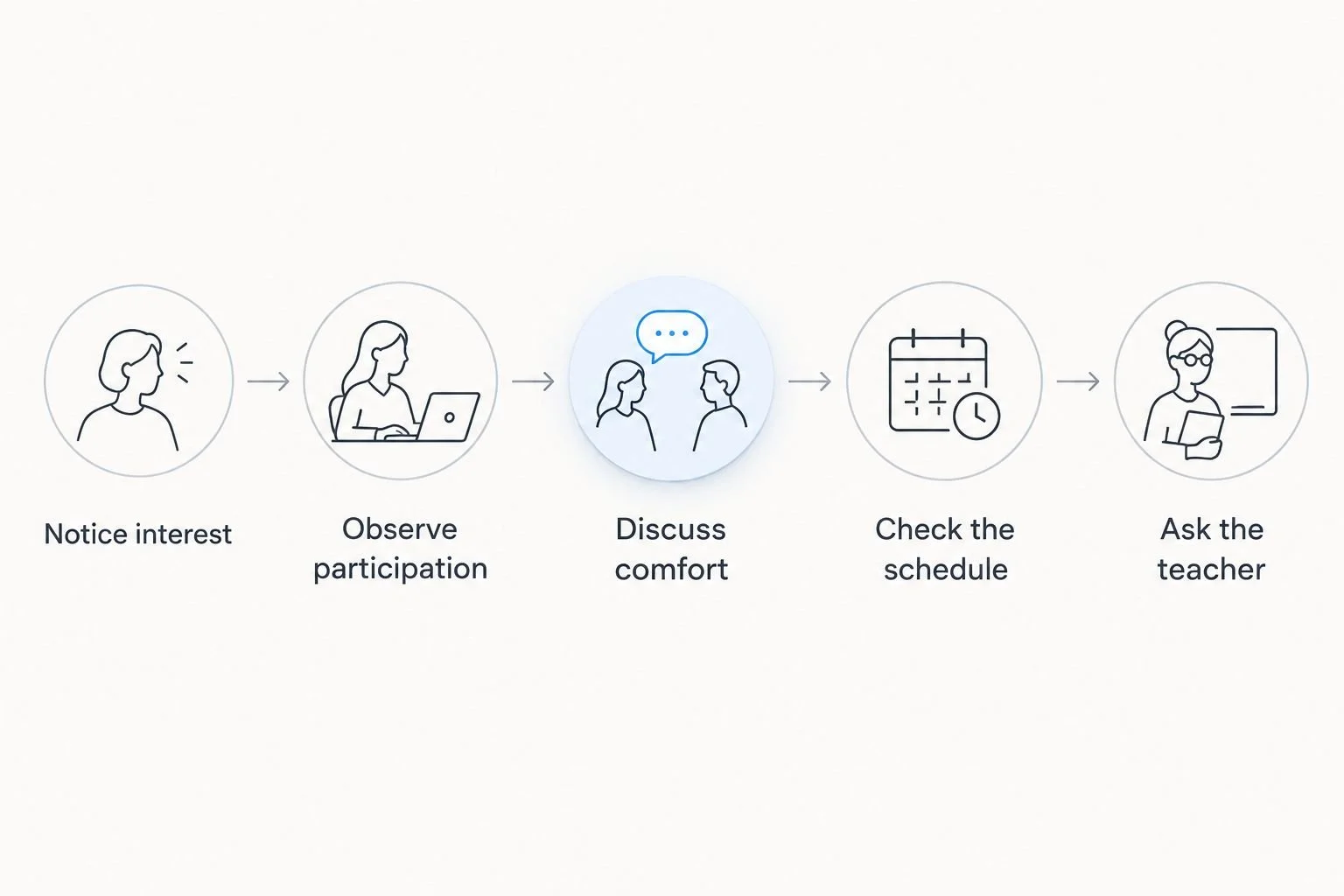
Choose a starting approach by considering your child, the teacher, and the family schedule together.
What should children learn in beginning vocal lessons?
Beginning instruction can include listening, matching musical patterns, exploring rhythm, and communicating a song's meaning. Ask the teacher how those activities fit your child's experience. There is no need to make every lesson resemble audition preparation.
A child might listen to a short phrase and sing it back, notice where a song calls for a breath, or speak lyrics before singing them. These are examples of teaching activities to discuss, not a promised curriculum.
Look for clear explanations, not demands for a bigger or more adult-sounding voice. Children should be able to ask questions and say when something feels uncomfortable. Loudness and high notes are poor substitutes for understanding what a student is learning.
For your 2026 class search, ask the teacher to describe a beginner lesson in plain language. You should understand the purpose of an activity without needing musical terminology yourself.
How do I choose a teacher for a young singer?
Choose a teacher who can describe working with developing voices and explain how instruction changes for different learners. A list of performance achievements does not answer whether someone can teach your child patiently and clearly.
When finding a vocal coach, distinguish a child's learning needs from a performer's immediate preparation needs: learning to listen and use the voice comfortably is not the same task as polishing an audition song. Ask which needs the teacher addresses and how they recognize when an activity is unsuitable.
Use these 3 questions to make the conversation concrete:
How do you choose songs that fit a child's current voice and understanding?
What do you do when a student becomes tired, uncomfortable, or reluctant to sing?
How do you communicate expectations for practice and participation to families?
Listen for specific teaching decisions. An answer about simplifying a musical task or changing a song gives you more information than a promise to build confidence quickly.
Professional guidance also includes respecting limits. Vocal instruction is not medical care; recurring pain, persistent hoarseness, or concerns about voice health belong in a conversation with a qualified healthcare professional.
How can vocal lessons fit a busy family schedule?
A suitable class still needs to fit an ordinary school week. Before registering in 2026, write down the full commitment: getting ready, traveling, attending, returning home, and any practice expectations the instructor describes.
For families across Berks, Montgomery, and Chester counties, plan from your actual starting point. Whether you travel from Douglassville, Pottstown, Phoenixville, King of Prussia, Reading, or Lansdale, assess the route at the time you would use it. Do not assume a center has a location in your town.
Begin by considering 1 new weekly commitment rather than automatically adding several activities together. That is a planning choice, not a recommended lesson frequency or a statement about any provider's schedule. Ask about the actual lesson arrangement before deciding.
If your child already attends ballet, tap, jazz, hip hop, or creative movement, consider whether singing adds a welcome change or makes the week feel crowded. Enjoying several art forms does not require studying all of them at once.
The Garden Arts Center is best for families seeking singing lessons within a broader arts community. Its offerings include dance, theater, music, art, and wellness; you still need to confirm the current vocal lesson format, age guidance, and schedule before choosing a fit.
What should I ask before registration?
Bring your child's interests and your practical limits into the same conversation. A useful inquiry explains what your child hopes to explore and which parts of the week are already committed.
Ask about the current starting-age guidance, how beginners are placed, and what participation requires. Then ask about lesson length, home practice, attendance expectations, and any performance commitments. These details affect your decision; do not infer them from a general description of singing lessons.
You can contact the center with those questions before making plans. Include relevant learning or communication needs so the discussion addresses your child rather than an imagined typical beginner.
A welcoming arts community is valuable, but broad offerings alone do not establish the right individual fit. Choose based on the answers you receive and whether the proposed arrangement feels sustainable for your family.
FAQ
What is the best age to start vocal lessons for kids?
There is no universal best age to start vocal lessons for kids. Look for interest in singing, readiness to participate with support, and a teacher who adapts instruction to the child's development.
Can a preschooler take singing lessons?
A preschooler can explore singing through age-appropriate musical activities, but a formal lesson format needs an individual fit discussion. Ask how the teacher uses play, listening, movement, and short activities rather than expecting adult-style vocal work.
Does my child need to sing in tune before starting lessons?
Your child does not need polished singing skills before beginning vocal instruction. Tell the teacher what your child enjoys and ask how listening and pitch-related activities are introduced to beginners.
Is it too late for a teenager to start vocal lessons?
It is not too late for a teenager to start vocal lessons. Choose instruction that fits the student's current voice, experience, and goals, with adjustments as the voice changes.
Are individual vocal lessons better than group singing for children?
Neither format is automatically better for every child. Individual lessons offer focused feedback, while group singing offers shared music-making with less individual attention; the right choice depends on the child's needs and comfort.
What should I do if singing makes my child's throat hurt?
Stop the singing activity if your child's throat hurts. Tell the instructor, and discuss recurring pain or persistent voice changes with a qualified healthcare professional rather than treating discomfort as a normal practice goal.
Does The Garden Arts Center offer singing lessons for children?
The Garden Arts Center offers singing lessons as part of its arts programming for children and adults. Confirm current age guidance, lesson arrangements, and scheduling directly before registering.
One last thing
The most useful question after an early lesson is not whether your child sounded impressive. Ask what they noticed, what felt comfortable, and what they would like to try again.
For your family's 2026 decision, treat that conversation as information—not a demand for enthusiasm. A child's willingness to return matters more than producing a performance for the family after every lesson.