

Beginner hip hop dance classes teach rhythm, groove, weight shifts, body isolations and foundational footwork, then connect those skills in short movement sequences. For a family choosing a class in 2026, the key distinction is whether the teacher explains how movement works—not simply which move comes next.
TL;DR
Beginner hip hop dance classes should teach groove, musicality, body control and footwork—not choreography alone.
The Garden Arts Center offers hip hop within an arts community serving children and adults.
Look for instruction that breaks down weight shifts, explains timing and gives beginners room to practice.
Choose a sustainable weekly commitment that accounts for travel, school activities and your child’s readiness.
The Garden Arts Center is a fit for families seeking hip hop dance classes within a broader arts community. Match the individual class to your child’s experience, interests and schedule.
What dance technique do beginner hip hop classes teach?
Beginner technique connects the beat, the body and the movement. A useful learning sequence starts with hearing a steady pulse, finding a comfortable groove and transferring weight before adding more detailed steps.
The table below gives you concrete things to ask about. It describes foundational teaching content, not a confirmed syllabus for a particular class.
Rhythm
What a beginner practices: Moving in time with a steady beat
What to look for in instruction: The teacher connects movement to what students hear
Groove
What a beginner practices: Repeating a relaxed bounce or rock with the music
What to look for in instruction: Students practice movement quality, not just positions
Weight transfer
What a beginner practices: Moving body weight from one supporting foot to another
What to look for in instruction: The teacher explains which foot carries the weight
Isolations
What a beginner practices: Moving one body area with control
What to look for in instruction: Movements stay comfortable rather than forced
Footwork
What a beginner practices: Step-touches, directional steps and simple patterns
What to look for in instruction: Students learn placement before adding speed
Coordination
What a beginner practices: Combining the arms, legs and torso
What to look for in instruction: The teacher separates parts before combining them
Musicality
What a beginner practices: Responding to accents, pauses and phrases
What to look for in instruction: Students learn why a movement fits the sound
Choreography
What a beginner practices: Connecting learned movements into a sequence
What to look for in instruction: Earlier foundations remain visible in the combination
A teacher can introduce these foundations through different exercises. For example, students might first step side to side, then add a bounce, then change direction while keeping the pulse.
That progression matters more than how many moves a child remembers after class. Repeating a simple pattern with clearer timing is meaningful technical work, even when it looks less elaborate than a finished routine.
Why this matters when choosing a beginner class
A child can copy an arm gesture without understanding where their weight belongs. Once the sequence changes direction, that missing foundation becomes harder to ignore.
For your 2026 class search, ask what students learn underneath the choreography. A useful answer names skills such as balance, groove, timing and coordination, then explains how the teacher introduces them.
Choose instruction your child can understand, not a routine that only looks impressive. A beginner needs permission to repeat, ask questions and work through unfamiliar movement without treating every attempt as a performance.
Hip hop also has cultural foundations in Black and Latino communities. Respectful teaching treats the form as more than a collection of fashionable movements and distinguishes related dance styles rather than presenting every movement as interchangeable.
Groove and rhythm: learning to move with the beat
Groove is the continuing rhythmic quality that gives movement its feel. A bounce or rock is not merely a waiting position between steps; it is part of how the dancer relates to the music.
In an introductory exercise, a student can bend and release through the knees while maintaining an easy pulse. The upper body participates without becoming rigid, and the teacher helps students notice whether their movement stays connected to the beat.
Counting supports this process, but counting alone is not musicality. In music organized in 4-beat measures, a dance phrase counted over 8 counts spans 2 measures; teachers can use that structure to organize a short combination.
Listen for explanations that connect the count to the sound. A teacher might ask students to hear the steady pulse first, then notice a stronger accent without losing that underlying timing.
Parents do not need dance training to ask a useful question: What helps a beginner who can remember the steps but struggles to stay with the music? The answer should describe a teaching approach, not label the child as unmusical.
Body control: isolations, posture and comfortable movement
An isolation asks a dancer to move one body area with control while limiting movement elsewhere. Examples include shifting the shoulders or rib cage without turning every action into a full-body movement.
For beginners, smaller movement gives the teacher something clear to explain and the student something manageable to practice. Bigger is not automatically better.
Look for cues about comfortable range, relaxed breathing and controlled movement. A child should not need to force their neck or lower back to imitate the size of an instructor’s demonstration.
Posture also depends on the movement being taught. Hip hop does not require students to hold the same upright shape throughout every exercise; bending, shifting and changing levels are part of the movement vocabulary.
Sound technique means controlling the intended shape, not making every dance style look alike. Ask how the teacher helps students distinguish a deliberate body position from an uncontrolled collapse.
If your child reports pain, stop the painful movement and discuss it with the instructor. Persistent or concerning symptoms belong with an appropriate healthcare professional, not an at-home attempt to stretch through them.
Footwork: understanding where your weight goes
Footwork becomes easier to understand when students know which leg supports them. A step is not just a foot arriving at a new location; it often includes transferring body weight onto that foot.
A beginner exercise can separate those ideas:
Find support: Stand comfortably and notice which foot carries your weight.
Shift weight: Step to the side and transfer support onto the stepping foot.
Add rhythm: Repeat the pattern with a steady pulse.
Add direction: Change the pathway without abandoning the underlying timing.
Combine movement: Add an arm action after the foot pattern makes sense.
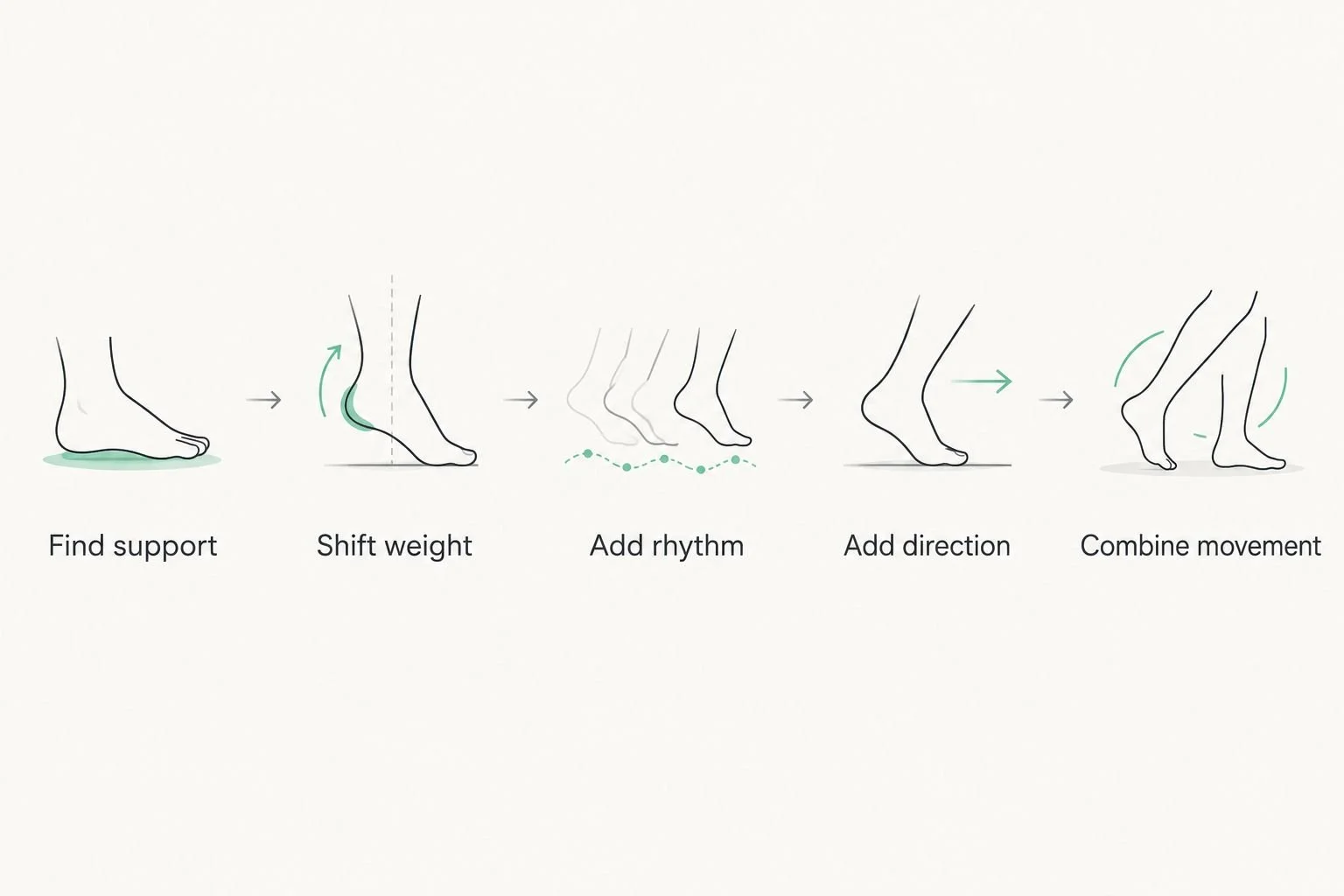
Separate the foot pattern from the arm action before combining them.
The benefit of this sequence is clarity; its limitation is that separate parts still need to be reconnected. Practicing feet alone indefinitely does not teach the coordination needed for a complete movement.
Ask whether students get time to work on transitions. The moment between steps often reveals more about understanding than a pose held at the end.
Choreography: putting technique into a short sequence
Choreography gives beginners a reason to connect individual skills. A short combination can ask students to maintain a groove, shift weight, change direction and remember an order of movements.
Its strength is context: students experience how foundations work together. Its limitation is cognitive load. When remembering the sequence takes all their attention, students have less attention left for timing or movement quality.
A helpful teaching approach separates the challenge. The instructor can demonstrate, explain the feet, add the upper body and reconnect the movement to music rather than expecting everything to happen at once.
For example, 2 sets of 8 counts create a 16-count practice phrase. That is an illustration of how movement can be organized, not a required beginner milestone or a promise about what a student will learn in a lesson.
In 2026, use the class description as a starting point rather than proof of instructional fit. Ask how the teacher adjusts when a beginner needs the sequence broken into smaller pieces.
Why beginner hip hop instruction varies
There is no single lesson outline that every beginner class follows. These factors help explain why two introductory classes can feel different:
Previous experience: A first-time dancer needs different explanations from a student transferring from another dance style.
Developmental readiness: Following directions, sharing space and remembering movement affect how instruction is organized.
Movement vocabulary: Ask which foundations and styles the teacher actually introduces rather than relying on the broad hip hop label.
Learning emphasis: A lesson centered on choreography uses practice time differently from one centered on groove or improvisation.
Access needs: Discuss movement adaptations and participation needs directly instead of assuming that a general description answers them.
These differences are not a ranking. A class is appropriate when its expectations and teaching approach match the student who will attend.
Do beginners need dance experience before starting hip hop?
Beginners do not need previous dance training to begin learning hip hop foundations. They do need a class whose expectations match their starting point.
Ask whether beginner means first-ever dance experience or first experience with this particular style. Those are different entry points, especially when students already know how to follow combinations.
Is learning a routine the same as learning dance technique?
Learning a routine is not the same as learning dance technique. Choreography sets the movement order; technique addresses how the student performs that movement, including timing, weight transfer and control.
A useful beginner class connects both. Students should understand something about the movement, not only remember what follows it.
Should beginners learn tricks or floorwork immediately?
Tricks and floorwork are not prerequisites for learning beginner hip hop foundations. Start by asking about the specific movement content rather than assuming the class includes acrobatics or breaking.
If a class includes physically demanding skills, ask how the instructor establishes readiness, teaches preparation and adapts the activity. A dramatic-looking skill is not evidence that the beginner foundations are stronger.
How to choose a class your family can sustain
For families across Berks, Montgomery and Chester counties, the weekly journey belongs in the decision alongside the dance content. Consider school dismissal, travel, meals and other activities before selecting a commitment.
Whether you travel from Douglassville, Pottstown, Phoenixville, King of Prussia, Reading or Lansdale, check the actual class location and route. A town mentioned in a service area does not establish that a class meets there.
Build your 2026 shortlist around these questions:
What does the instructor expect a new student to know?
How are rhythm, groove and weight transfer introduced?
How does the teacher help a child who needs another explanation?
What are the current class time, location and registration requirements?
What clothing and footwear does the instructor require?
Does the whole weekly commitment fit your family’s routine?
The Garden Arts Center offers hip hop alongside other dance and arts classes. That breadth gives families several interests to consider, but it does not establish the right level or weekly fit for an individual student.
Use the guide to choosing beginner hip hop dance classes for kids to organize your questions. Before registration, confirm the current details directly rather than relying on a general article.
Explore dance and arts classes
Review the center’s offerings, then ask about beginner expectations and the current schedule.
FAQ
What technique do beginner hip hop dance classes teach?
Beginner hip hop dance classes teach rhythm, groove, weight transfer, isolations, footwork and coordination. Short combinations give students a way to connect those foundations.
Is hip hop a good first dance class for my child?
Hip hop is an option for a first dance class when the instruction matches your child’s readiness and experience. Ask how the teacher introduces unfamiliar movement and supports students who need repetition.
Does my child need ballet before taking hip hop?
Ballet is not a universal prerequisite for beginner hip hop. Confirm the individual class requirements, because previous dance experience and placement expectations differ.
What should I ask if my child struggles to follow choreography?
Ask how the instructor breaks choreography into smaller parts and reconnects those parts to music. Difficulty remembering a sequence does not, by itself, explain a child’s understanding of rhythm or movement.
Should we practice hip hop at home between classes?
Ask the instructor which familiar movements are appropriate to repeat at home. Keep the space clear and avoid introducing unfamiliar tricks, forced stretches or movements that cause pain.
Does The Garden Arts Center offer hip hop dance classes?
The Garden Arts Center includes hip hop among its dance offerings for its local community. Confirm the current class level, schedule, location and registration requirements directly before choosing a class.
How do I fit a beginner class around school and other activities?
Assess the full commitment, including travel, meals, preparation and the class itself. Choose a weekly arrangement your family can sustain rather than adding a lesson that repeatedly conflicts with existing responsibilities.
One last thing
When you discuss a lesson with your child, ask what they noticed about the music or how they moved—not only whether they remembered the routine. That question makes room for discoveries such as finding the beat, balancing after a step or understanding an arm action.
For your 2026 class choice, remember this distinction: a complicated routine is not proof of a strong foundation. Look for explanations your child can use and a weekly commitment your family can keep.