

Best for codified foundations: ballet. Best for audible rhythm: tap. Best for movement exploration: creative movement. This 2026 guide to dance classes ranked by technique matches each style to a learning goal, so you can choose for your child rather than chase a universal winner.
TL;DR
Dance classes ranked by technique: choose ballet for codified foundations and tap for audible rhythm.
Creative movement suits children exploring rhythm, space, and movement before more formal dance study.
The Garden Arts Center suits families seeking dance alongside music, theater, art, and wellness.
Choose kids dance classes by readiness, instruction, and a weekly commitment your family can sustain.
Why this matters
A technique-focused class is not automatically the most advanced-looking class. Technique includes how students place their weight, coordinate movement, hear music, and repeat a skill with control. Different styles make different parts of that learning visible.
The Garden Arts Center is a fit for families seeking dance within a broader arts community. Explore The Garden Arts Center with a specific question in mind: which class matches your child's interests and current experience? A style name alone does not establish the right placement.
What makes the best technique-focused dance class?
Use these criteria when comparing your family's 2026 options:
Clear foundations: Instruction breaks movement into understandable parts rather than relying only on copying choreography.
Musical understanding: Students connect movement to a beat, rhythm, phrasing, or another clear musical cue.
Appropriate progression: New work builds on skills students can already perform with control.
Useful feedback: Corrections explain an action, such as shifting weight, rather than judging appearance alone.
Room for expression: Students learn how technique supports movement choices, not just how to reproduce shapes.
Sustainable participation: Travel and school commitments leave enough room for regular attendance without overwhelming the family.
Dance classes ranked by technique: at a glance
The order below starts with codified foundations, then separates distinct technical goals. It does not rank artistic value, teaching quality, or difficulty.
Best for: Codified foundations
Standout technical focus: Alignment, placement, and named positions
Key limitation: Formal repetition does not suit every beginner
2. Tap
Best for: Audible rhythm
Standout technical focus: Foot articulation and rhythmic accuracy
Key limitation: Less emphasis on sustained movement lines
3. Jazz
Best for: Coordinated performance movement
Standout technical focus: Isolations, directional changes, and accents
Key limitation: Class content varies across jazz traditions
4. Hip hop
Best for: Groove and grounded coordination
Standout technical focus: Weight shifts, bounce, and rhythmic texture
Key limitation: The broad label needs a clearer class description
5. Modern
Best for: Weight and momentum
Standout technical focus: Grounded movement and relationships to gravity
Key limitation: Methods differ by technique tradition
6. Contemporary
Best for: Adaptable movement pathways
Standout technical focus: Transitions, floorwork, and changing dynamics
Key limitation: The label does not specify prerequisites
7. Lyrical
Best for: Expressive phrasing
Standout technical focus: Connecting movement to musical feeling
Key limitation: Expression does not replace technical foundations
8. Creative movement
Best for: Early movement exploration
Standout technical focus: Space, rhythm, and imaginative movement
Key limitation: Less emphasis on codified technique
1. Ballet: best dance classes for codified foundations
Ballet organizes movement through named positions, steps, and established placement principles. Beginner instruction commonly introduces pliés, tendus, posture, and coordinated arm and leg movements. This gives families a clear vocabulary for discussing progress beyond remembering a routine.
Ballet pros:
Named steps make learning goals identifiable.
Repeated exercises support attention to placement.
Musical exercises connect movement and timing.
Ballet cons:
Repetition can feel restrictive to a child seeking freer movement.
An emphasis on appearance without clear instruction misses the purpose of foundational work.
Best for: A student who enjoys structure and wants to understand how movements are built.
Verdict: Choose ballet for a clearly organized technical foundation, not because it must precede every other style.
2. Tap: best dance classes for audible rhythm
Tap turns footwork into sound. Students learn to distinguish actions such as brushes and steps, then arrange those sounds into patterns. A teacher can use an 8-count phrase as an exercise in both movement memory and rhythmic accuracy.
Tap pros:
Sound makes rhythmic differences noticeable.
Footwork develops coordination between separate actions.
Patterns connect listening with physical execution.
Tap cons:
Footwork-centered study gives less attention to sustained lines.
Producing sound is not the same as producing a controlled rhythm.
Best for: A child drawn to percussion, musical patterns, and making sound through movement.
Verdict: Choose tap when rhythm is the main technical interest.
3. Jazz: best dance classes for coordinated performance movement
Jazz dance brings together rhythmic accents, isolations, traveling steps, and coordinated combinations. Jazz includes different traditions, so ask what the class teaches rather than treating the label as one fixed syllabus. An isolation exercise, for example, asks a dancer to move one body area while keeping others comparatively still.
Jazz pros:
Isolations make coordination a specific learning task.
Combinations connect individual steps into phrases.
Changes of direction encourage spatial awareness.
Jazz cons:
Different jazz classes emphasize different movement traditions.
Fast choreography can obscure basic mechanics if explanations are missing.
Best for: A student interested in rhythmic, coordinated movement presented in combinations.
Verdict: Choose jazz for performance-oriented coordination with explicit technical instruction.
4. Hip hop: best dance classes for groove and grounded coordination
Hip hop dance study can emphasize groove, bounce, weight shifts, and rhythmic variation. These are technical skills, not breaks from technique. Ask which foundations and styles a beginner class covers; a broad class title cannot answer that question.
Hip hop pros:
Groove connects body movement closely to music.
Weight shifts develop grounded coordination.
Rhythmic variation encourages attention to musical detail.
Hip hop cons:
The class label can conceal substantial differences in content.
Memorizing choreography alone does not explain groove or movement mechanics.
Best for: A student interested in grounded rhythm and learning the foundations behind the movement.
Verdict: Choose hip hop when the program explains its foundations rather than offering choreography alone.
5. Modern: best dance classes for weight and momentum
Modern dance explores relationships among weight, gravity, space, and movement. Different modern traditions organize those ideas differently; contraction and release, for example, belong to particular approaches rather than every modern class. Ask how the instructor introduces the approach being taught.
Modern pros:
Weight transfer becomes a central technical subject.
Momentum helps connect movements into phrases.
Different dynamics expand a student's movement vocabulary.
Modern cons:
A general class description might not identify its technique tradition.
Unfamiliar movement principles require explanation, even for experienced dancers.
Best for: A student curious about grounded movement and how weight changes the quality of a phrase.
Verdict: Choose modern for focused exploration of weight, momentum, and gravity.
6. Contemporary: best dance classes for adaptable transitions
Contemporary dance draws on varied movement approaches rather than one universal syllabus. Classes can explore floorwork, changing dynamics, and transitions between levels. The key question is how those movements are introduced at the advertised level.
Contemporary pros:
Transitions receive attention alongside individual shapes.
Changes of level encourage whole-body coordination.
Dynamic contrasts connect control with expressive choices.
Contemporary cons:
The name alone does not establish entry requirements.
A visually impressive phrase can conceal movements a beginner has not yet learned.
Best for: A student interested in varied movement pathways and connecting standing work with lower levels.
Verdict: Choose contemporary when the class level matches the student's preparation.
7. Lyrical: best dance classes for expressive phrasing
Lyrical dance commonly combines ballet- and jazz-influenced movement with expressive musical interpretation. Students work on connecting steps into phrases rather than presenting each movement separately. Expression and mechanics belong together: an emotional intention does not remove the need for controlled movement.
Lyrical pros:
Musical phrasing gives movement a clear expressive purpose.
Connected sequences encourage attention to transitions.
Interpretation creates space for individual choices.
Lyrical cons:
Expressiveness alone does not demonstrate technical readiness.
Ballet- or jazz-influenced vocabulary needs explanation when unfamiliar.
Best for: A student who wants to connect dance foundations with expressive musical interpretation.
Verdict: Choose lyrical for expressive phrasing with continued attention to fundamentals.
8. Creative movement: best dance classes for early exploration
Creative movement introduces dance through exploration of space, rhythm, shape, and imagination. A teacher might ask children to travel along a curved pathway or alternate a small shape with a wide one. These are concrete movement problems, even without formal ballet vocabulary.
Creative movement pros:
Imaginative prompts give movement a familiar entry point.
Spatial tasks introduce awareness of other dancers.
Rhythm activities connect listening and movement.
Creative movement cons:
It offers less codified technique than a style-specific class.
A child seeking detailed step instruction might prefer a more structured format.
Best for: A child beginning to explore movement in a group.
Verdict: Choose creative movement for readiness and discovery, not as a lesser version of formal dance.
How the ranking works
This 2026 ranking separates styles by their clearest technical emphasis. Ballet leads for codified foundations; the remaining choices answer different goals rather than represent declining quality. No placement claims that one style produces better dancers than another.
Instruction matters within every category. Ask what beginners learn, how the teacher explains unfamiliar movements, and how placement decisions account for experience. Those answers tell you more than an advanced-looking performance clip.
Fit the class into your family's week
For families across Berks, Montgomery, and Chester counties, the practical choice includes the journey. Whether you travel from Douglassville, Pottstown, Phoenixville, King of Prussia, Reading, or Lansdale, evaluate the actual route alongside school and other commitments; these communities are not a list of center locations.
Build your 2026 shortlist around these checks:
Student interest: Ask which movement quality your child wants to explore.
Class fit: Confirm level, prerequisites, and how beginners receive guidance.
Travel plan: Check the trip from your actual starting point, including the return journey.
Weekly commitment: Consider whether 1 weekly class fits before adding another activity.
The decision is not simply whether a class fits an open calendar square. Include the transition from school, meals, transport arrangements, and time to settle afterward. Choose a commitment you can sustain without making every class day a rush.
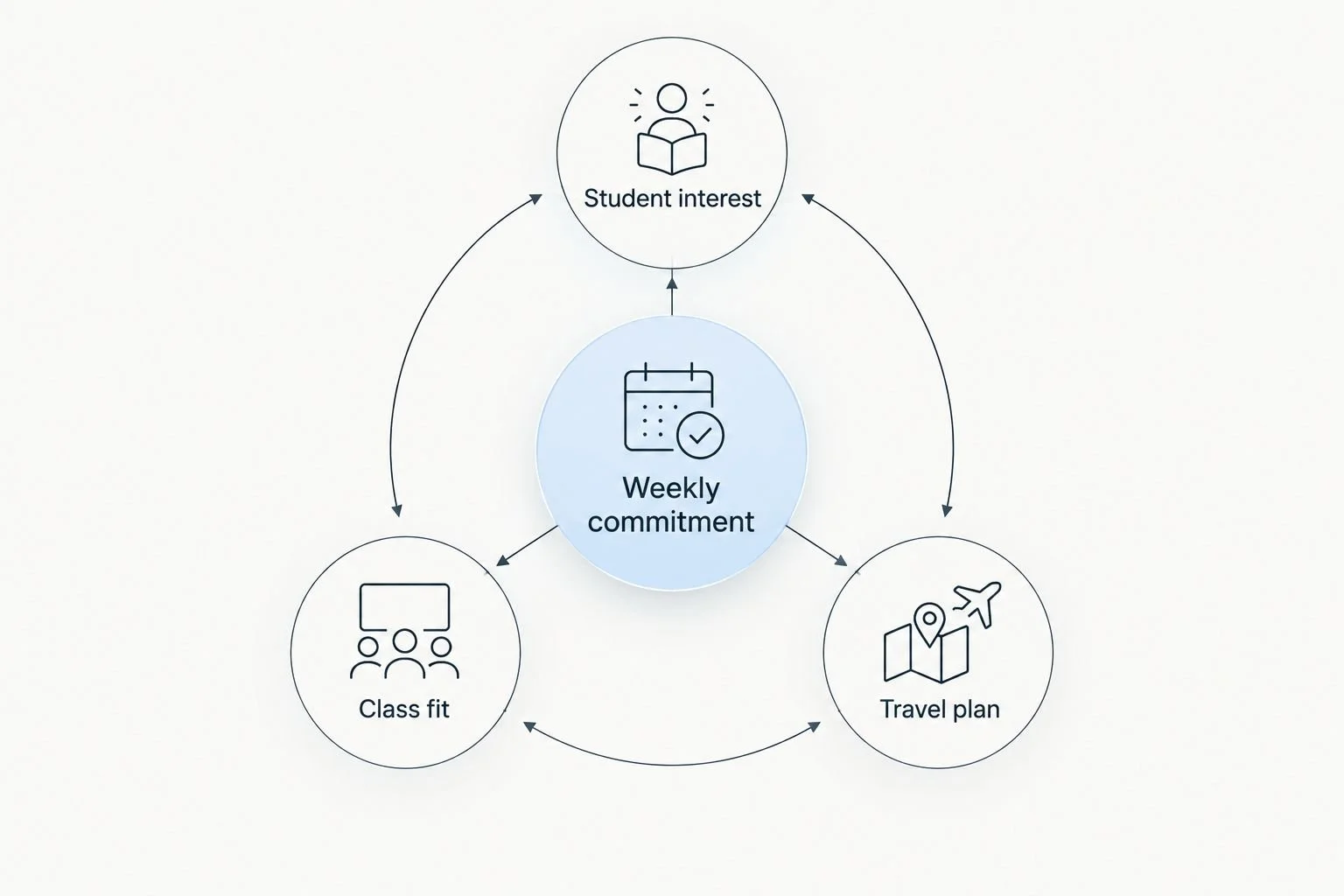
Choose a class that fits both the student and the family week.
Before registration, ask The Garden Arts Center which current class matches that combination of interest, experience, and family logistics. Confirm the schedule and requirements directly rather than inferring them from a style description.
Explore your family's class options
Review the center's information, then ask about level, schedule, and registration requirements.
Which dance class should you choose?
Choose ballet if your main goal is a clearly codified foundation. Choose tap for audible rhythm, jazz for coordinated combinations, or hip hop for groove. Modern, contemporary, and lyrical answer distinct interests in weight, transitions, and expression; creative movement provides an exploratory starting point.
For an undecided child in 2026, begin with interest and readiness rather than the highest-ranked style. A well-matched beginner class is the better decision than a technically demanding class your child does not want to attend.
FAQ
What's the best dance class for learning technique?
Ballet is the clearest choice for codified positions and placement principles. Tap, hip hop, jazz, and other styles teach distinct technical skills, so choose according to the movement your child wants to learn.
Does my child need ballet before starting another dance style?
Ballet is not a universal prerequisite for other dance styles. Ask about the specific class requirements and choose a level that explains the foundations your child needs.
Is creative movement a real dance class?
Creative movement teaches dance through rhythm, space, shape, and imaginative tasks. It emphasizes exploration rather than the codified vocabulary found in a formal ballet class.
Are hip hop classes less technical than ballet?
Hip hop and ballet emphasize different technical skills, so less formal vocabulary does not mean less technique. Hip hop foundations include groove, weight shifts, and rhythmic coordination.
Should a beginner start with pointe classes?
Pointe is not a starting class for a new ballet student. Ask a qualified ballet instructor about readiness, preparation, and placement rather than choosing pointe by age or enthusiasm alone.
How many dance classes should my child take each week?
Choose a weekly commitment that matches your child's interest, placement needs, and family schedule. Confirm the program's requirements before registering, and include travel and school activities in the decision.
Can adults use this technique ranking too?
Adults can use the same technical distinctions to compare styles. Placement still needs to reflect current experience and the specific class requirements, whether you are starting or returning.
One last thing
A useful question is not just whether your child remembered the dance. Ask, What did you learn about how a movement works? An answer about transferring weight, hearing an accent, or controlling a landing points to learning beyond choreography.
For your 2026 choice, look for that kind of understandable instruction alongside a class your family can keep attending.