

Yes, you can take pilates classes for beginners without prior fitness experience; you do not need a dance background or an established exercise routine to start. Choose instruction that introduces the basics rather than expecting you to follow unfamiliar movements immediately. A beginner label does not replace individual guidance, so discuss injuries, pregnancy, recent childbirth, or health concerns before participating.
TL;DR
Pilates classes for beginners teach foundations; prior fitness experience is not an entry requirement.
Choose beginner instruction that explains breathing, positioning, and movement options rather than assuming you know the exercises.
The Garden Arts Center offers Pilates alongside arts classes for families exploring movement and creative interests.
Before registering, confirm the class level, equipment, physical demands, and fit with your family's weekly schedule.
Can beginners take Pilates without prior fitness experience?
You can begin Pilates before you feel strong, flexible, or coordinated. Those qualities are not an entrance test. Your starting point determines which movements and variations you practice, not whether you deserve to join a class.
For your 2026 class search, separate a session designed to teach beginners from a session that simply permits them to attend. Ask how the instructor introduces unfamiliar movements and supports someone who has never exercised in a group.
If you are considering The Garden Arts Center, ask about beginner Pilates instruction before registering. Describe your experience honestly, including having none, and ask which class fits that starting point.
Use these 5 questions to understand the instruction:
Is this class intended for first-time students? Ask whether you need to recognize exercise names or follow an established sequence.
How are movements demonstrated? Look for explanations of positioning and breathing, not just instructions to copy a shape.
What happens when an exercise is too difficult? Ask how the instructor offers an alternative or a rest.
What equipment does the class use? Confirm what you need to bring and what the session involves.
Who should discuss suitability before joining? Explain relevant health concerns rather than assuming every beginner class fits every body.
Why this matters
A parent who spends the week coordinating school, work, and children's activities does not need another setting where they feel behind. Starting something unfamiliar should make room for learning.
Beginner Pilates involves more than completing repetitions. You are also learning how to listen to movement cues, notice your position, and distinguish a manageable challenge from an exercise you should stop.
Choose a class where you can ask questions without feeling rushed. An impressive-looking exercise is not more useful to a first-time student than a simpler movement they understand.
What will you learn in beginner Pilates?
Beginner instruction commonly introduces breathing, controlled movement, and awareness of body position. The exact sequence depends on the teacher and format; these are learning areas, not a promised syllabus for a particular class.
Breathing while you move
You will encounter cues about coordinating breath with movement. At first, keeping track of both can feel unfamiliar. Ask the instructor to repeat the breathing cue rather than holding your breath while concentrating on everything else.
You do not need to arrive knowing Pilates terminology. Understanding an explanation is part of the lesson, not preparation you must finish at home.
Positioning and control
An instructor can explain where to place your feet, arms, pelvis, or shoulders for the exercise being taught. You practice moving deliberately instead of trying to reach the largest possible range.
For example, a smaller leg movement can give you room to work on keeping the rest of your body steady. Bigger is not automatically better, and copying another student's range is not a useful starting goal.
Choosing a manageable variation
An introductory session should give you a way to participate without forcing the hardest version of a movement. Ask what to do if you lose control, cannot maintain the position, or need a break.
Treat a variation as a teaching choice, not a lower grade. Your goal is to understand and practice the movement you are doing.
Which Pilates format should a beginner ask about?
Mat-based and equipment-based Pilates are different formats, not automatic beginner and advanced levels. Choose by instruction and suitability, not by which format looks easier in a photograph. Neither format alone tells you how quickly a class moves.
The comparison below explains general distinctions. It does not identify the formats offered by any particular provider.
Mat-based Pilates
Best for: Beginners who prefer learning floor-based exercises without an apparatus
Useful feature: Introduces movement using a mat, with props depending on the class
Limitation to consider: Getting down to and up from the floor can affect suitability; mat work is not automatically easy
Equipment-based Pilates
Best for: Beginners who want instruction using Pilates apparatus
Useful feature: Apparatus offers resistance and support in ways that differ from mat exercises
Limitation to consider: You must also learn equipment setup and use; equipment does not make every exercise appropriate
When comparing 2026 options, ask each provider to describe the actual beginner session. A clear explanation of entry level, equipment, and teaching approach tells you more than the format name alone.
If floor transfers are difficult, mention that before attending. If an apparatus feels unfamiliar, ask how first-time students learn to use it. Neither question is a reason to feel embarrassed.
Why beginner Pilates experiences vary
Two sessions with similar names can ask very different things of a new student. These factors help explain the difference:
Entry expectations: A foundations class and a mixed-experience class do not necessarily introduce exercises in the same way.
Teaching pace: Time to watch, ask, and reset changes how easily you can follow an unfamiliar movement.
Exercise selection: Floor work, standing work, and apparatus-based exercises place different demands on participation.
Movement options: An explanation of alternatives matters when the first version does not suit you.
Your starting point: Previous injuries, comfort with floor transfers, and familiarity with exercise affect what you need to discuss.
Schedule fit: Travel, childcare, and competing activities affect whether the class is practical for your household.
None of these factors requires you to become fit before asking about a class. They help you choose instruction that meets you where you are.
How do you choose a class that fits family life?
For a 2026 routine, begin with the week you actually have—not the week you hope will suddenly become less busy. Put the proposed class beside work, school pickup, homework, meals, and children's activities before making a commitment.
Families traveling from Douglassville, Pottstown, Phoenixville, King of Prussia, Reading, or Lansdale should check the destination and journey for the specific class. A town mentioned in a class search does not establish a provider's physical location there.
Use these 3 checks in order:
Check the level. Confirm that the instruction welcomes someone without prior fitness experience and discuss any participation concerns.
Check the journey. Consider the trip from your actual starting point, whether that is home, work, or school pickup.
Check the commitment. Ask about current class details and registration terms, then decide whether the routine fits your household.
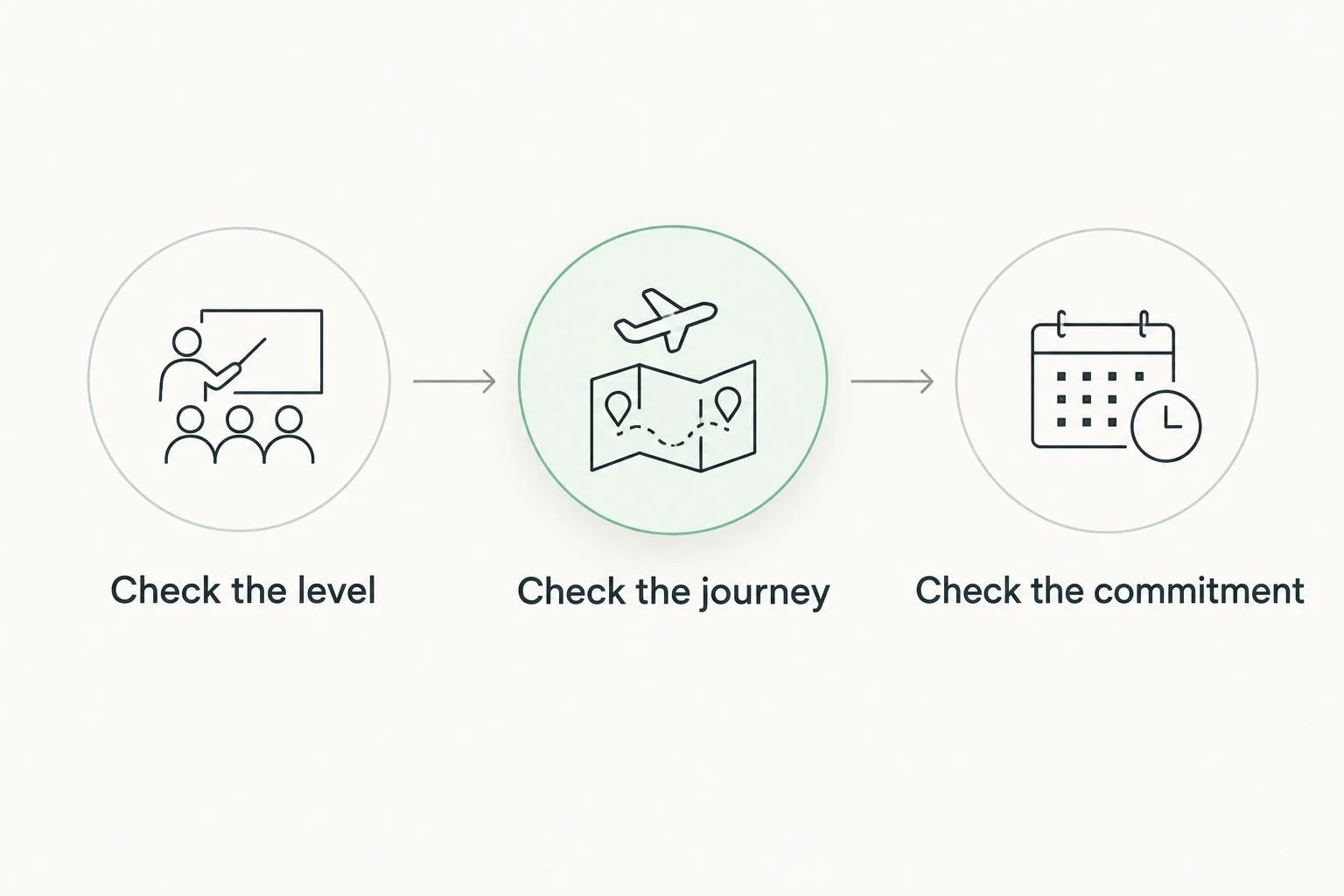
Check suitability before building the class into your family schedule.
Consider starting with 1 weekly class if that is a realistic commitment for your household. This is a scheduling suggestion, not a prescribed exercise dose or a statement about any provider's attendance requirements.
For families across Berks, Montgomery, and Chester counties, the best plan is one that leaves room for the journey as well as the lesson. Do not assume an adult class and a child's activity run together; confirm each schedule separately.
Ask about your Pilates starting point
Discuss beginner suitability, current class details, and the questions that matter to your family.
What should you do before your first Pilates class?
Before your first 2026 session, confirm the clothing, footwear, equipment, and arrival instructions with the provider. Requirements differ, so avoid buying specialized items based only on a general article.
Tell the instructor that you are new. A useful introduction is straightforward: explain that you have not taken Pilates before and ask how to follow the beginner options.
If you have an injury, are pregnant, have recently given birth, or have a condition that affects exercise, discuss participation with an appropriate healthcare professional. Then share relevant restrictions with the instructor. A general class is not an individual medical assessment or rehabilitation plan.
During the session, stop an exercise that causes pain and tell the instructor. Do not use the person beside you as the standard for how far, fast, or long you should move.
Afterward, evaluate the teaching as well as the effort. Could you understand the instructions? Did you know what to do when something felt too difficult? Those answers are more useful than deciding whether you looked experienced.
Do you need to be flexible before starting Pilates?
You do not need to be flexible before starting beginner Pilates. Tell the instructor when a position feels out of reach and ask for a suitable alternative. Do not force a stretch to match a demonstration or another student.
Is a beginner Pilates class supposed to feel easy?
A beginner Pilates class does not have to feel easy to be introductory. Learning controlled movements and new cues requires attention, even when the exercise looks small. The important distinction is whether the teacher explains the task and gives you a manageable way to participate.
Can parents start Pilates while their children explore arts classes?
Parents can explore Pilates as their own learning interest while children pursue arts classes. Treat the adult class as a separate decision, with its own suitability and scheduling questions. Do not assume childcare, shared timings, or combined registration arrangements.
The Garden Arts Center is a fit for families exploring Pilates alongside dance, music, theater, and art. Its range of arts and wellness subjects gives families different interests to ask about; you still need to confirm the specific Pilates format, current schedule, and beginner suitability.
FAQ
Can I join Pilates if I have never exercised before?
Yes, you can join Pilates without previous exercise experience when the class is appropriate for first-time students. Tell the instructor you are new and ask how the session introduces movements and alternatives.
Do Pilates classes for beginners require dance experience?
Pilates classes for beginners do not require dance experience. You can learn the movement cues and positioning without knowing ballet, jazz, or other dance techniques.
Should I choose mat Pilates or equipment-based Pilates first?
Choose the format with suitable beginner instruction rather than assuming mat or equipment-based Pilates is easier. Ask about floor transfers, apparatus use, movement options, and the pace of teaching.
What should I wear to my first Pilates class?
Confirm clothing and footwear requirements with the provider before your first Pilates class. Choose clothing that allows movement, and ask whether the session has specific footwear or equipment requirements.
Can I take Pilates after having a baby?
Discuss returning to exercise after childbirth with your healthcare professional before choosing a Pilates class. Share relevant guidance with the instructor and ask whether the class suits your current needs.
How do I fit Pilates around school and children's activities?
Choose a Pilates class only after checking the full journey and weekly commitment alongside school and children's activities. Confirm current details rather than assuming adult and children's classes happen together.
Does The Garden Arts Center offer Pilates?
The Garden Arts Center offers Pilates alongside dance, music, theater, art, and other wellness classes. Ask about the current Pilates format, beginner entry expectations, and schedule before registering.
One last thing
For your 2026 first-class decision, ask a more useful question than whether you are fit enough: Will this class teach me how to begin? That shifts your attention from comparing bodies to evaluating instruction.
Leave your first lesson knowing something you did not understand before—even if it is simply how to adjust a position or ask for another option. Learning is a valid reason to be there.