

Contemporary dance is not inherently harder to learn than jazz for beginners; the class level, teaching approach, and your child's interests matter more than the style name. Jazz often gives beginners clear rhythmic patterns and repeatable combinations, while contemporary can introduce unfamiliar weight shifts, floorwork, and open-ended movement choices. For your 2026 class choice, look for beginner instruction that teaches those skills gradually rather than expecting students to arrive with them.
TL;DR
Contemporary dance vs jazz dance has no universal difficulty winner; compare beginner expectations, teaching pace, and your child's interests.
Jazz suits children who enjoy rhythmic patterns; contemporary suits children interested in expressive movement and exploration.
The Garden Arts Center offers dance classes within an arts community for children and adults.
Choose a manageable weekly commitment before adding another dance style.
Why this matters
A child who enjoys learning a recognizable sequence might feel comfortable in jazz, while another might enjoy exploring how a movement changes with music. Neither preference tells you how talented the child is. It tells you which kind of learning experience to investigate first.
The Garden Arts Center offers jazz, contemporary, ballet, creative movement, and other arts classes. When comparing dance classes in 2026, separate the style your child likes from the level your child needs: an appealing performance video does not tell you what a beginner lesson expects.
Is contemporary dance harder to learn than jazz for beginners?
Neither contemporary nor jazz is automatically the harder starting point. Both involve coordination, musical awareness, balance, and learning to move with control. The difference lies partly in how those demands appear during class.
The table describes common teaching approaches, not a fixed syllabus. Ask the instructor how the actual beginner class introduces each skill.
Best for
Jazz dance: Beginners who enjoy rhythmic patterns and clearly demonstrated sequences
Contemporary dance: Beginners who enjoy expressive movement and exploring different movement qualities
Common starting tasks
Jazz dance: Following counts, learning basic steps, and combining movements
Contemporary dance: Exploring weight shifts, moving through space, and connecting movements
What can feel approachable
Jazz dance: A repeated combination gives students a recognizable pattern to practice
Contemporary dance: An exploratory task allows different movement responses
What can feel challenging
Jazz dance: Coordinating steps, arms, timing, and changes of direction
Contemporary dance: Managing unfamiliar transitions, floorwork, or less prescribed movement choices
Important teaching support
Jazz dance: Break combinations into parts before connecting them
Contemporary dance: Explain the movement task and teach transitions before increasing complexity
Main limitation of choosing by style alone
Jazz dance: A jazz class labeled by style still needs an appropriate experience level
Contemporary dance: A contemporary class labeled by style still needs an appropriate experience level
Jazz is not simply the easy option, and contemporary is not simply the advanced option. A fast-paced jazz combination can overwhelm a newcomer; a carefully introduced contemporary exercise can be accessible. The reverse is also true when class expectations differ.
For families considering a longer progression, the jazz-to-contemporary technique pathway offers a related starting point for questions about connecting the styles. There is no need to treat that progression as a prerequisite for beginning contemporary.
Jazz dance: Best for children who enjoy clear patterns
Jazz can be a good starting choice when your child likes copying a demonstrated phrase, finding a beat, and practicing a sequence until it feels familiar. Beginner work can introduce coordinated steps and arm movements, changes of direction, and contrasts between sharp and sustained actions.
The benefit is structure. A child can return to the same sequence and notice a specific task, such as remembering the direction change or keeping an arm movement connected to a step. That gives practice a concrete focus without requiring a complicated routine.
The challenge is that recognizable patterns still require coordination. A child might understand the rhythm but need more explanation when the feet and arms do different things. Ask whether the teacher demonstrates those parts separately before combining them.
Choose beginner jazz for an interest in patterned movement, not because someone has promised it is easier. Music preferences can start the conversation, but teaching pace and placement should settle it.
Contemporary dance: Best for children who enjoy movement exploration
Contemporary can be a good starting choice when your child enjoys changing the mood, size, or energy of a movement. An introductory task might involve shifting weight, moving at different levels, or exploring how a phrase changes when performed smoothly rather than sharply.
Its appeal is room for expression within a taught task. Students can work with movement qualities as well as remembered steps. Contemporary is not the absence of technique: balance, coordination, and controlled transitions still matter.
The challenge is unfamiliarity. Moving toward the floor or responding to an open-ended prompt can feel less obvious than copying a fixed sequence. Ask how the instructor explains the task, demonstrates transitions, and supports children who prefer a clear example first.
Choose beginner contemporary when movement exploration interests your child and the instruction welcomes newcomers. Do not assume that an expressive child already has the physical skills required for a more experienced class.
Why beginner difficulty varies
Difficulty changes with the lesson, not just the dance category. These factors help explain why the same child can feel comfortable in one beginner class and lost in another:
Starting level: A class for new dancers should introduce its foundations rather than rely on unexplained prior training.
Teaching pace: Students need an understandable route from separate movements to a connected phrase.
Coordination demands: Combining arms, feet, direction, and timing creates a different task from practicing each part alone.
Movement familiarity: Floor transitions, rhythmic patterns, or expressive prompts can each be new, depending on the child.
Learning preferences: Some children want a demonstration to copy; others enjoy choices within a clearly explained task.
Weekly routine: A class that conflicts with school activities or a difficult journey is a different commitment from one your family can sustain.
Use these factors to frame questions, not to label your child as naturally suited or unsuited to dance. A preference for structure does not rule out contemporary. Enjoying free movement does not rule out jazz.
How do you choose a beginner class without guessing?
For your 2026 shortlist, compare actual class expectations in a consistent order. You do not need to predict which style your child will prefer forever; you need to identify a suitable first learning environment.
Child's interest: Ask what appeals to your child: learning a sequence, moving expressively, dancing with others, or trying something new. Use their answer as a starting point rather than a permanent label.
Beginner placement: Describe any previous dance experience and ask whether the class teaches from the beginning. Ask about age grouping and prerequisites rather than inferring them from the class title.
Teaching approach: Ask how the teacher introduces a combination or unfamiliar movement. Listen for an explanation of demonstration, practice, and feedback rather than a promise of quick progress.
Family schedule: Consider the journey, school commitments, and the practical transition into and out of class. Choose a routine that works on an ordinary school week.
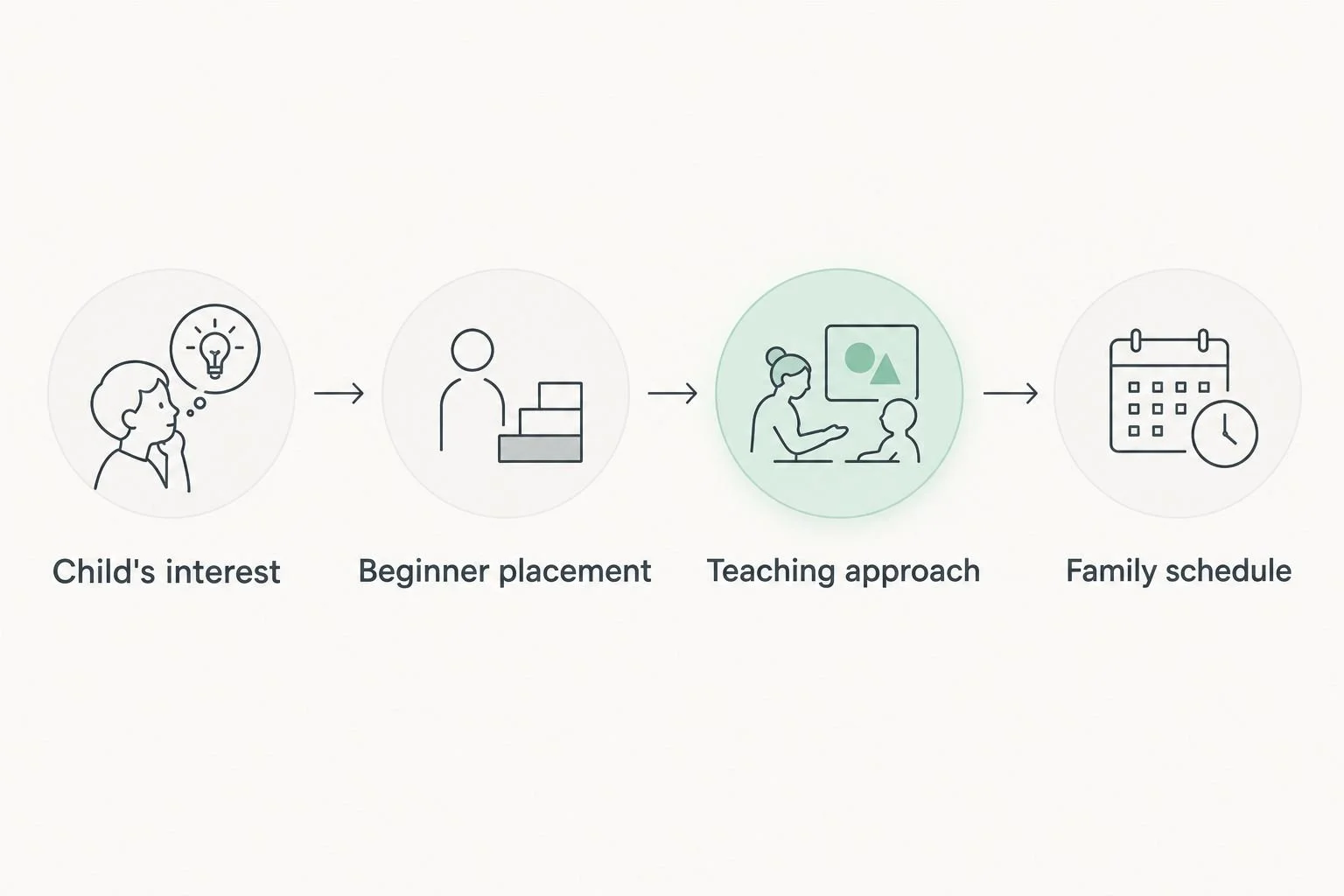
Choose the level and weekly routine as carefully as the dance style.
An instructor conversation should leave you knowing what your child is expected to bring in terms of experience, not just what the class is called. If an answer remains unclear, ask for an example of a beginner task and how the teacher helps a student who finds it difficult.
The Garden Arts Center is a fit for families seeking dance classes within a broader arts community. That range gives families different creative subjects to consider, but the center's range alone does not determine whether a particular class is the right level or weekly fit.
Ask about beginner dance placement
Discuss experience, class expectations, and your family's weekly commitments before choosing a class.
Can my child start contemporary without taking jazz first?
Your child does not need to treat jazz as a universal prerequisite for contemporary. Ask whether the specific contemporary class accepts students without previous dance training and which foundations it teaches.
Previous jazz or ballet experience gives an instructor useful information for placement, but it does not replace that conversation. A child who knows some dance vocabulary still needs instruction in unfamiliar tasks, and a newcomer needs a class that introduces its own expectations clearly.
If your child is new to organized movement altogether, ask about the suitability of creative movement as well. Treat that as a placement question, not a mandatory stage that every child must complete.
Should my child learn jazz and contemporary together?
Your child does not need both styles at the start to make a valid beginner choice. Begin with the class that fits the child's interest, starting level, and family routine; consider another style when there is a clear reason to add it.
Studying both introduces different movement tasks, but it also adds another commitment. Before expanding the schedule, ask what each class contributes and whether the expectations complement your child's current experience.
For your 2026 plan, leave space for schoolwork, other interests, and ordinary family time. Adding classes is not a substitute for selecting appropriate instruction.
How can local families make the weekly commitment manageable?
Families across Berks, Montgomery, and Chester counties should compare the whole trip, not just the lesson itself. Whether you are traveling from Douglassville, Pottstown, Phoenixville, King of Prussia, Reading, or Lansdale, confirm the class location and assess the journey from your actual starting point.
For a sustainable 2026 routine, consider these practical questions:
Will your child leave from home, school, or another activity?
Does the journey fit around siblings' commitments and the return trip?
Are you comparing the current schedule rather than assuming a previous arrangement still applies?
Have you asked about attendance expectations and any additional participation commitments?
These questions do not favor jazz over contemporary. They help you choose a class your family can realistically support, which is more useful than choosing a style on an abstract difficulty scale.
FAQ
Is contemporary dance harder than jazz if my child has never danced?
Contemporary dance is not inherently harder than jazz for a child who has never danced. Compare beginner placement, teaching pace, and the movements each class expects students to learn.
What's the main difference in contemporary dance vs jazz dance for beginners?
Jazz commonly emphasizes rhythmic patterns and repeatable combinations, while contemporary commonly explores movement quality, weight shifts, and expression. Actual beginner content depends on the class and instructor.
Does my child need ballet before starting contemporary dance?
Ballet is not a universal prerequisite for starting contemporary dance. Ask whether the specific class accepts new dancers and teaches its foundations without assuming prior ballet experience.
Which dance style is better for a shy child?
Neither jazz nor contemporary is automatically better for a shy child. Ask how the teacher introduces group activities, explains unfamiliar tasks, and supports children who need time to participate comfortably.
Does my child need to be flexible before taking beginner dance?
Existing flexibility alone should not determine beginner dance placement. Describe your child's experience and any relevant physical concerns to the instructor, and seek individual medical advice when needed.
Can my child change from jazz to contemporary later?
Your child can explore contemporary after jazz, but placement should reflect the expectations of the new class. Ask which skills transfer and which movements need a separate introduction.
What should I ask The Garden Arts Center before choosing a dance class?
Ask The Garden Arts Center about beginner placement, prior-experience expectations, teaching approach, and the current schedule. Explain your child's interests and your family's travel commitments so the conversation addresses practical fit.
One last thing
Ask your child, “Which part would you like to try again?” after discussing a class or watching an appropriate example together. That question gives you something more useful than asking which style looks easiest: a concrete movement interest to discuss with the instructor.
Your 2026 choice does not have to settle a lifelong dance direction. Choose suitable beginner instruction and a sustainable routine, then let your child's experience inform the next conversation.