

Instead of guessing when your child should move from tap to jazz, build a tap to jazz dance pathway around teacher feedback, beginner jazz foundations, and a weekly commitment your family can sustain. Use this 2026 guide to decide whether to add jazz, change classes, or stay with tap while your dancer develops.
TL;DR
The Garden Arts Center offers tap and jazz dance classes for families exploring both styles with professional guidance.
A tap to jazz dance pathway needs jazz-specific instruction; tap experience does not determine jazz placement.
Choose beginner jazz lessons by readiness and teacher guidance, not by years spent in tap.
Build the family schedule before adding another dance class.
Why this matters
Tap and jazz share musical timing, coordination, and performance skills, but they ask dancers to use those skills differently. Tap makes rhythm audible through the shoes; jazz develops movement phrasing through the whole body. Being confident in one does not make a child advanced in the other.
The Garden Arts Center is a good fit for families seeking both tap and jazz dance within a broader arts community. The center offers both styles; individual placement still needs a conversation about your child's experience and goals.
Start with the foundations described in jazz dance classes for beginners, then use the planning steps below. The aim is an appropriate class your child can attend consistently, not the fastest possible move through class labels.
Before you start
Gather useful experience notes. Record the styles your child has studied, what they enjoy, and any recent teacher feedback. Include relevant support needs and questions about participation.
Bring the real family calendar. Include school activities, homework, meals, sibling commitments, and travel. For your 2026 plan, check actual class details rather than carrying forward an old schedule.
Confirm placement and footwear before committing. Tap shoes are not a substitute for jazz footwear, and tap class level does not automatically transfer to jazz. Ask about both before buying anything or arranging the week around a particular class.
Choose the starting point
Tap and jazz: what changes?
Use this comparison to identify the learning your child wants next. These are general characteristics of the styles, not a description of a particular class syllabus.
Tap
Best for: Children interested in making rhythm through movement
What students work on: Clear sounds, weight changes, timing, and rhythmic patterns
Strength: Gives dancers audible feedback about rhythm
Limitation: Does not replace jazz-specific work on movement lines, isolations, and traveling combinations
Jazz
Best for: Children interested in full-body phrasing and expressive combinations
What students work on: Isolations, coordination, changes of direction, and movement matched to music
Strength: Develops movement vocabulary beyond percussive footwork
Limitation: Requires new technique even when a dancer already understands musical counts
Neither style is a prerequisite ladder with a guaranteed next rung. A child can enjoy tap as their main practice, begin with jazz, or study both when placement and scheduling fit.
Ask your child what they want to explore. Separate wanting to dance with a friend from wanting to learn a style. Both matter, but they answer different questions.
Describe current skills without assigning a level. Useful observations include following a rhythm, remembering a short sequence, changing direction, or responding to a correction. Let the instructor interpret those observations.
Choose a learning goal. Try a plain sentence such as learning to coordinate arms and feet, moving more comfortably across the room, or exploring a different style of music.
Expected result: You can explain why jazz interests your child without assuming that tap experience settles class placement.
Build the class plan
At The Garden Arts Center, ask about tap and jazz dance instruction in relation to your child's actual experience. Keep questions specific: what should the dancer already understand, what will the class introduce, and how is placement decided?
Readiness and instruction
Request placement guidance. Share previous training and ask which starting point matches it. Do not choose a level solely because its name resembles the current tap class.
Ask about beginner foundations. Jazz instruction commonly includes isolations, weight transfer, coordination, and movement phrases. Ask how the proposed class introduces its foundations rather than assuming every class follows the same sequence.
Clarify how teachers give corrections. Ask how an instructor explains unfamiliar movement and helps a child understand what to change. This makes the discussion concrete without asking for promises about progress.
Confirm practical requirements. Ask about clothing, shoes, class expectations, and any performance commitments before making arrangements. Keep the answers with your schedule notes.
Expected result: You have a proposed starting point and understand the questions to resolve before registration.
Weekly commitment
Map the full outing. Include leaving home or school, travel, changing, class, and the return trip. A class occupies more of the evening than its teaching time alone.
Check the difficult week. Look at a week with a school event or a sibling activity, not just an empty calendar. Decide who handles transport when the usual arrangement changes.
Set a manageable starting scope. If the week is already crowded, consider 1 weekly dance class as a planning starting point, subject to instructor guidance and class requirements. This is a scheduling suggestion, not a training standard.
Review 2 ordinary school weeks. Use your calendar to test the proposed travel and activity pattern. Look for rushed meals, missed homework time, and unreliable transport before adding another commitment.
Families across Berks, Montgomery, and Chester counties need a plan that works from home, not just on paper. Whether you travel from Douglassville, Pottstown, Phoenixville, King of Prussia, Reading, or Lansdale, check the route for the actual travel window; town names alone do not tell you the journey time.
Expected result: Your 2026 class plan has a workable transport arrangement and room for everyday family needs.
The sequence is simple: establish the learning goal, confirm placement, check the calendar, and then decide. Keeping that order prevents a convenient time slot from becoming the only reason for choosing a class.
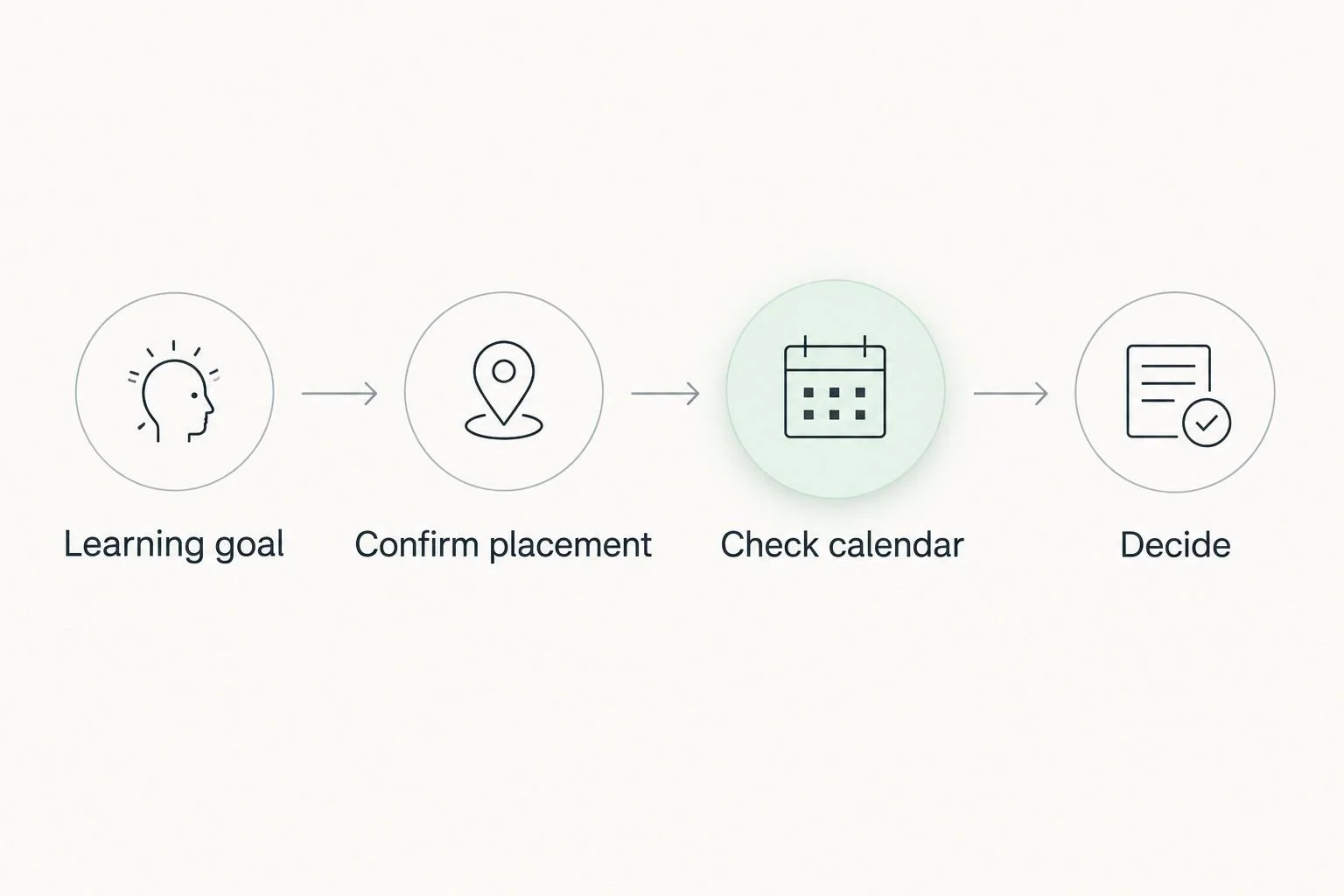
Confirm the learning fit before committing the family calendar.
Coordinate the transition
A tap-to-jazz transition needs a clear purpose, whether your child keeps tap or changes styles. Tap experience is useful background, not a reason to skip jazz foundations.
Explain the connection without equating the styles. Tell your child that listening for rhythm remains useful, while jazz introduces different movement tasks. Expect unfamiliar vocabulary and coordination work.
Follow the teacher's practice guidance. Ask what, if anything, is appropriate to revisit at home. Do not turn a remembered class combination into a home lesson on turns, leaps, or flexibility.
Ask 3 questions after class. What did you enjoy? What felt unfamiliar? What would you like help understanding? These invite detail without making every lesson a test.
Share patterns with the instructor. Repeated confusion about directions, footwear, or expectations deserves a practical conversation. Ask what support or placement adjustment makes sense.
Review the whole commitment. Consider interest, learning fit, and the household schedule together. Enjoying jazz does not obligate your child to keep every previous activity.
Expected result: You have a way to discuss the transition without treating immediate confidence as the measure of success.
Use the contact page to ask The Garden Arts Center about a suitable starting point and the details needed for registration. Share your child's experience and scheduling constraints in the same message so the conversation addresses both.
Ask about your dancer's next step
Share your child's tap experience, interest in jazz, and family scheduling needs.
Add jazz while continuing tap
Best for: children who want both styles and families with room for both commitments. Continuing tap while beginning jazz preserves time for rhythmic footwork while introducing a different movement vocabulary. The trade-off is a larger scheduling and transport commitment.
Use the same placement process for jazz even when your child remains in tap. Keep the goals distinct: tap practice might concern clear rhythmic sounds, while jazz practice might concern coordinating a movement phrase. Follow the relevant instructor's guidance for each.
Before combining classes in 2026, ask about the full expectations attached to each. Do not assume that classes share footwear, performance arrangements, or attendance requirements simply because they belong to the same arts center.
Switching focus instead? Ask how to start jazz at an appropriate level, then explain the change to your child as exploring a style rather than graduating out of tap. The benefit is a simpler weekly focus; the limitation is less scheduled time devoted to tap technique.
Troubleshooting your tap to jazz dance pathway
Your child hears the beat but struggles with the combination
Musical timing and learning a movement sequence are different tasks. Tell the instructor which part is confusing: remembering the order, coordinating arms and feet, or changing direction. Ask for an appropriate cue rather than adding more repetitions without guidance.
The proposed class seems too advanced
Describe specific difficulties to the instructor instead of relying on the class label. Ask whether a different starting point would better support the foundations. A lower-sounding label is not evidence that previous tap learning was wasted.
Your child enjoys class, but the evening does not work
Recheck the entire outing, including meals and the return home. Ask about current scheduling possibilities without assuming an alternative exists. If the commitment cannot fit, simplify the activity plan rather than treating family stress as something the dancer must overcome.
Footwear is creating confusion
Stop guessing and request the class-specific guidance. Confirm the type of shoe and any floor-related requirements before the next purchase. Do not ask a child to adapt tap shoes for jazz or practice unfamiliar movements in unsuitable footwear.
Your child wants to quit after feeling new again
Ask what changed: the movement, the group, the pace, or the routine around class. Share that concern with the instructor and discuss an appropriate next step. Avoid promising that discomfort will disappear or requiring your child to prove commitment through distress.
Customize your workflow
The Garden Arts Center offers dance alongside theater, music, art, and wellness classes. That range gives families different interests to discuss, but it does not create a requirement to combine activities.
If your child enjoys storytelling through movement, ask how that interest fits their dance goals. If rhythm is the main attraction, discuss what they enjoy about tap before changing the plan. Choose the next activity for the child in front of you, not an imagined future performer.
For 2026, keep a short planning note with the learning goal, placement guidance, practical requirements, and transport arrangement. Update it when school activities or family responsibilities change. The pathway should remain useful when the calendar changes.
FAQ
Does my child need tap before starting jazz dance?
No, tap is not a universal prerequisite for beginner jazz. Tap develops rhythmic skills, but jazz placement should reflect the child's experience and the proposed class requirements.
When is my child ready to move from tap to jazz?
Readiness depends on the proposed jazz class, the child's experience, and instructor guidance—not a fixed period in tap. Share current skills and ask which starting point supports learning the new style.
Can my child take tap and jazz at the same time?
A child can study both styles when placement, class requirements, and the family schedule fit. Confirm the expectations for each before combining commitments.
Will my child's tap shoes work for jazz class?
Tap shoes are not a substitute for jazz footwear. Ask for the proposed jazz class's footwear guidance before buying shoes or attending.
What should I ask The Garden Arts Center before registering?
Ask The Garden Arts Center about placement, class requirements, footwear, scheduling, and any performance expectations. Explain your child's tap experience and your family's practical constraints together.
How do I fit dance classes around school activities?
Plan the full outing, including travel, changing, meals, and the return home. Test the arrangement against ordinary school weeks and a difficult week before adding a commitment.
Does starting jazz mean my child should stop tap?
No, starting jazz does not require stopping tap. Decide whether to continue both by considering your child's interests, instructor guidance, and the weekly commitment your household can sustain.
One last thing
A smooth transition does not require your child to look experienced immediately. Tap gives a dancer something useful to bring into jazz, but being a beginner in a new style is still appropriate. Ask what your child is learning before asking whether they are ready for the next level.